
Alexander-Arnold's Absence is Not Responsible for Salah's Downturn
Well, not entirely. Trent Alexander-Arnold's departure may not be as significant for Mohamed Salah as we all assume though.
Liverpool have made a stuttering start to the 2025/26 campaign. Even though there are several key players who are not performing close to their best, it is Mohamed Salah who has drawn so much of the media glare.
‘Why Liverpool Are Struggling to Get the Best Out of Mohamed Salah’, ‘Should Liverpool be worried about Mohamed Salah’s form?’ and ‘Mohamed Salah’s gambling backfires for Liverpool’ are three recent articles that delved into the Egyptian’s form.
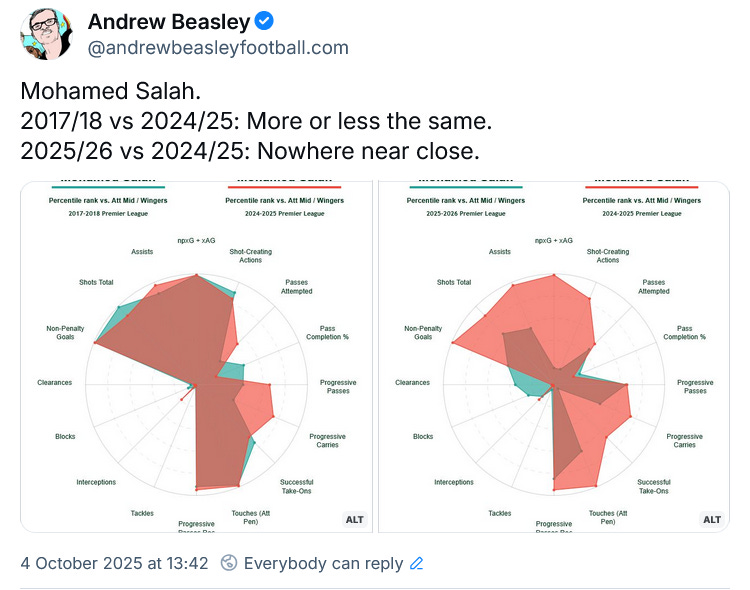
Others have tried to explain it through the absence of a right-sided colleague: ‘Mohamed Salah missing Trent Alexander-Arnold’s service at Liverpool’ and ‘Liverpool’s struggles show that Trent Alexander-Arnold is not easily replaced’ are a couple of examples. The Real Madrid right-back is usually mentioned in the articles that don’t carry his name in the headline too. Yet Alexander-Arnold’s influence upon Salah’s output has not been as influential as you probably assume.
Before we get to that, it’s only right to put expectations for the 33-year-old into fair context, as we recently did for Florian Wirtz. Salah delivered 38 non-penalty goal contributions in the league last season, second only to Lionel Messi’s 41 in 2019/20 for men in their age-32 campaign in England, France, Germany, Italy or Spain.
The Argentine GOAT produced 36 the following year, with Zlatan Ibrahimovic logging a remarkable 46 when he was 33 years old in a Ligue 1 warped by the spending power of his club, Paris Saint-Germain. Maintaining that sort of level has proven much harder in the Premier League.
The top 10 players for non-penalty output when 32 who remained in the English top flight the following season went on to see their collective tally shrink by 102 goal contributions. Their output shrunk by 48.6 per cent, 26 percentage points more than their drop in playing time.
Liverpool would have known this history when offering Salah a hefty two-year contract, presumably figuring the Egyptian King was fit enough to out-do earlier veterans. Salah could feasibly become just the sixth forward to clock up 2,600 Premier League minutes in their age 33 season, even allowing for the Africa Cup of Nations depriving him of domestic matches.
The competition’s record for combined non-penalty goals and assists for a player of his age is 16. Twenty contributions from the Reds’ number 11 in 2025/26 would feel underwhelming despite being 25 per cent above anything anyone else has ever produced at his age. As unstoppable as Salah has been, history is against Liverpool’s talisman having anything like as productive a campaign as he enjoyed last term.
Much of the recent analysis has highlighted that his totals are down on this point last season. A better comparison is against what Salah achieved in the corresponding fixtures. It’s also worth checking how involved Alexander-Arnold was in his success.
In some ways the Reds’ right forward hasn’t been too bad, just several rungs below his remarkable 2024/25 campaign. Ryan O’Hanlon framed it well for ESPN: “Both of Arsenal‘s right wingers, Bukayo Saka and Noni Madueke, are almost exactly in line with Salah’s underlying performance so far this season… But, c’mon -- this is Mo Salah!” If his biggest problem is ‘only’ hitting the level of very good Premier League players, I’d gladly trade places.
David Segar’s article for Opta Analyst also noted things really haven’t been disastrous for Salah. “It should also be noted that his creative numbers have not all dipped as much,” he wrote. “While he is creating around half a chance fewer per 90 [minutes] (1.6 from 2.1 last season), his expected assists per 90 (0.23 from 0.24) and big chances created per 90 (0.65 from 0.66) are basically identical.” That implies the average value of the opportunities Salah is providing has risen, which is no bad thing even if you’d hope to see more of them.
The shot numbers for 2025/26 aren’t as healthy, with only 11 non-penalty efforts across the league matches. “Last season, Salah had already attempted 22 shots through seven games,” wrote O’Hanlon. “His previous low at this point was 19, in 2022-23. His current xG total is 1.18. Last season, it was 3.31, and the previous low was 2.59 in 2020-21.”
The issue is that the fixtures are not comparable. Liverpool have played five of their seven games against the current top eight in the Premier League, with one of the others in front of a St James’ Park crowd baying for blood. The Reds didn’t face anyone who ended above seventh in their first seven last season, with their opponents including three of the eventual bottom six. You would not expect Salah to have as many shots this term given this disparity.
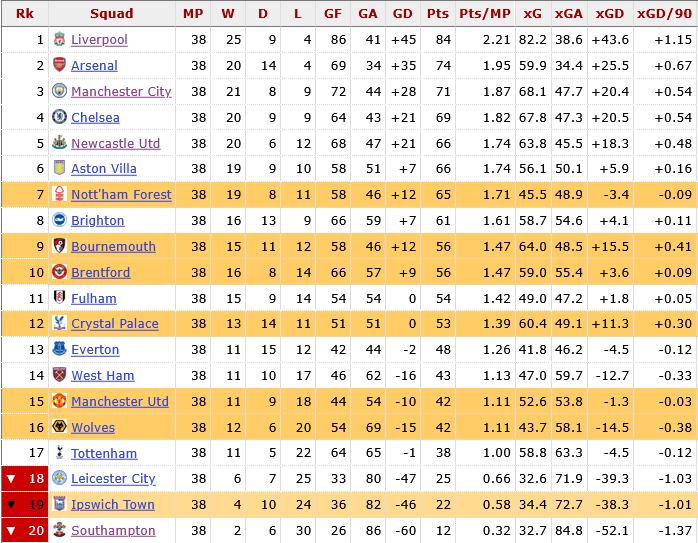
If we exclude Burnley as they were not in the division last season, Salah took 12 shots for 1.7 expected goals in the six other corresponding fixtures. To be at 11 for 1.3 (non-penalty, per FBRef) doesn’t look anywhere near as bad a drop-off. What can’t be accounted for is that two of the fixtures last season were dead rubbers, so it would be fair to expect a little more against Arsenal and Chelsea this time around as the games mattered.
Does he look like his pace is down? It is mentioned in the ESPN article that Salah hasn’t yet matched the top speed he recorded last season. However, it continues. “Since 2020-21, he’s averaged about 20 sprints (runs north of 25 kilometers per hour) and 60 high-speed runs (runs between 20 and 24 km/hour) per 90 minutes. Those are his exact numbers for this season, too.” It’s not a lack of effort so is it a lack of involvement?
One inescapable fact is that Salah’s rate of touches in the penalty box per 90 minutes has halved since 2024/25. He will inevitably contribute less if not on the ball in the prime real estate as often.
But wait. O’Hanlon: “Liverpool are averaging 185 touches in the attacking third this season. Since Salah joined the club, they’ve averaged 215 attacking-third touches and have never been below 200 in a single season.” With fewer touches to go around, it will be harder for Salah to score or assist. The issue is deeper than him alone.
Which brings us back to Trent’s ability to play line-breaking passes. “Alexander-Arnold made 147 of them to Salah last season, a whopping 36 per cent more than any other Premier League pairing, with Josko Gvardiol to Jeremy Doku next on 108,” wrote Sky’s Nick Wright.
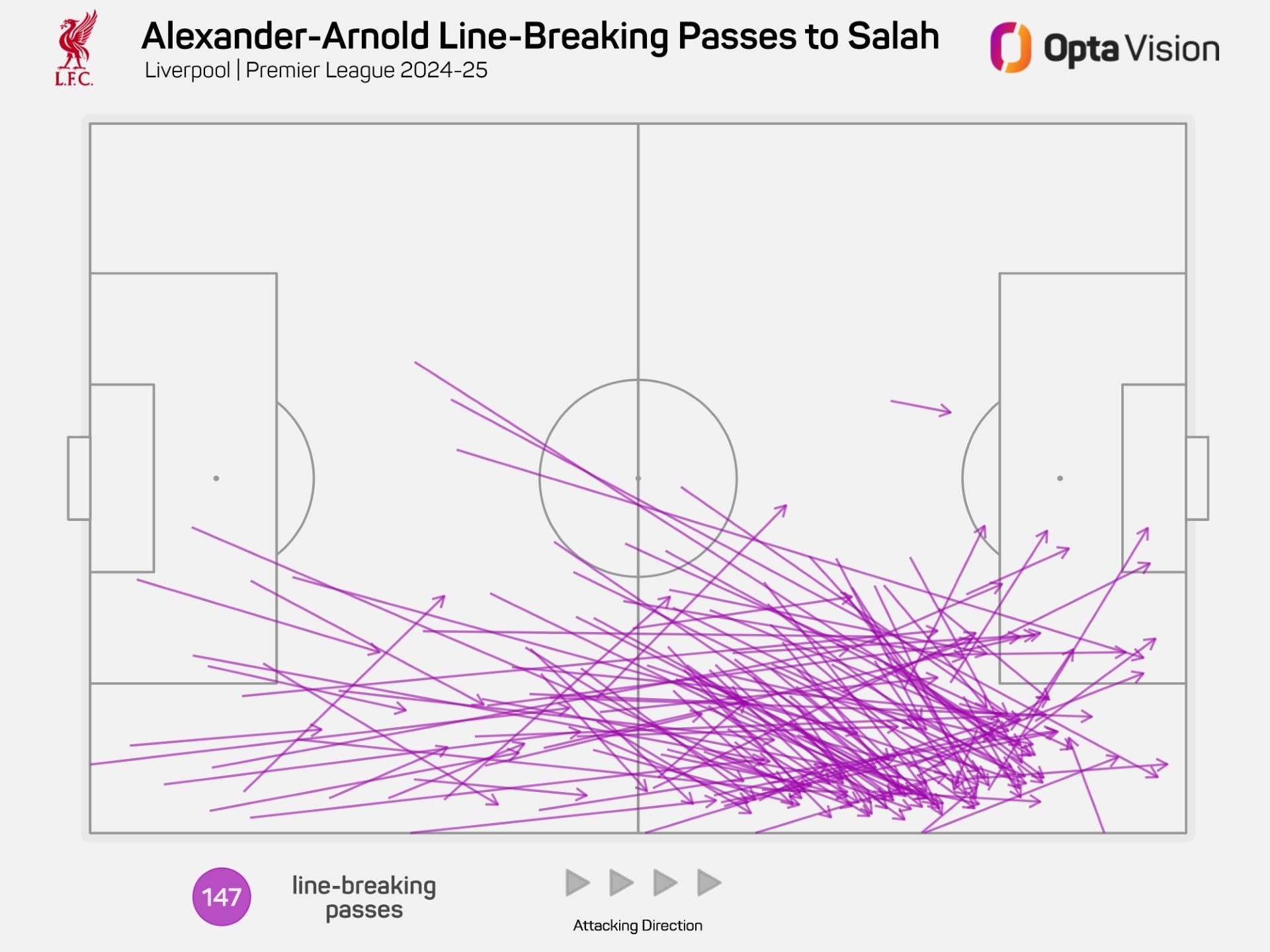
Leaving aside that some of the line-breakers appear to be throw-ins and the data was provided prior to the Chelsea match, nobody was playing more than 3.5 per 90 to Salah this season when Alexander-Arnold averaged 5.6 in 2024/25. As Jonathan Wilson wrote with reference to Trent in The Guardian, “his rapid and accurate 30- and 40-yard passes were often what released Salah.”
Alexander-Arnold’s ability to find Salah generating an expected possession value of 1.55 (per the ESPN article). Only Salah’s passes to Dominik Szoboszlai produced more last season:
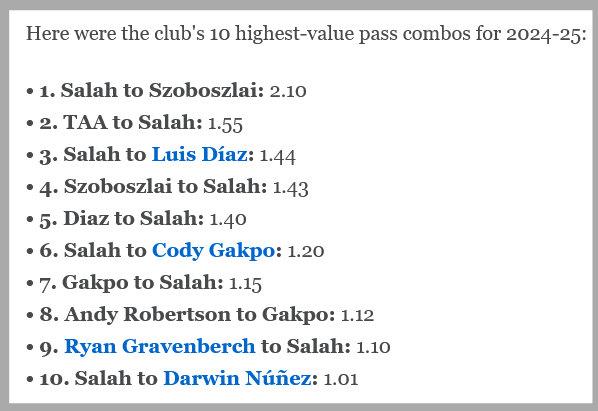
It feels this must explain Salah’s downturn in form. His actual Trent-related output suggests otherwise.
Alexander-Arnold set him up for two goals last season, both in the 3-3 draw at Newcastle. There were a further three Opta-defined big chances, with the number 66 responsible for four of the 35 (or 11.4 per cent) of the ‘should score’ opportunities that were set up for Salah.
As most of the line-breaking passes went to the zone between the edge of the penalty area and the touchline, it’s likelier Alexander-Arnold was playing pre-assist passes rather than setting Salah up to shoot. There were two goals in 2024/25 that fit this description: Diogo Jota for the first of the campaign at Ipswich, then Cody Gakpo in the home win over Manchester City.
As with Salah’s goals, Trent teed him up to create a further three big chances. This means five of the 32 the Egyptian set up (15.6 per cent) occurred after he had received the ball from Alexander-Arnold.
The net result is that a Trent pass led to four of the Egyptian’s 46 non-penalty goal contributions, nine of the 67 created big chances which he either shot or set up. If not nothing, it suggests the absence of Alexander-Arnold is something of a red herring for explaining Salah’s relative lack of output in 2025/26.
That doesn’t change that the right-back’s defection to Madrid has impacted the Reds’ build-up play. More quick passes to Salah inevitably creates more goal scoring opportunities, even if they aren’t of particularly high value or converted.
And maybe Salah simply needs to be as involved as possible this season? Not just to have more chances as an established player within a new look front line but to feel part of things, to feel useful. To be kept busy, occupied, not left thinking of what he has lost, in terms of both tragedy and transfers out of the side.
Salah’s gang is not what it was less than six months ago. If there’s no one reason his numbers have dipped - though perhaps they have not by as much as we think - it might be this which is the best explanation. He looks sad, a little lost. We all are.
Most memorable pre-assist from Trent last season was the one he put over the top to Darwin (because Mo would've been offside) who then crossed it to Mo for the second equalizer at Arsenal. So, yeah, I can believe that Trent was contributing a lot more on the "hockey assist" level and, like you say, that is something we're definitely missing. That's probably what's making Florian's struggles stand out to me more, in that Trent isn't here to do those things and the guy we recruited whom I thought might replace them... isn't. So, yeah, just another part of the down picture and not the "Mo's inevitable downturn has started as soon as he signed the contract!" doomsday scenario that I've seen so often lately.
Fantastic dissection of the situation Andrew!
Hopefully we get the team functioning properly soon and Salah can get back to doing what he does best.