
It doesn’t feel appropriate to write about players or transfers or anything like that right now, but I wanted to keep occupied. Life continues, even if it feels impossible to contemplate 2025/26.
I hope people appreciate this article, though my tribute to Diogo Jota is far more important. It’s a free read which shows where he stands in the pantheon of Premier League finishers/scorers (spoiler: really near the top).
A strength which helped Arne Slot get the Liverpool head coach gig was keeping his players fit. For all the numerous positives Jürgen Klopp brought to the club, injuries were a significant problem at times.
“One of the reasons Liverpool appointed Slot was the sort of injury record that he’d had at previous clubs. Of course, Feyenoord in particular, I think it was sort of a 90% availability rate that he’d had among the squad,” said Andy Jones on a podcast for The Athletic.
“Crucial to that was a guy called Ruben Peeters, who he brought to Liverpool,” he added. “He’s lead physical performance coach. He plays a big role in sort of periodisation, which is basically mapping our training sessions and workloads and individual workloads and individual time tables for players.”
Gut instinct says that Liverpool’s record for availability markedly improved in 2024/25, so it’s time to put the Reds’ figures into the wider context of England’s top division. We can do this using data from Premier Injuries, who recently shared their findings in an excellent summary article.
They have a metric called ‘Time-loss Injury’, which they define as “any injury that results in a player missing at least one competitive fixture.” This is a sensible method of measurement, as a player might be substituted due to an injury problem then feature in the next match. To count, a game should be missed.
Liverpool suffered 22 injuries by this measure in Slot’s debut campaign, second fewest behind Nottingham Forest (20). Here’s Premier Injuries’ graph of the data, which indirectly reveals that the average was 29.7 per club.

They also share statistics on the cumulative totals of days lost and games missed to injuries, though these inevitably follow a similar pattern for most clubs. While there were some exceptions to these correlations, Liverpool didn’t provide one; the Reds were second best for days lost (764 versus the league average of 1073), third for games missed (88 versus 130 average).
Injury records sit somewhere between the axes of luck and judgement. How much is down to Slot, Peeters et. al can only ever be guessed. The Reds dropped their possession-adjusted pressures rate by just over eight per cent per game on 2023/24, suggesting a tactical choice may have helped maintain squad fitness.
But then contact injuries are a matter of bad luck. All a coaching team can do is minimise the likelihood of absenteeism to the best of their ability. The data suggests the current crew at Liverpool deserve serious credit.
It’s vital to view the single season figures in context. Forest suffered fewer injuries than the Reds in some part thanks to playing fewer fixtures. Liverpool played more games by the end of the first week of March than Forest totted up in total in 2024/25.
Premier Injuries account for this by factoring in the total minutes each club played. We can see each team’s time-loss injuries per 1,000 minutes, with this chart showing the figures for sides that were in the top division for both the last two campaigns.
Eleven of the 17 teams improved year-on-year, but it was Liverpool who dropped to the lowest average for either season. Adding in the preceding two campaigns doesn’t change anything for Slot’s Reds, they still have the best rate in the sample.
The upward moves made by Arsenal and Manchester City following 2023/24 took them from best in class to closer to the middle of the pack. Their supporters will argue this prevented them truly competing for major honours.
They probably have a point, as long-term followers will know. Liverpool’s points record has tracked their injury rate since I started collating the data nine years ago. This obvious logic likely applies across the board to other teams too. Slot’s considerable coaching prowess will be very ably supported by his apparent ability to keep his players available.
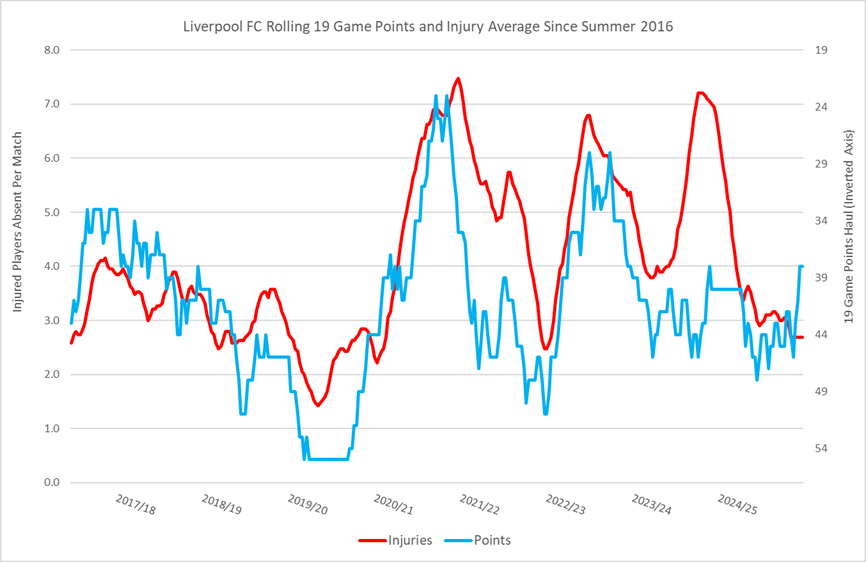
The identity of the players who are missing is clearly of huge importance too. Did anyone even realise that Liverpool were without Tyler Morton for two months in the spring? It generated rather fewer column inches than the injuries suffered by Rodri or Bukayo Saka.
For the Reds, there was improvement in terms of games missed for almost every player. Just three men were absent for at least three matches more in 2024/25 than they were the year before. Even then, it’s hard to argue that Conor Bradley, Harvey Elliott or Joe Gomez would’ve been first choice for their respective positions had they been available anyway.
The following figures are my manually compiled data which is updated after every game, applying to all competitions.
Look at the names at the top end of the chart. There aren’t many key players from the title-winning campaign who missed even three games in all competitions. The value of this should not be underestimated.
We should also acknowledge the other side of injuries; what happens once they have occurred? Fitness issues are inevitable, no matter how smart the coaching team’s methods are. Getting players back in the squad is almost as vital as injury prevention itself.
A well stocked roster allows for rotation which helps in keeping key men available. The opposite of this is what stymied Klopp’s Liverpool at times, as a few injuries snowballed into full-blown crises.
An injured Reds player missed an average of 4.0 games in 2024/25, only a shade better than the four-year Premier League average of 4.3. Liverpool were on that latter mark in 2021/22, at 5.1 the following year then 4.5 in 2023/24. Slot has overseen an improvement in this area of injuries too.
While he will have different players under his charge next term, the club has usually recruited with an eye on availability. Jeremie Frimpong has only missed two games in the last three years, per Transfermarkt, with Milos Kerkez one of only six outfield players to start every Premier League match this season.
The new recruits can be confident of maintaining their availability under Slot. Assuming that is the case, Liverpool should be in the title mix once again.
It's partly why Slot was hired and he undoubtedly delivered.