
Arne Slot's Subtle Sub Impact
Liverpool got numerous goals and assists from their bench last season. That hasn't happened yet under Arne Slot but the impact has still been there.
“Of Liverpool’s last 23 goals it was the 20th scored in the second half and it was done.”
Sid Lowe reporting on Girona 0-1 Liverpool for The Guardian
Liverpool’s win at Girona on Tuesday was not a shining beacon of an advertisement for the new Champions League format. The Reds didn’t particularly need to win, while the home side’s priority was to avoid defeat. That’s not a set of circumstances likely to birth a classic.
Had either side scored early, perhaps it would have been different. Girona’s three highest value chances, per FBRef, were on the board by the 17th minute. If one had been converted, Liverpool would’ve opened up a bit more. The game might have spiralled in entertaining fashion.
The Reds’ best non-penalty chance came in the first half too, Darwin Núñez seeing his effort saved. That this opportunity went begging was not a surprise for two reasons: a) the Uruguayan is an unreliable finisher, and b) as per the quote at the top, scoring early hasn’t been something which Liverpool have done too often recently.
It’s not that they haven’t been trying, of course. The Reds scored in 10 of their first 13 first halves this season, with at least one Opta-defined big chance in all-but-three of their opening 45-minute periods in 2024/25. As finishing is fairly random, the time in a match at which the goals are scored is by default too.
Since the summer of 2008, 56 per cent of Premier League goals have been scored after the interval. Liverpool’s proportion this season? 55 per cent. They’re on par for the timing breakdown of their goals, as above average as they are in so many other respects.
That’s not to say there isn’t something interesting about when Arne Slot’s side has been scoring recently, and not just that most of the goals have been in the second half. The head coach’s influence from the sidelines perhaps explains the phenomenon too.
Mohamed Salah scored the only goal of the Girona game from the penalty spot in the 63rd minute. It has proven a profitable 60 seconds for the Reds recently, with goals in the same minute against Brighton (in the Carabao Cup) and Bayer Leverkusen.
Luis Díaz’ opener against Xabi Alonso’s men came two minutes earlier, while Liverpool also scored equalisers against Southampton (65th minute) and Newcastle (68th) around that time too. Looking further back, the opener at Ipswich (59:26) and winner at Wolves (60:12) were as bang on the hour mark as you could realistically expect.
Again, it’s likely random. You could easily find similar patterns elsewhere within matches (such as their six goals between the 81st and 85th minutes in the last 10 games). However, Transfermarkt carries a breakdown of Premier League goals scored by quarter-hour intervals. The Reds lead the 61-75 minutes bracket with seven. Liverpool averaged 14 a year in this slot under Jürgen Klopp, so they are only a touch ahead of that as we approach Christmas.
More interesting is that the seven goals represent 24 per cent of their total. The club hasn’t been this proportionally productive in minutes 61 to 75 since the 2006/07 season under Rafa Benitez.
Seeing the Spaniard’s name attached to this time frame of matches takes me back. Really takes me back. In 2010, the first football article I ever wrote was an analysis of the times at which Benitez made his substitutions.
English football media was still in the relative dark ages at that point. Richard Keys and Andy Gray ruled the roost, with in-depth analysis limited to the Scot bellowing “you don’t save those” after a good strike. They criticised Benitez for everything he did, with one target of their ire his propensity to make substitutions around 60 to 65 minutes into matches.
I checked the data. Sure enough, if you ignored first half injury enforced changes, the average time at which the Liverpool manager brought on his first player from the bench was the 64th minute. The thing was, opposition managers were only about a minute later when facing the Reds that season.
It seems little has changed in the Reds’ dugout in the intervening decade and a half. Monitoring Slot’s substitution patterns this season due to being unfamiliar with his strategies has revealed that the 66th minute is the average time at which they fall.
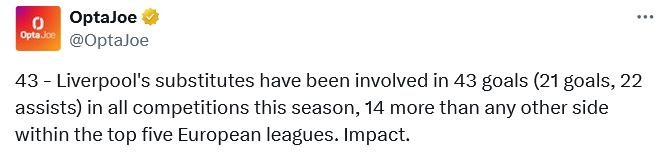
His changes haven’t made too much direct impact upon score lines yet. Trent Alexander-Arnold became only the third Liverpool sub to set up two goals in a Premier League game recently, at Newcastle, to bring the total to five contributions from the bench. The Reds’ subs are not delivering the ridiculous level of goals and assists they did last season, albeit such a burning hot streak was inevitably going to cool off.
Something interesting has been happening of late, nonetheless. Liverpool have scored six goals within five minutes of making a substitution in their last eight matches. Cody Gakpo came off the bench against Real Madrid, scoring eight minutes later to effectively settle that contest too. While a couple of the goals in question merely turned the Leverkusen win into a more eye-catching result, three were equalisers across a trio of fixtures from which the Reds took seven points. Whether the substitutes were directly involved or not, there’s no doubting the value of those moments.
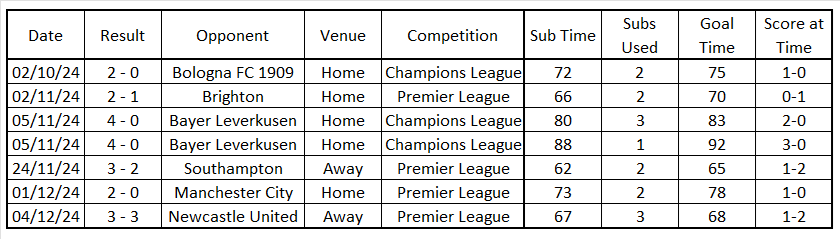
This is just something I happen to have noticed. Perhaps a lot of other teams score quickly after making changes from the bench; sadly, there is no easy way to check.
But for five of the seven instances in the table above, Liverpool had a shot sooner after the substitution than the previous goal attempt had preceded it. For three of them, the effort after the change didn’t become the goal, yet they still found time to score within five minutes of the fourth official’s board going up to herald the switch.
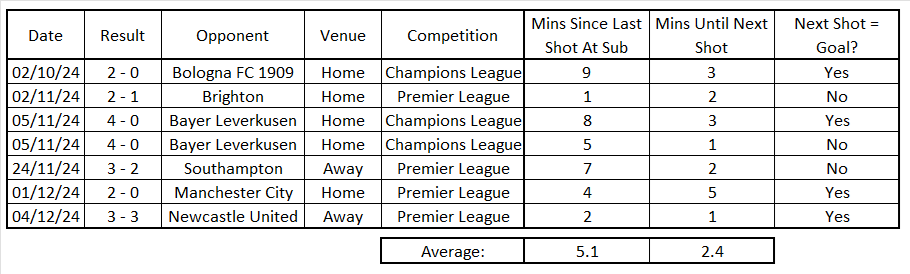
It may just be the players regroup and go again having had a breather while the change takes place. Perhaps a mild tactical tweak helps. Or it could just be entirely random. Slot’s impact on what followed immediately after he amended his XI may have been minimal.
Or maybe it was massive.