
Cody Gakpo, Bob Paisley and Moneyball
Few players score Premier League goals more often than Cody Gakpo. The Liverpool forward performs well at a stat which could be football's Moneyball metric
Is Cody Gakpo underrated? It doesn’t feel like he is universally popular among Liverpool supporters so it seems a reasonable question to ask.
His record is perhaps better than many people realise. Since his debut for the Reds almost two years ago, Gakpo has scored 17 goals in the Premier League. If that sounds underwhelming, consider that only 40 of his 70 appearances have been starts.
If we look at non-penalty goals per 90 minutes, only nine men with at least as much playing time have better records than the former PSV Eindhoven man. Mohamed Salah is one of them, as you’d expect, but the rest of Gakpo’s Liverpool colleagues have to fall in behind him.
There has been a remarkable variety to his goals too, in light of how relatively few he has bagged. Gakpo scored the last Liverpool goal from at least 30 yards (at West Ham in 2023), the furthest out header since he joined the club (versus Sheffield United) and unleashed one of the top five finishes by a Reds player in the last eight seasons.
The 25-year-old has found the net against Everton, Manchester United and Tottenham, twice each for the latter two. In the space of five days last week, Gakpo added Real Madrid and Manchester City to his goal résumé.
Seeing one of those strikes shortly after a Moneyball meme made me think of how Cody might’ve made Bob Paisley smile. What the hell am I on about? Our story begins at the turn of the millennium in Oakland.
You’ve probably seen the film Moneyball. You might have read the book. I’ve done so three times in the two decades since it was released.
I first read it because I’d heard it was good. Some years later, I had an understanding of statistics in football so enjoyed the book for a second time. Most recently, my newfound appreciation of baseball made it worth revisiting again. The paragraph which is perhaps key to the whole story is the introduction of Paul DePodesta.
[He] “had been hired by Billy Beane before the 1999 season, but well before that he had studied the question of why teams win. Not long after he’d graduated from Harvard, in the mid-nineties, he’d plugged the statistics of every baseball team from the twentieth century into an equation and tested which of them correlated most closely with winning percentage. He’d found only two, both offensive statistics, inextricably linked to baseball success: on-base percentage and slugging percentage. Everything else was far less important.”
Renamed Peter Brand and played by Jonah Hill in the film, the metric of on-base percentage (OBP) - how often a batter reaches at least first base - is integral to probably the most famous scene in Moneyball. Billy Beane (Brad Pitt) is holding a meeting with his scouts. He suggests David Justice as a potential target, only for his player evaluators to list reasons that would be a bad idea. “Why do you like him?,” asks one. Beane points at Brand to get the response he wants. “Because he gets on base,” is the quant’s answer.
Justice had an OBP of .378 across his 14 years in the Major Leagues. He delivered .376 for Oakland in 2002, above both the American League average of .331 and the .364 Beane was seeking in order to replace the average of what three departed players had posted the previous year.
Best of all, the New York Yankees were so keen to get rid of Justice, they paid half of his salary that year. Despite Oakland having a total payroll less than one-third of baseball’s most famous team, both they and the Yankees won 103 regular season games.
Football has no OBP. There is no single metric which is so important to success. The sport has many more variables than baseball which is essentially a game of set pieces. With forwards, non-penalty expected goals per shot (npxG/Sh) is a decent starting point. Like getting on base, having a good figure increases the chances of your team scoring.
Some players fire off numerous attempts from poor locations (hiya, Mario Balotelli) which gives them a good shot total but a low likelihood of scoring many. Indeed, this was something of a team-wide problem for Liverpool last season.
Since the summer of 2022, Erling Haaland has unsurprisingly been the Premier League king for npxG/Sh, at 0.20, ahead of Alexander Isak (0.18). Two players are one percentage point behind the Newcastle man, Ollie Watkins and Brennan Johnson. The Moneyball meme was recently used by analytics community stalwart Mark Thompson to help describe a strength of the latter.
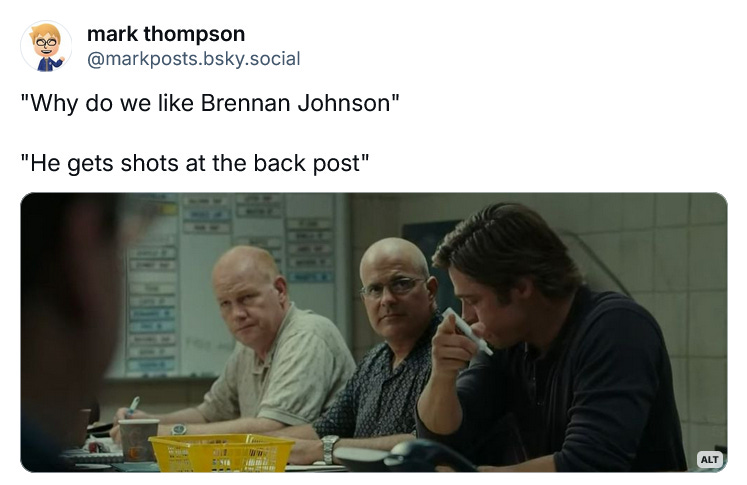
My response was to note that Gakpo also gets shots at the back post. He did exactly that to open the scoring against City last weekend, one of the biggest goals of the Reds’ season so far. Five of the 17 he has stuck away in the Premier League fall into this category, with eight of his tally hit from within the six-yard box.
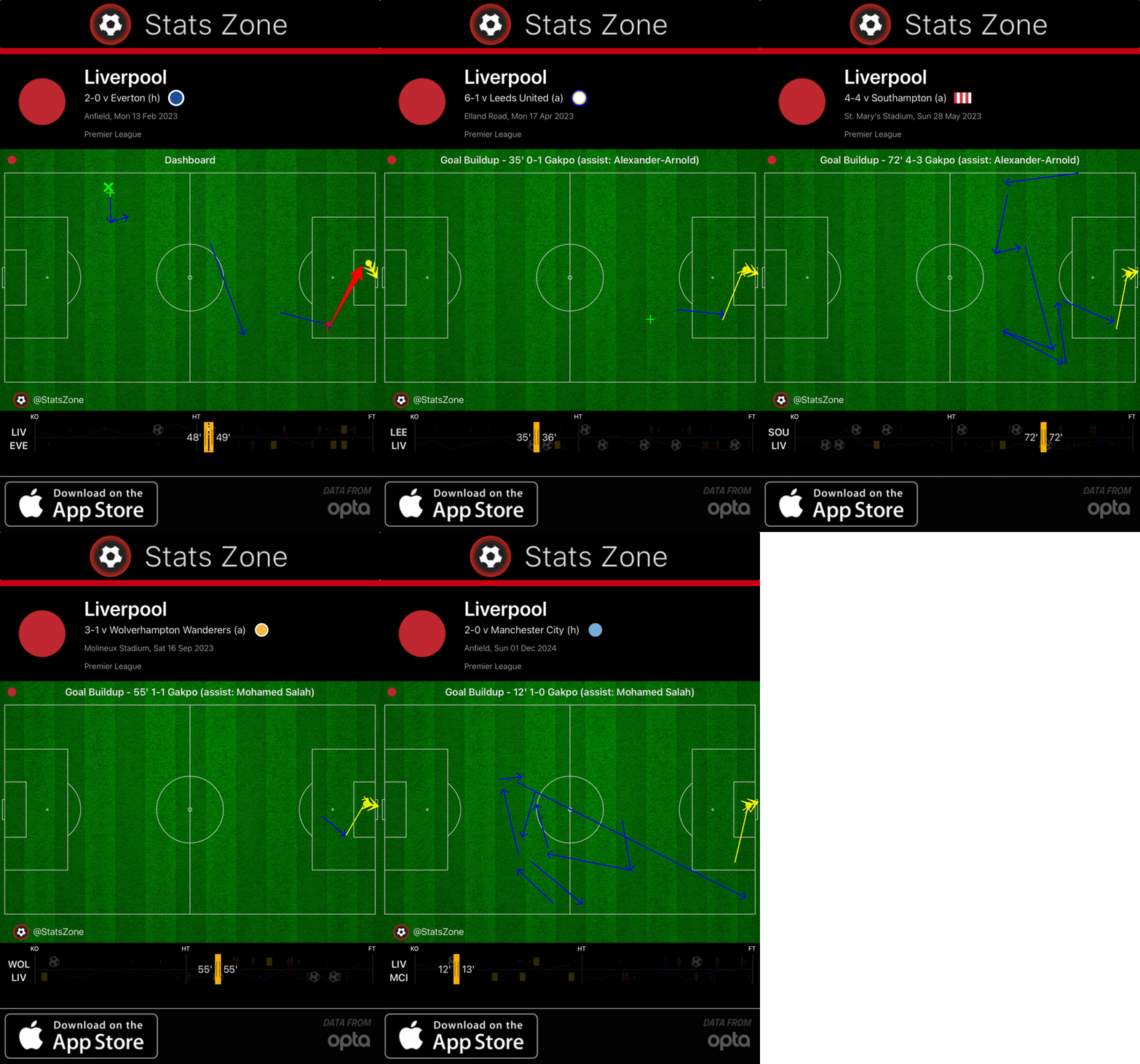
Three were set up by Trent Alexander-Arnold, two by Salah. The Egyptian made just one pass to Gakpo against Newcastle on Wednesday, finding him at the back post. He really should’ve scored, with his header across the face of the goal narrowly missed by Darwin Núñez.
While Salah is Liverpool’s leading man for npxG/Sh, on a joint-sixth-best-in-the-league 0.15, Gakpo is just one point behind. There is sadly no easy way to locate all of a player’s shots which would be classed as back post, but the five the Dutchman has converted have an eye-watering average xG value of 0.87.
The chances were so good that a simulation reveals that scoring five goals from them was the likeliest single outcome. Too central to be deemed a back post goal, Gakpo also converted a 0.96 xG shot at Villa Park last season which originated from a shot from wide in the penalty box. The principle was the same, only the delivery method differed.
In the last seven-and-a-half years, the Reds have scored 12 league goals which had a minimum xG of 0.94. Gakpo has scored four of the last five and more than any other player. This isn’t a new phenomenon from him either; watch his PSV Eindhoven goals compilation to see several back post goals which summon memories of his Liverpool efforts. He is a master of the art.
Gakpo was born after Paisley died but the three-time European Cup winning manager might well have approved of his talent. When coaching courses were using phrases like ‘position of maximum opportunity’, Paisley reportedly pointed out that they were merely referring to the back post.
Football’s Moneyball metric or not, Gakpo has a very good knack for being on the end of maximum (xG value) opportunities. Long may he remain underrated and undetected at the back post.
Ha. I appreciate the shot at Balotelli. Was mentioning the other day that I saw him come on for Genoa against Cagliari. The crowd went crazy seeing him on the touchline and I just laughed because the guy is a NAME, but hasn't been worth his space on the bench in a decade, largely because of what you mention here (all show, no substance.) In the end, he didn't even get a touch in his roughly 10 minutes in the match. One of the best things that Arne has done is play Cody in that position in which he excels for the Oranje, as it produces more xT (last I checked) and it gives him those opportunities that you highlight here, with Mo and Trent doing the work down the right side and then feeding Cody across the box. Great piece.