
How Good Are Liverpool?
Liverpool have been dropping points regularly recently. Should their Premier League title rivals (Arsenal) be expecting the Reds to fall away?
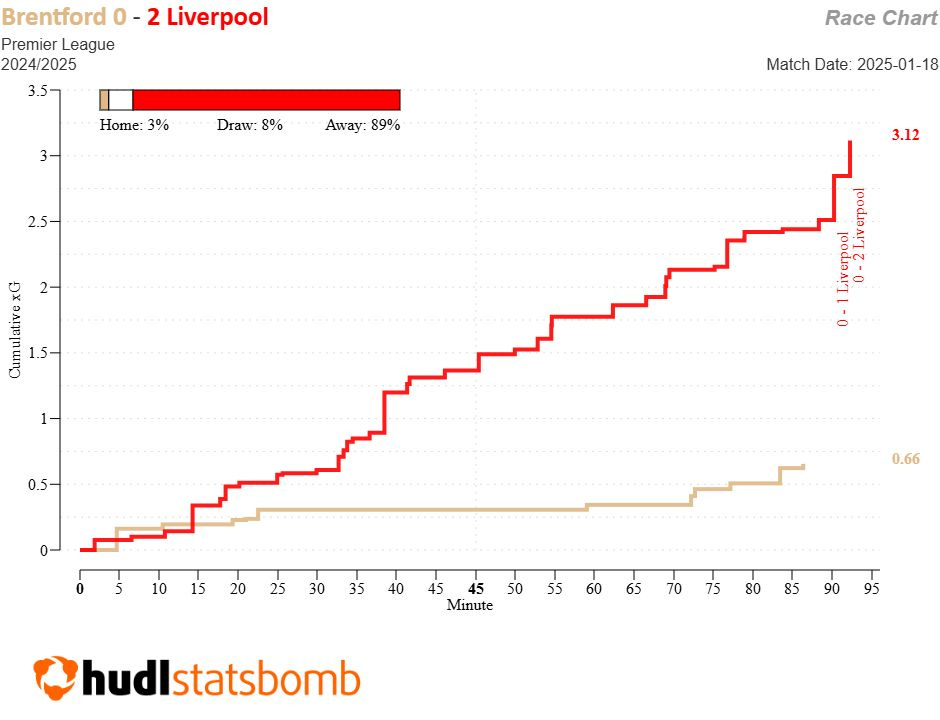
How good are Liverpool? It’s the question at the forefront of supporters’ minds at the moment, Reds or otherwise. Thomas Frank reckons they are the best team in the world but what does he know?
“They’re complete. Their work ethic, the way they track back, are good indicators. They’re so good all over the pitch. Such a threat going forward. These are really, really good. It’s the best team in the Premier League and the world. They’re huge favourites to win it [the title].” THOMAS FRANK
The Club Elo and Opta rankings agree with the Brentford boss. Recent results have given reason to wonder, though, with Liverpool only winning four of their last eight league games. Were it not for Darwin Núñez’s heroics at the death at the Gtech, the Reds would likely have dropped six points in their past three games.
It is not a time for panic. Even if the match with the Bees had ended goalless, Liverpool’s underlying process has been hugely encouraging in recent weeks. This post from Ted Knutson, combined with the race chart at the top of the page, proves the point.

It’s interesting that he said that Arne Slot’s men “rode their luck a bit and got the best results that maybe weren't always that deserved”. Ted built Statsbomb, he knows football data better than just about anybody. The Opta statistics, via FBRef, imply the Reds have deserved to win 18 and draw three of their 21 matches though. Or at least they do if you set a bar of an expected goals margin greater than 0.4 xG to merit a victory.
It’s roughly the value of one Opta-defined big chance, plus it ensures the expected points table has a realistic number of drawn matches. The xPts table for 2024/25 contains 62 draws when there have been 60 in reality.
Liverpool’s expected draws by this method were away to Manchester United, Arsenal and Newcastle. Only against the latter two did they lose the xG score, by just 0.1 and 0.2 respectively. They are nine xPts ahead of the next best side, which isn’t even Arsenal. It is beyond doubt that they are very good within the context of the 2024/25 Premier League.
But how about when assessed against seasons and champions past, how do they measure up then? While they’re not the best team English football has seen in the last eight seasons, they are heading in that direction.
Their xPts average of 2.71 per game is near impossible to match across a whole season. Manchester City have only done so once and it wasn’t their centurion side either. Quadruple chasing Liverpool? 97 point, Champions League-winning Liverpool? They weren’t as strong in the league as the Liverpool we’re watching right now.
Notice that most of the elite sides earned fewer points than their dominance merited. Mark that down to an unlucky bounce of the ball here or there, strange refereeing decisions or occasional sub-par finishing. Nobody ever gets exactly what they deserve in football, it’s too random.
Some of these teams may also have had little to play for in the final fixtures of the season (although most did). It’s worth looking at how they stood after 21 games.
The City side of 2021/22 had an expected win-draw-loss record of 18-3-0, identical as the present day Liverpool. Their forefathers (mostly the same players) from three years earlier were 16-5-0 from their opening 21 fixtures. Pep Guardiola’s first champions stood at 17-4-0.
The Reds of 2018/19 were 16-4-1, as were the team of three years ago, while their title-winning side was 14-5-2. None of them can match the Liverpool of Slot’s freshman campaign for xPts at this stage.
Naysayers - Arsenal fans, mainly - highlight that the Reds have some tricky away matches lying in wait this season. It is true that they must still travel to six of the current top 10. Let’s compare the best xPt sides of the past with the 2024/25 Reds on corresponding fixtures.
The best way to do this is to use the standings in the expected points table for the relevant season. That shows the true strength of a team more accurately than their position in the Premier League table or reputation from history (*cough* United *cough*).
Once again, we find the City of 2021/22 were 18-3-0 on xPt from the fixtures Liverpool have played this term. The Reds were 14-7-0 from these matches that season, by the way.
Three years earlier, City were again deserving of an 18-3-0 record from these fixtures with the Reds at 16-3-2. There is no way to slice the data fairly which produces a better team on expected points than 2024/25 Liverpool, with only some of City’s sides recording slightly better xG differences.
Not that a team needs to be the best in history, recent or long term, to win the league. Just better the rest, not even necessarily on the underlying statistics; City were ahead of Liverpool in 2019/20 if you judge it on expected goals.
Do you think Leicester cared that other sides were better on the underlying metrics in 2015/16 or that just 72 points would’ve seen them finish ahead of second-placed Arsenal? Was Sir Alex Ferguson bothered that United were only the seventh best team on the basic shot on target metrics of the day when he won the league in his final season? He’s probably not even bothered he bestowed the club an ageing squad and David Moyes as manager. Winning is everything in the heat of battle.
The chance of doing that are only enhanced by being the best in class though. When forecasting the outcome of future matches using data, you need to establish the attacking and defensive strength of every team. The easiest way to do this is to see how they compare to league average for expected goals at each end.
For instance, Liverpool have posted 2.35 xG per game this season, which means they are 59 per cent above the 1.48 average for the Premier League. By only allowing 0.89 xG every 90 minutes, the Reds are 40 per cent better than average in defence.
There’s predictably correlation between over- or under-performance at both ends. A team is unlikely to be markedly stronger at one than the other. Here’s how teams from the last eight seasons of Premier League football rate against each other for relative strength.
Only six of the 160 dots on the graph represent teams who were at least 40 per cent better than league average at both ends of the pitch; the Liverpool of 2024/25 are one of them. Chances are the Reds might drop points or win a match they might not deserve to soon enough, but don’t worry if that happens. They’re too far ahead of the competition for it to carry any long-term significance.
This is what I keep saying to people. It's not just the "eye test" that shows "more control." It's also the underlying numbers almost across the board. They're just functioning better as a unit and in adjusting to the most variable of the major sports on a game-by-game and even half-by-half basis. Arne inherited a team full of veterans that had won everything and a few very promising newcomers. But somehow he's reinforced the psychology that this team can win everything. I think it's a really interesting question as to what adjustments he's made in the team's preparation that seemingly makes them so much more confident, which is playing out on the pitch.
I was feeling a great run was more likely than a poor one….right before United. But that seems a blip as we have been good in the matches since, save the Spurs cup one, I guess. I wonder if it is the sign of the value of xG that I would be “feeling/expecting” even better from this impressive team?