
How Many Shots Should Liverpool Have Conceded?
On shot numbers alone, Liverpool don't have the defence of Premier League champions. A closer look highlights a distinct positive in their numbers
Liverpool made such a remarkably good start to the season defensively that it was unlikely to be sustained throughout the campaign. After seven games, the Reds had conceded just two goals.
Only four times in Premier League history had a team conceded fewer at that stage of a season. Yet the recent 5-0 win at West Ham was Liverpool’s first clean sheet in five league matches, with their last on the road occurring in the first week of October.
Their total of 17 goals conceded in the first 18 games is only two fewer than the struggling Reds of 2022/23 allowed two years ago. It has left supporters wondering if their team is defensively sound enough to win the title.
Liverpool have let in two-or-more goals in five league matches since the final weekend of October, as many as Arsenal (two) and Chelsea (three) combined. The explanation for the downturn in their defensive form appears obvious.
For most of the opening seven games of the season, Arne Slot was able to field Ibrahima Konaté and Virgil van Dijk in front of Alisson Becker. The Brazilian missed the 3-0 win over Bournemouth, but it was in the seventh match, at Crystal Palace, that he suffered a far more serious injury. Though Alisson has since returned, Konáte has been absent since before he did so.
While hugely relevant, other factors will have played a part. As he so often does, Neil Atkinson made an excellent point during The Anfield Wrap’s Review show for the Reds’ 6-3 win at Tottenham. He noted that Liverpool had not played the sides sat 14th, 15th and 17th in the league table, with only one of the bottom 10 having visited Anfield. Atkinson suggested the shots conceded average would decrease once the Reds had played those games.
Sure enough, Leicester then had just four efforts at Liverpool on Boxing Day, before West Ham mustered seven against them last time out. Point proved. It got me thinking, nonetheless. As one can use expected goals to predict the score line of a match, it is possible to do the same for shots. The Reds have allowed 9.7 per game this season but how many should they have conceded?
As with any model, this can’t account for everything. It can’t know which players made up the back four or whether a team was away in Europe in midweek. Was the game played at a fog-bound Anfield? Did one side go down to 10 men in the 17th minute? There are numerous ingredients, including these, which will have contributed to the total of shots Liverpool conceded.
The figures which follow are also calculated using the shot data for the season to this point. For most games it will have looked different when the match was played. In short, this is only a guide. Enough of the terms and conditions. What can we learn?
A simple way to do this exercise would be to compare a team’s average shots they have at home or away as appropriate against the total when they faced Liverpool. For instance, West Ham have taken 13.4 per match at the London Stadium, so as they only had seven against the Reds, Slot’s men were 6.4 better than average.
By this measure, Liverpool have conceded 56.8 shots fewer than expected in 2024/25, second only to Manchester City (64.6), with Arsenal (54.5) and surprisingly Manchester United (50.1) next in line ahead of Chelsea (25.7).
For this method to be valid you have to assume that all defences are equal though. You would expect teams to have fewer shots against the title challengers than they would against the relegation-threatened clubs. A season-wide average treats any opponent as par when they obviously vary in standard; West Ham had 23 shots at home against Ipswich, to illustrate the point.
We have to rate attacks and defences at home and away by their shot averages (using this method if you want all the gory details). We can then calculate an expected shots score for any match.
By pairing the Hammers’ home attack with the Reds’ defence on the road, we would expect Julen Lopetegui’s men to muster 8.5 goal attempts. By only allowing seven, Liverpool beat the model by 1.5.
In any given game, any performance against expectation is possible, good or bad. But across a season, no team is going to be wildly off piste, as the figures are based on their body of work. The 20 teams in the Premier League are all within 6.4 per cent of their expected shots conceded.
Liverpool are 3.3 per cent below par, having faced 174 shots against an expectation of 168.5, with two matches largely explaining why they have not been better off.
Do you want to tell Slot that the Nottingham Forest game is his side’s best performance by this new metric or shall I? He won’t be impressed or care either way.
The above looks very positive overall. If you could choose the matches in which you conceded fewer shots than expected, fixtures against City, Arsenal and Chelsea would be among them.
At the bottom of the chart, it is very hard to meet expectation against Southampton, Brentford and Wolves when only given around six shots for a benchmark. Had Adam Armstrong converted his penalty rather than the rebound at St Mary’s, that match would’ve met defensive expectation from Liverpool’s perspective.
Bottom of the pile is the 3-3 draw at Newcastle. There were two factors at play here. The Magpies only had three shots in their home opener against Southampton, in part as Fabian Schär was dismissed in just the 28th minute. A tally that low will sink an average in a small sample, giving them a weaker attack in a model than is the case in reality. We must also acknowledge the patched up nature of the Reds’ starting back line for that game.
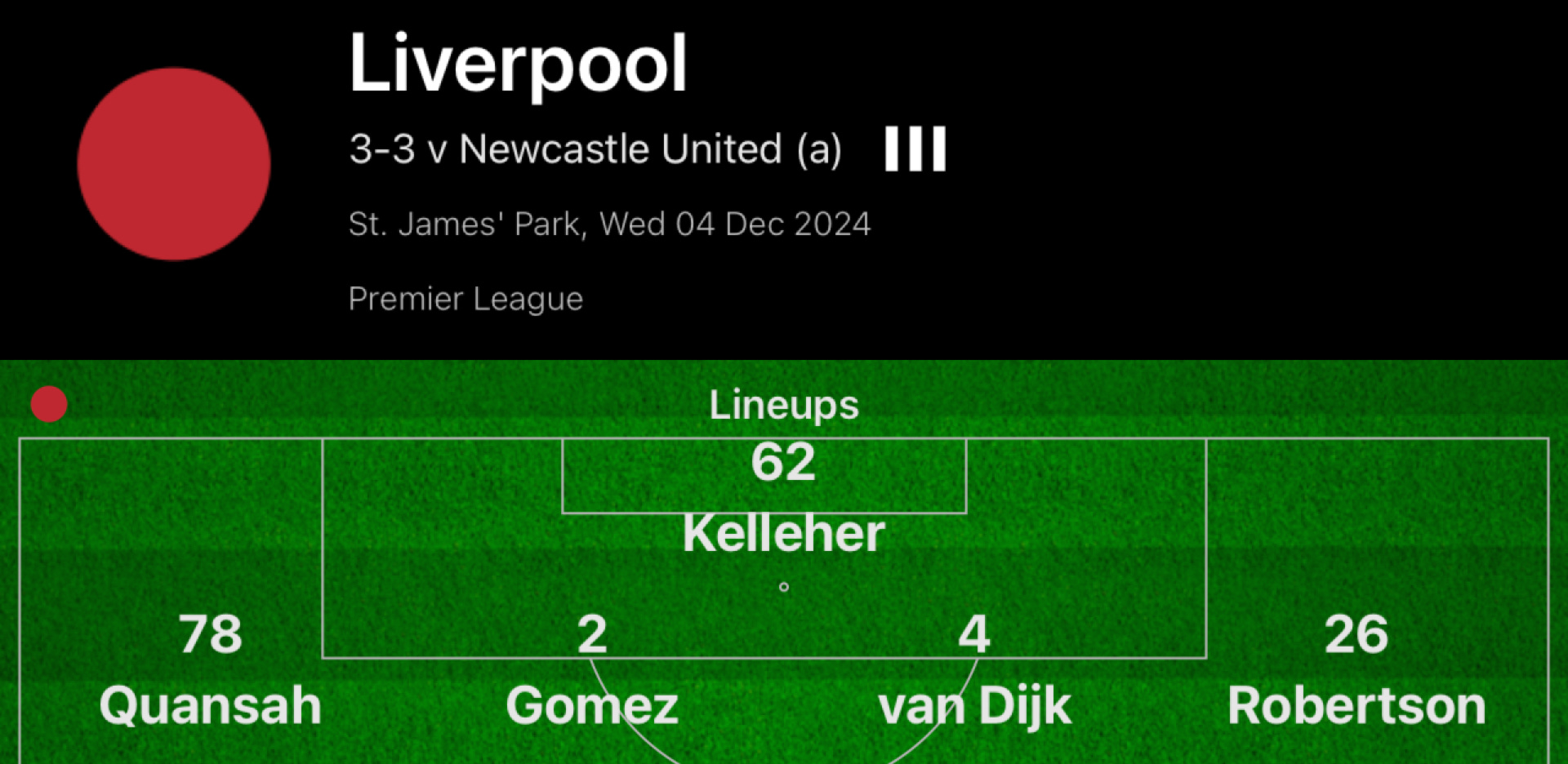
Jarrell Quansah is not a right-back while Joe Gomez was starting a second straight game at the heart of the defence for the first time since February 2023. With Ryan Gravenberch having a rare off night under the St James’ Park lights, a higher shots against figure was inevitable.
The other stand out game in a potentially bad way was the home clash with Bournemouth, in which the Cherries logged the highest shot total a visiting side has mustered at Anfield (in the FBRef database). However, xG data paints them as the second best team in the 2024/25 Premier League.
As the above chart shows, Bournemouth had the highest expected shots figure (12.8) against Liverpool this season. It’s worth noting that they recorded their 13th effort in the 80th minute of a match which the Reds had led 3-0 since the 37th minute, though. An easing up was inevitable, if unlikely to have been fully tolerated by hard taskmaster Slot.
But the Liverpool head coach should be pleased. His side are limiting opponents in the toughest matches, which bodes very well for the tough challenges ahead. United are expected to have 10.3 shots at Anfield this weekend. As they are not one of the top teams, maybe they will.