
Jérémy Jacquet Points Towards a Back Three
Liverpool's transfer business in their post-Klopp rebuild suggests they might move to a back three system. Analysis of Jacquet adds an intriguing dimension.
Liverpool supporters don’t usually know what the backroom brains at the club are plotting. It leads to a lot of idle speculation on their plans.
It was widely assumed the Reds were not going to sign anyone in January once Marc Guéhi and Antoine Semenyo moved to Manchester City. Liverpool didn’t make a move in terms of competing in 2025/26, though they did agree a deal for Rennes centre-back Jérémy Jacquet to join in the summer.
Most supporters won’t have been aware of the 20-year-old. The solution is to undertake the trusted method of research: watching a compilation on YouTube in which the only bad thing is the music. It’s obviously great to see what a player does well but such videos never provide a rounded picture of their strengths and weaknesses.
Still, there was plenty to admire about Jacquet in the clips. A look into his club data revealed his side have played almost exclusively in a 3-5-2 system. Adding that to what we know about other Liverpool acquisitions and targets sparked a thought. I floated the following on Bluesky, indirectly hinting at the notion of the Reds lining up with a back three in the future (and thanks to people who prompted several further lines of enquiry in the replies):
Jacquet plays in a back three at Rennes. Frimpong is a wing-back. He thrived alongside Wirtz in a 3-4-3 at Leverkusen. Frankfurt (Ekitike) ended last season regularly playing in some version of a formation with a back three as did Parma (Leoni).
The idea of the Reds setting up in, say, a 3-4-1-2 system next season doesn’t seem odd in light of the above, albeit what a player did before isn’t evidence of all they can do. Could the below be Liverpool’s opening day line up for 2026/27? With another young centre-back included, only Alisson and Virgil van Dijk would be over 27-years-old. Reds of the future, assemble.
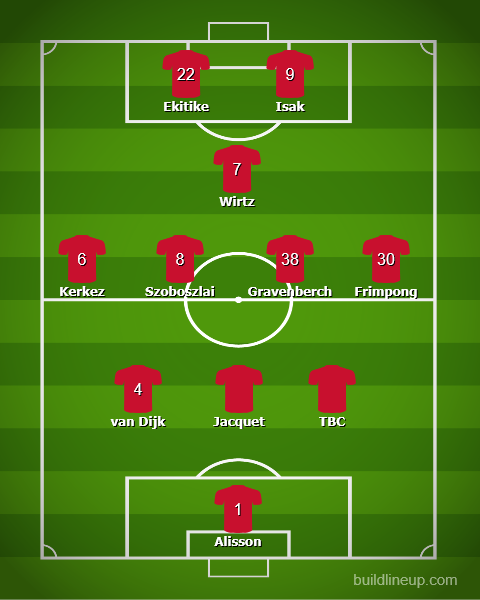
Guéhi started on the left of a back three under Oliver Glasner at Crystal Palace, which strengthens this tactical theory. Other former targets Leny Yoro not playing in a central defensive trio (bar one game) nor Dean Huijsen doing so for Bournemouth weakens it.
As for the looming presence of Xabi Alonso, who completed an unbeaten, double-winning domestic season with a back three, well. Make up your own mind on that.
Another reason to think Liverpool could be heading down this systemic path is that they have recently been stockpiling young centre-backs. Last month, deals were either completed or agreed for the summer for Ifeanyi Ndukwe (17 years old), Mor Talla Ndiaye (18) and Noah Adekoya (19).
Career data is understandably scarce for these lads, but Ndukwe played on the left of a trio in his one UEFA Youth League appearance. Transfermarkt also suggests Ndiaye featured in a back three for Senegal’s under-18 side. Both were in back fours at the recent Under-17 World Cup, though, which is reportedly where they caught the eyes of scouts.
Even so, with this trio, Giovanni Leoni and Jacquet, Liverpool have the potential makings of a back three platoon for the next decade. As the Italian will remain out of action for some time, we’d better take a detailed look at the Rennes man to see how he could fit in to the Reds’ (new look?) side.
Here’s the Jacquet video I watched. There are countless others out there.
You don’t need to watch all 14 minutes, you see what he’s about almost immediately. Tall in stature, his rangy frame allows him to move across the pitch with ease. There are sublime passes on show, some of which inevitably bring van Dijk to mind when he pings the ball out to the right wing.
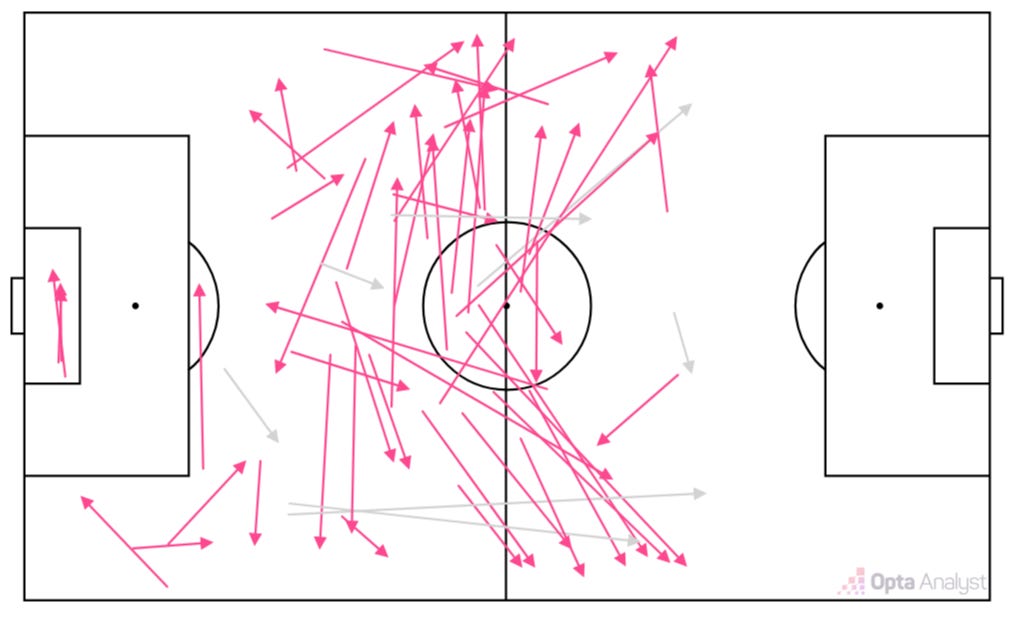
As this pass map illustrates, he’s comfortable playing near the halfway line, an absolute must for a centre-back at Liverpool. Jacquet appears capable of delivering as much expected threat with his passing as his future teammates too.
Per MarkStats, the youngster offers 0.09 xT per 90 minutes for a Rennes side averaging 52.2 per cent possession. That should scale up to at least matching Ibrahima Konaté’s 0.10 for Liverpool given the Reds average over nine per cent more ball.
Speaking of Ibou, Jacquet has a marginally higher win rate for aerial duels this season, by 75.5 per cent to 73.3. Among the 10 players who are aged under 21 and have at least 1,200 minutes starting at centre-back in this big leagues this term, only Luka Vušković has been more successful (80.0 per cent).
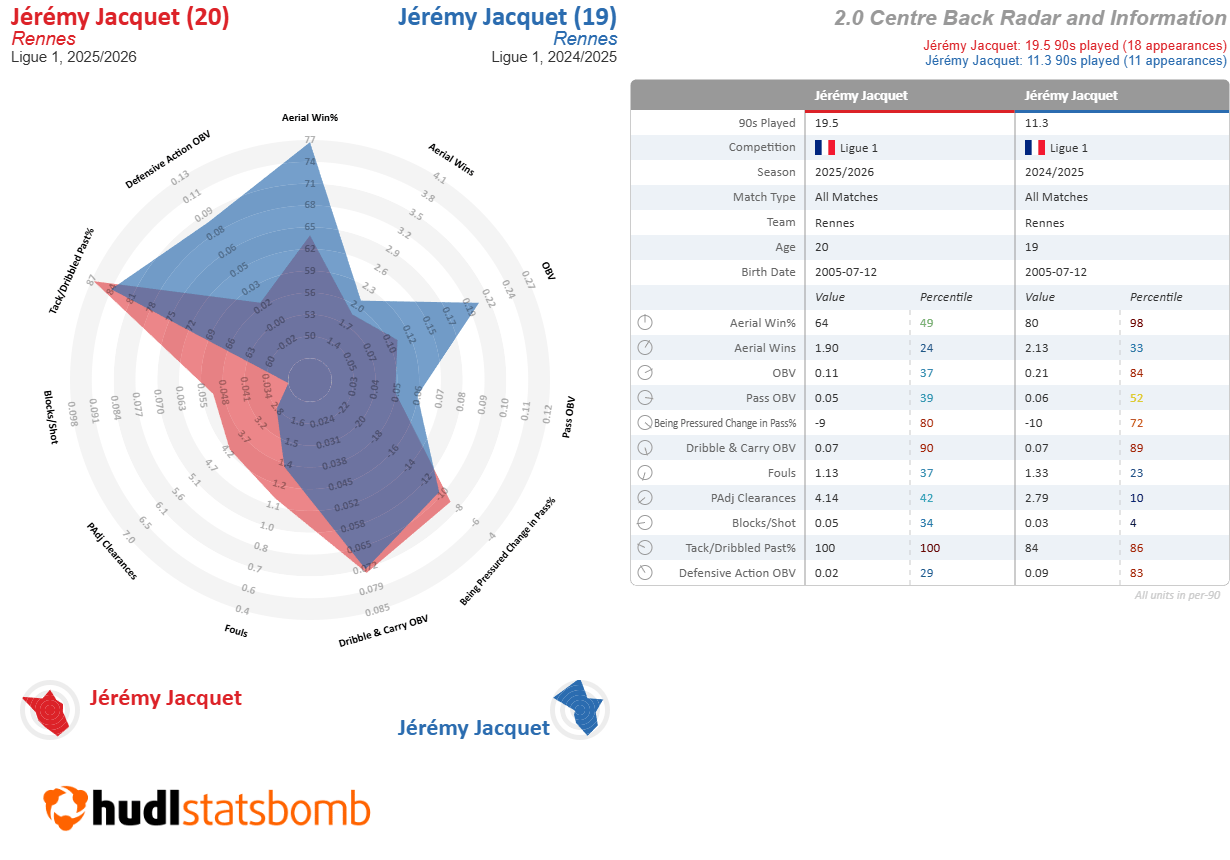
Using the data in the above radar, we can also compare Jacquet with Konate and van Dijk for on-ball value. He holds up well, albeit he has seen a dip since last season.
The three players are all very similar for ball carrying. Where Jacquet averages 8.5 progressive carries across a total of 90.2 metres per 90, Konaté and van Dijk are posting 8.9/92.9 and 8.8/89.3 respectively.
The new signing is a monster in the air. Good on the ball and progressive with it. Time on his side to improve. Tick, tick, tick, tick.
The obvious stumbling block with these findings is that Jacquet has only played in Ligue 1. Eleven of the 18 teams in that division are rated by Opta as worse than Wolves, another two are below Burnley. Paris Saint-Germain are the only team in a top 16 of the two leagues combined.
None of that is his fault. For now, let’s look on the bright side of Liverpool securing a player who looks to be one of the best young centre-backs on the continent.
We can also start to ponder how he will fit into the Reds’ back line. Jacquet’s Opta Analyst page reveals that he has spent the majority of his playing time in the centre of Rennes’ back three this season.
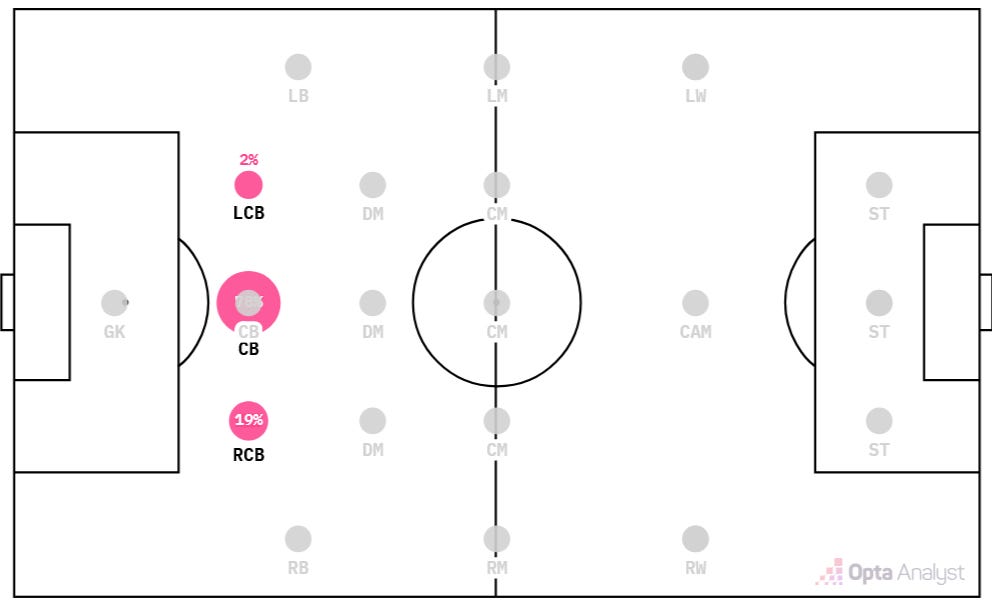
This gives him the opportunity to move forward without disrupting the back four that is left behind. Leoni’s final eight Serie A appearances for Parma saw him play all three roles in their centre-back trio. They didn’t concede in any of the three matches in which he was on the right, suggesting he might be best on that side (as much as anything can in his brief career).
That would leave a left-sided berth for Virgil. Who knows, maybe this could extend his Liverpool career. Or more likely the Reds aren’t going to deploy a back three at all. There is compelling evidence to support the theory, nonetheless.
3412 has some positives. The biggest: Alex & Hugo playing CF at the same time creates a huge problem for opponents. In attack, Hugo could be truly unleashed, dropping into midfield (box 4) or interchanging w Florian & opponents will really struggle because they have to mark Alex. In defense, it protects the center, enabling central pressing traps galore.
The biggest concern is the wingbacks. The wingbacks need to be special players with James Milner-level endurance, pacy, carry an attacking threat & smart (risk/reward) in split-second decisions about when to press. Milos has the endurance but that's about it. Conor & Jeremie are a better fit for the role but fitness is a concern. We'd definitely have to buy a LWB.
The outside CBs have to be a fit as well. They have to have the pace to cover the space behind the wingbacks & strong in possession & technical skills bc of a greater reliance on them to progress via passing or carries. Jacquet looks tailor-made for outside RCB - pace & a midfielder-level technical toolbox for carrying, passing to move us forward. I'm not sure Virg at 35 is suited for the outside LCB but he'd be great in the center of 3 CBs. We'd need to sign a LCB.
Who knows what Hughes is thinking but a back 3 feels like a rigid/fragile system bc of its reliance on specialists ... remove 1 piece bc of injury and it's hard to adapt. I'd bet we stick with 4231, counting on Hugo being able to play on the left when Alex is at CF + Florian developing into his defensive responsibilities at the 10.
Thanks for that again, Andrew. Looking at Amorims recent, uhm, successes just up the M62, is there any real possibility of using a back 3? We're already using a variation of it with a withdrawn fullback but there doesn't seem to be much success with 3 CBs in the PL in recent years