
Liverpool are Getting Better at Passing The Pressure On
Arne Slot wants his Liverpool players to 'kill' the opposition with passes. Their improvement at passing under pressure is a big part of how they do it.
Most statistics in football are a two-way street. If you’re trying to do something, the chances are you have an opponent intent on stopping you.
The view of the outcome of any such situation can vary. Take pressing, for instance. You picture a player attempting to regain possession, possibly with ideals on launching a counterattack. It can be one of the most exciting facets of the game when executed correctly.
But less than one in five pressures result in the presser’s team regaining possession within five seconds, per Fantasy Football Scout. It’s a huge part of the sport, so teams can usually play their way out of tight corners as they expect to be closed down.
Inevitably some players are more proficient at this than others, leading to teams varying in their standard of pressure escapology. Being able to evade a press is as much about the movement of colleagues without the ball creating passing options as it is about the ability of the player in possession to find them.
Assessing the latter is far easier than the former thanks to Statsbomb data. Like any metric this season, it’s fascinating to assess Liverpool’s record under Arne Slot against their data from their final year under Jürgen Klopp, especially as the squad is largely unchanged.
While players have inevitably seen a shift in their figures, there has been an overall trend which will please the new head coach. One change which won’t have pleased the men in red on the pitch is that they are now making a higher percentage of their passes under opposition pressure than they did in 2023/24.
Even with that raise, which has occurred almost across the board in the Premier League, the Reds play a lower proportion of passes when being pressed than any other side in the division.
It must be hard work playing for Brighton this season. At Liverpool, most players have seen a negligible change, as you would expect from the data in the above chart.
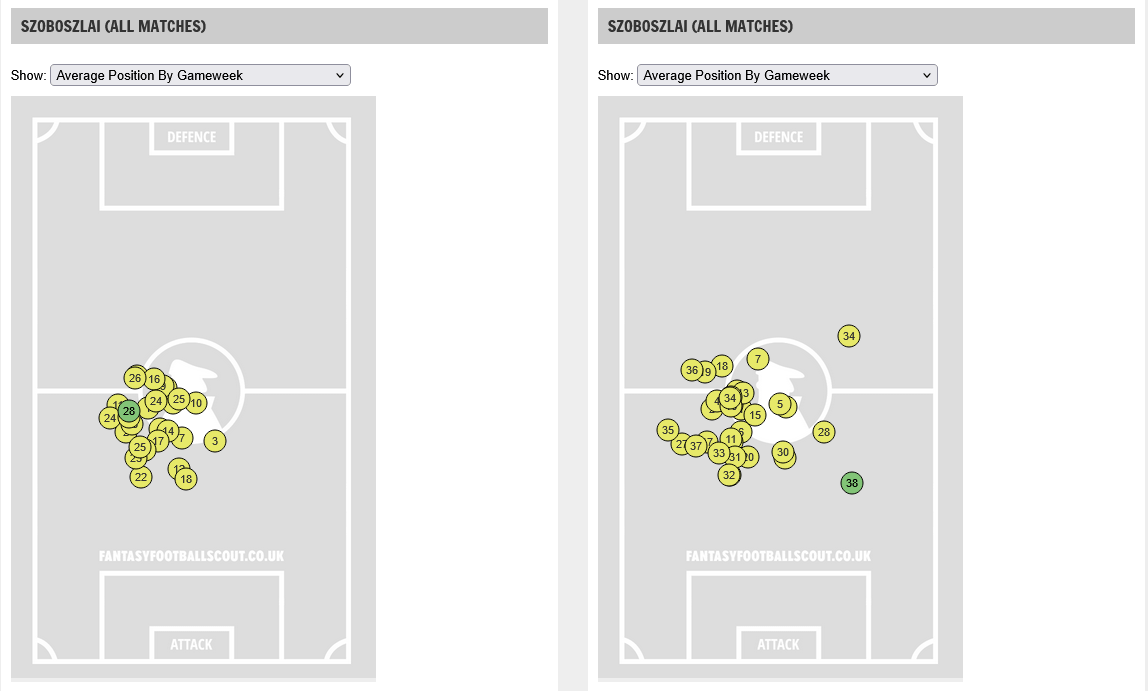
There are a couple of exceptions which seem easy enough to explain. Dominik Szoboszlai now plays as a number 10 in a 4-2-3-1 system rather than as one of the eights in a 4-3-3 framework, meaning he tends to be centrally in the opposition half more often. It is no surprise his percentage of passes made under pressure ha risen by 6.4. Seeing a shift of almost Brightonian proportions makes sense.
What initially appears stranger is a change at centre-forward, the position in the team which has proven most enigmatic in a number of ways in the Slot era. For Darwin Núñez, the difference between last season and this for the metric has been less than half a percentage point, nothing otherwise worth mentioning.
Except that Diogo Jota is now having to play an additional 10.7 per cent of his passes under opposition pressure. Among Premier League players who’ve at least matched the Portuguese forward for passes and minutes played, only Dango Ouattara (11.5) and Nicolas Jackson (11.4) have seen bigger rises since last season.
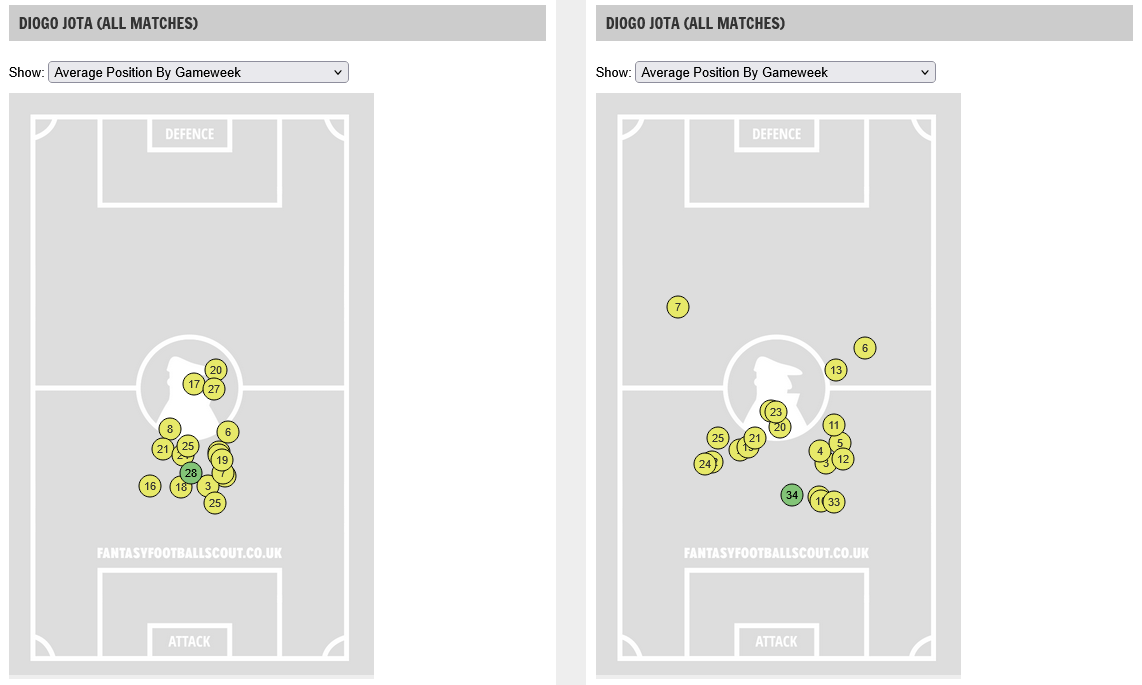
Like Szoboszlai, Jota has also been far more central than he was in 2023/24, when he had starts on both flanks. That will inevitably draw more pressure from defenders.
This is likely why Jota has seen his rate for succeeding with passes when under pressure drop by 2.1 per cent since last season. He is one of only four players at the club who have declined on this for Slot.
What is notable is that the only two players with a bigger drop have been markedly worse while fulfilling the same role as each other.
Conor Bradley’s sample size is small enough to potentially be an irrelevant distraction here, but the Trent Alexander-Arnold shift is surprising considering the improvements made by the majority of the squad. It’s hard to think of a reason for this, as he has been playing a more conventional right-back role for Slot. If a rise in pressured passes per 90 minutes would explain a dip for many players, Alexander-Arnold should be able to rise above that.
For now, that’s something to ponder. More interesting is that most Liverpool players have improved their accuracy under pressure this season. This speaks of a side with a better working system, a stronger structure in possession. Squad members having fixed positions - Luis Díaz from the regular starters aside - will likely have aided this too.
If this line of thinking does not explain all changes in success across the Premier League, what is certain is that only West Ham and Brentford have seen bigger improvements than the Reds in 2024/25.
Liverpool’s overall passing success rate is higher this term than it was in any of the preceding seven seasons, likely thanks in part to the above improvement. However, the rise on last season (which was the previous joint-best alongside, surprisingly, 2020/21) is just 0.6 per cent, so hardly earth shattering.
Statsbomb have an Expected Pass model which suggests there has been a greater upgrade on the Reds’ passing since last season, but that’s for another article on another day. For now, know that Liverpool have turned the direction of traffic on Pressing Street further in their favour when they are in possession.
Statistics correct prior to matches played on April 1.
So what has happened to Trent - any ideas, anyone?