
The crowd was up, the party had started. A goal down, the visitors resumed play, only to lose the ball within moments. It was 2-0 less than 30 seconds later. Bang bang, just not necessarily ‘you’re dead’.
Liverpool killed off Arsenal in the title race long ago. Last weekend it was time to emphasise their dominance in a match that didn’t even matter to them. Scoring again quickly would’ve swiftly rekindled memories of the famous 5-1 win in 2014.
You’d think the Gunners would’ve learned a lesson from the previous passage of play, but no. After both goals, Martin Ødegaard kicked off by playing the ball back to David Raya, only for him to go long to the left flank without finding a teammate. It was mildly more successful the second time in that they won a throw-in, at least.
The ball made it’s way to Mikel Merino on the edge of the Liverpool box, who took a shot that was so obviously going to be blocked it may as well have been your details on your ex’s mobile. An immediate counter-attack was launched, with Curtis Jones seeing a shot saved just 13 seconds later.
Imagine if he’d scored. The Reds would have gone from goalless to 3-0 up in exactly four minutes, with the ball in play for comfortably less than half of that. Arsenal likely fold in this scenario, which later allows Jarell Quansah to come on for Conor Bradley. It would’ve left us to ask Trent Alexander-Arnold-who? rather than to Trent Alexander-Arnold-BOO.
The sequence for Jones’ goal attempt brought to mind a Hudl article from two weeks ago on ball carrying, as both the shooter and Luis Díaz had dribbled up field within the move.
“I thought it could be interesting to see how these [carrying] numbers looked for players within a team: Liverpool, the team who generate the most counter attacking shots in the league,” wrote Lily Wood-Blake, before sharing this chart.

The hudlstatsbomb data likely doesn’t match Opta’s statistics perfectly, but they are in agreement that the Reds are the Premier League’s leading side for shots following counter attacks (a.k.a ‘fast breaks’). Per WhoScored, Liverpool are also ahead of any team from France, Germany, Italy or Spain for good measure.
More significantly, they have scored 14 goals, 19 in all competitions. The league figure is at least four more from counters than any other team in the last 16 seasons of top flight football in England, creating a suspicion that Opta have eased their definition for this pattern of play.

There were 665 Premier League shots deemed to be from fast breaks across Jürgen Klopp’s first three full seasons in England, just 17 more than the 2024/25 campaign has seen with two weeks remaining. Even if it’s easier than ever before to record a statistically-defined counter attack, it’s worth looking at who has been most involved in creating or shooting them for Liverpool. Four men have broken quickly from the rest of Arne Slot’s pack.
The Dutchman’s success this season has come because he retained the best of his predecessor’s style of play while making a few tweaks to solidify the side. More patient overall, the Reds still spring quickly into attack when the time is right.
“If this pass after transition immediately leads to a chance and the fans are loud, that also gives you the right energy, mental energy,” Slot said in October. He has known the power of what Klopp’s side did at their best all along.
The German’s top man for counter attacking shots in the Premier League last season was Darwin Núñez. Featuring far less for his new head coach, the Uruguayan’s involvement rate per 90 minutes has remained decent, perhaps in part to chances arising as a substitute against tired, beaten teams.
The top player, as he has been in so many ways, is Mohamed Salah. He has remarkably averaged one counter attack shot or chance created per 90 in all competitions this season. It doesn’t feel possible when you think of teams defending deeply at Anfield, offering such little space in which to break.
Salah’s total of 34 goal attempts from fast breaks is the same tally as Tottenham have registered in the Premier League to sit seventh in the team standings. Even if we discounted the chances created, he would still only be behind Cody Gakpo for involvements per 90.
The Egyptian king finished breaks by scoring against teams of all standards; from good like Arsenal or Aston Villa down to terrible in Leicester or Spurs. Salah has assisted fast break goals for a quartet of players too: Alexander-Arnold, Nunez (both against Villa), Diogo Jota (West Ham) and Alexis Mac Allister (Newcastle).
Liverpool have only converted three counter attack goals in the 2024/25 Premier League which the 32-year-old didn’t score or assist. He featured earlier in those moves anyway, naturally.
Remember when Darwin scored at Brentford with a ludicrous chipped finish? That was the Reds’ previous top flight fast break goal in which Salah played no part whatsoever.
He was on the bench at the time. There are no examples of Liverpool counter goals in the league in the last two seasons which occurred without his involvement if he was on the pitch. Salah predictably features in the majority of the top creator-shooter combinations in all competitions for Slot.
The surprising pairing in the upper reaches of the list is the Gakpo to Dominik Szoboszlai axis. They linked up to fashion the goal which sealed Liverpool’s 3-1 win in Milan early in the campaign, with their quintet also including shots in other big games against Chelsea, Bournemouth and Everton. Both players have proved ultimately disappointing with fast breaks overall though.
Szoboszlai has missed all seven counter attack shots he has taken since scoring at the San Siro. Gakpo is even worse. The Dutchman is the Reds’ top player for non-penalty goals per 90 yet has missed all nine goal attempts he has fired off in fast break situations. Even with an average level of conversion with these chances, Gakpo would be sitting on a 20-goal campaign.
Him aside, the forwards have similar records. Jota has netted 29 per cent of his counter shots ahead of Salah (24), Díaz (23) and Núñez (20).
Liverpool’s conversion rate has also remained consistent no matter the scenario. They have put away 20.0 per cent of their fast break shots when level or losing, 21.3 per cent in total and 22.4 per cent when ahead. You can even break the winning margins down to one, two, three or four goals and the success rate still only ranges from 20.8 to 28.6 per cent.
The Reds have been more proficient in some past seasons in the league, though as hinted at earlier, maybe counter attacks were harder to come by in the data back then. If that was the case, the chances were likely of higher quality so easier to convert.
Either way, Liverpool are breaking on teams at a rate never seen before, using their ability to excellent effect in 2024/25. Slot must keep this element of the attack in place as he begins to evolve the team further to his way of thinking this summer. Maybe the Reds can then make Arsenal pay for their mistakes at Anfield next season.
Postscript
Since publishing the newsletter, I’ve found this The Analyst article on counter attacks. Liverpool’s new Premier League records for counter attack shots and goals stretch back further than first thought, and that was the case in late March. There’s a shot map of their fast break chances dating to that point below.
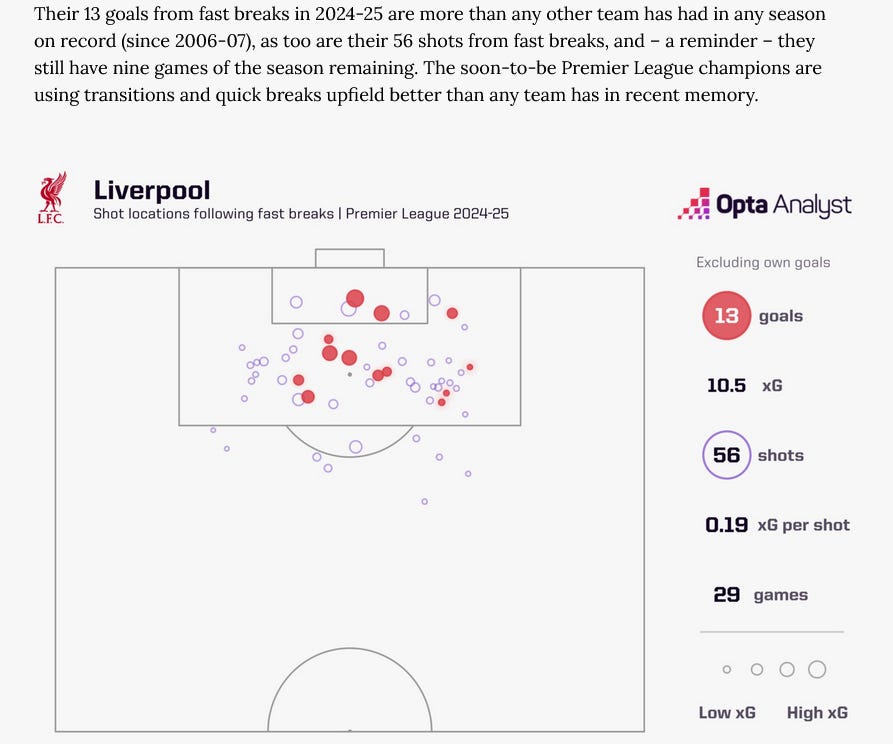
The data rules must've changed, right?! It doesn't feel like Liverpool counter attack significantly more than ever before, but apparently they do.
Surprised to not see Bradley appear in any of these.