
Liverpool's Goal Involvements (No, not goals or assists)
Liverpool have already recorded a couple of very long possession sequences leading to goals this season. Is it a tactical shift or a random occurrence?
Four different forwards scored for Liverpool against Bournemouth, a rare occurrence. There have only been three instances of five scoring for a team in a Premier League match, positional vagaries notwithstanding.
At no point were the Reds’ productive quartet on the pitch together. Not that Arne Slot would be afraid to use four at once; he deployed five simultaneously in the most interesting five minutes of 2024/25. Perhaps he’ll unleash a quintet later this season once Alexander Isak is on board.
Liverpool failed to score when they had five forwards together, which happened against Crystal Palace in the final game of the campaign. Something interesting occurred shortly after that period shuddered to a halt after Ryan Gravenberch’s red card ordered a tactical rethink though. The last goal of 2024/25 was unique for the campaign in that four forwards were involved in the sequence which led to it.
Not only that, they made the final four contributions: Diogo Jota played the ball into space on the right flank, from where Darwin Núñez crossed to the back post. Cody Gakpo then headed the ball into the centre of the box for Mohamed Salah to round off an unforgettable season with its closing goal. Here’s the clip.
Goals with three forwards linking up aren’t as unusual. Luis Díaz passed to Salah for him to assist Gakpo against both Leverkusen and Fulham last year, for instance. The latter two players were also part of the sequence which led to Federico Chiesa’s decisive goal on Friday.
It was a slightly strange passage of play, which began with a free-kick. Bournemouth made four clearances within the move yet couldn’t reclaim possession, which explains why eight Liverpool men were involved yet the longest sequence of successful passes only ran to five.
This is evidence of the pressure the Reds put opposing teams under. Getting a touch only to immediately need to defend again is a regular occurrence against Liverpool. The first goal of 2025/26 is Exhibit A for this phenomenon.
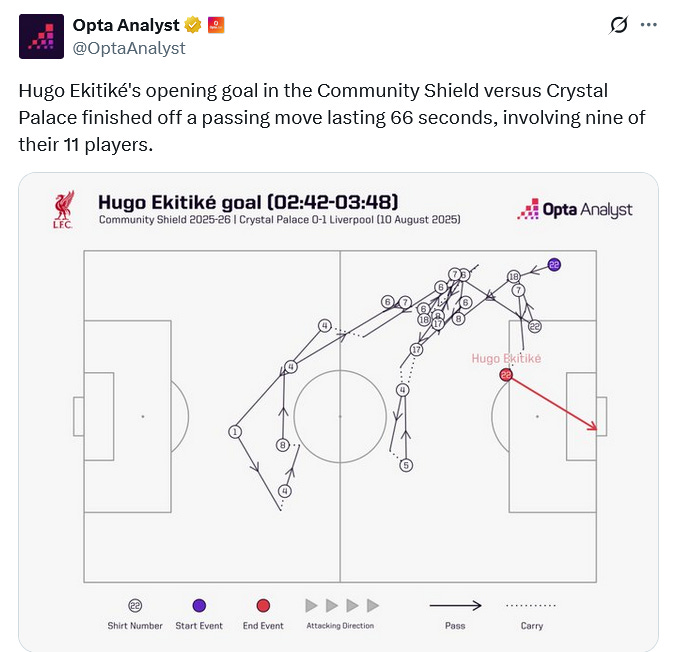
Much was made Hugo Ekitike’s Wembley strike being the culmination of a 22-pass move. Yet the full sequence ran to 49 actions with all 11 players making contributions. It just featured a couple of minor interventions from Palace along the way which broke it into chunks.
An eight-man, 18-pass possession chain delivered the first goal of the Premier League campaign, again for Ekitike. That it featured Alisson Becker but not Florian Wirtz shows how random such things can be. It feels striking that two of Liverpool’s first three goals of 2025/26 featured such lengthy sequences, though.
With Opta data enabling a check of all shot-ending possession sequences, it’s time to review Liverpool’s data for last season to see how unusual Ekitike’s goal build-ups are. Has this been a tactical development or is it random chance?
We can see which players were most involved in the goals while we’re at it. This is a rare attacking metric for which Salah does not finish first.
By directly scoring or setting up 57 goals, the Egyptian obviously couldn’t also lead the way for other sequence involvements. That honour fell to Alexis Mac Allister, who registered 38 to finish three ahead of Andy Robertson.
The Argentine combined that tally with 13 goal contributions in the traditional sense. That’s a bigger total than it sounds for a Liverpool midfielder of recent times; nobody hit that mark without penalties for Klopp, save Philippe Coutinho who frequently played a more advanced role. A fully fit Mac Allister’s attacking instincts are vital to Slot’s Reds, as much as he feels most needed to improve the team’s defensive structure at present.
Next in line for non-goal or assist involvements was Virgil van Dijk, with 33, albeit the majority of his contributions naturally occurred earlier in sequences. He leads the squad (with five) after the first two matches of this season too. FBRef award credit for the two actions prior to the goal; Virgil only had one penultimate involvement last term whereas Mac Allister’s 14 took the top spot.
No Liverpool goal in 2024/25 featured all 11 players in the move like Ekitike’s Community Shield effort did. Five involved 10 men, with a Gakpo goal against Ipswich the only instance where every participant was an outfielder.
Looking at the length of sequences that led to goals last season highlights that the recent examples were random rather than a result of a specific change. The longest chain which changed the scoreline ran to 16 passes, fewer than for either of the recent openers against the Eagles and the Cherries. However, the goal in question was also against Bournemouth.
You can see on the pass maps for the build ups (below) that they were similar in a couple of ways; both sequences involved passing around the back line from left to right, plus a vaguely triangular flurry of ball exchanges in midfield. These sections falling in different orders explains why Mac Allister’s assist for Ekitike was far shorter than Ibrahima Konaté’s for Díaz.
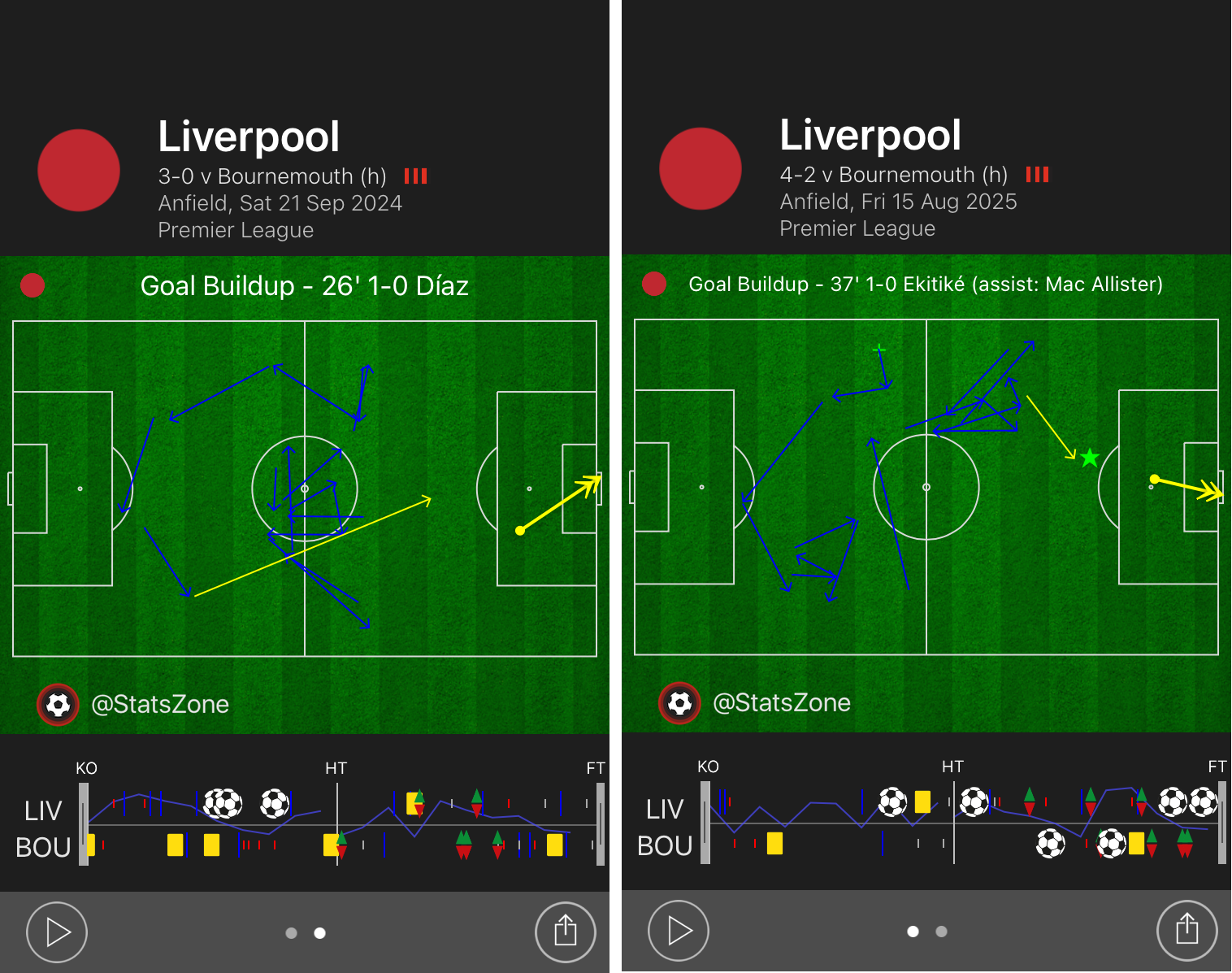
This proves the new longer sequence lengths are largely random as much as anything can. The two build-ups pictured are against the same team within a year of each other, so similarities are to be somewhat expected. The Reds will have been forced into passing shapes and directions by the pressing that Bournemouth offered in response to their possession in different areas.
Díaz’s first goal for the club featured a longer sequence too. The below video was posted in a terrible aspect but demonstrates the 34-pass preceding his Kop end strike against Norwich. If you can face going on X, a better version is available here.
That move took as many passes as it did thanks almost entirely to the Canaries deploying two banks of four or five men, the norm for visiting sides at Anfield. Almost all of Liverpool’s lengthiest possession sequences which resulted in goals inevitably unfolded on home turf.
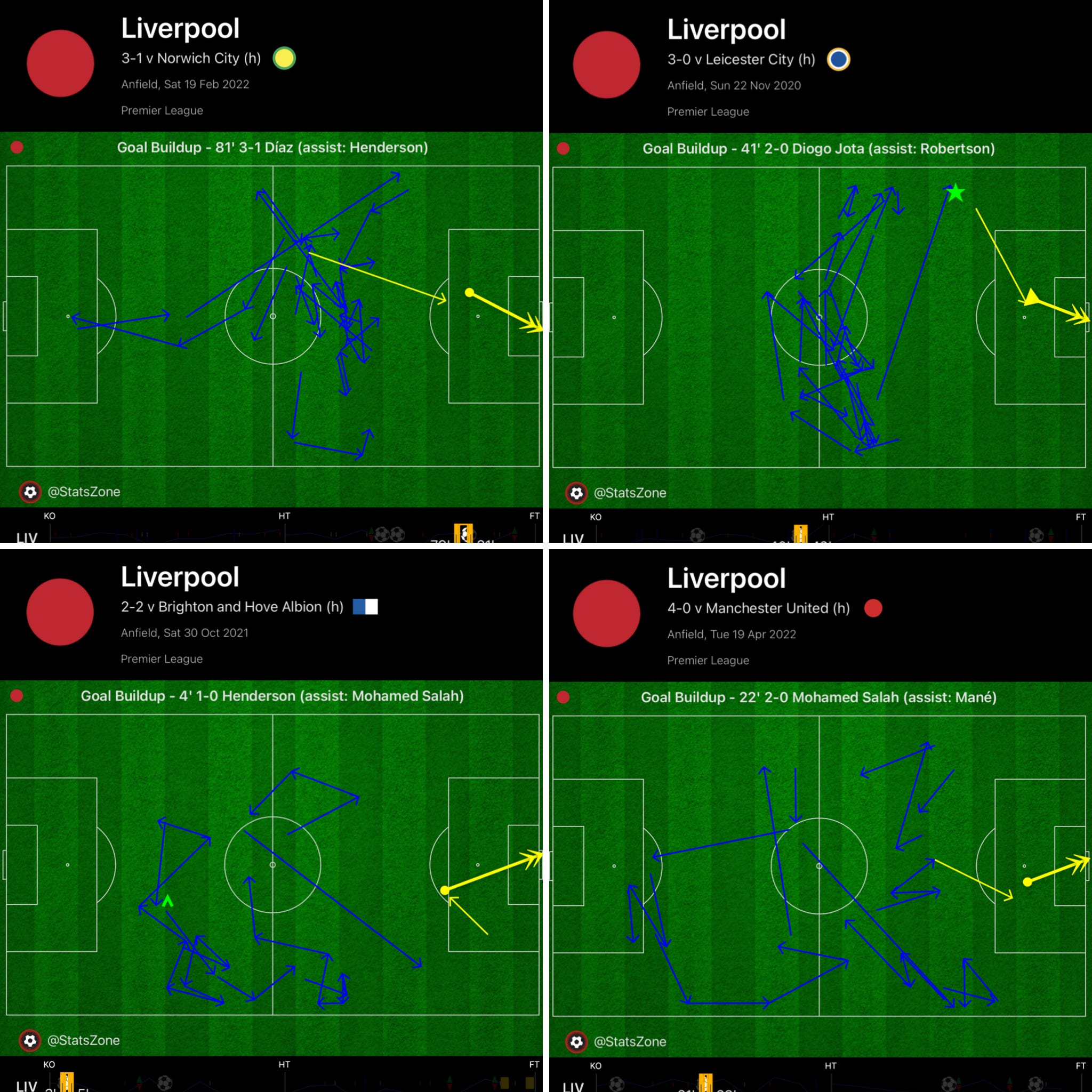
Liverpool have to bide their time, recycle possession, then pounce. Such moves often involve a long pass to break the opposition open a little, as you can see on the maps here (plus the one for the 2024/25 Bournemouth goal).
In that sense the aforementioned Díaz goals were alike. Wait until there’s an opportunity for the right pass, to borrow a Bob Paisley-ism, then we move. This remains something to watch for over the next nine months, for now.
Perhaps its mostly a Bournemouth thing?! Good to know they can string long sequences of possession together... I wonder if we've already seen the two longest that will lead to goals this season?