
Liverpool Need A New Formation
The system is easier to change than the head coach or the players, after all.
The headline of this edition of the newsletter is a little misleading. Sorry about that. What Liverpool need more than anything else is for several key players to rediscover fitness and form.
A Reds side containing Alisson Becker, Ibrahima Konaté, Ryan Gravenberch, Alexis Mac Allister and Mohamed Salah at something far closer to the peak of their powers would be a more welcoming environment in which the likes of Florian Wirtz and Alexander Isak could thrive. All the pieces matter, detective.
Converting more than four of their 21 Opta-defined big chances across their five one-goal defeats would’ve made quite an impact too. They’d still only be at par if they had scored twice as many.
As relevant as these factors are, Liverpool have lost the last five matches in which they started with a 4-2-3-1 formation. This bleak run is only lightened by a 5-1 Champions League win in Germany. The Reds began against Eintracht Frankfurt in a 4-4-2 system.
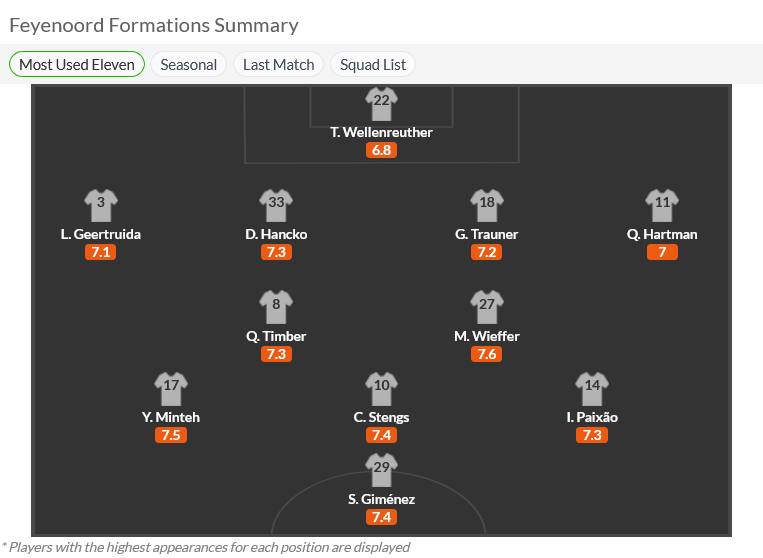
Is permanently switching to that tactic too simplistic a solution to their current woes? Sure. Even if this were the answer, formations aren’t static (unless Roy Hodgson is in charge). Arne Slot denied his Feyenoord team played 4-2-3-1 when the available evidence suggested they regularly did. Formations are just numbers on a page, a shorthand to describe how a team lines up. They only really show the positions for when a side is out of possession.
Tactical frameworks such as these still provide a starting point for analysis. Using Understat data we can see how Liverpool have performed in the league with their different formations across the last 12 seasons. If not the most accurate expected goals model, we will at least be comparing like-for-like.
Sorting the FBRef and Understat xG difference for the 2025/26 Premier League reveals only four teams are further than one place apart in their standings on each table anyway. The scale might be different for the two models but the principle isn’t producing wildly different results.
The league data for this season’s Reds is hugely concerning. It could be argued that the 4-2-3-1 version of the present day team is worse than any other iteration of Liverpool since the days of Luis Súarez ended.
That doesn’t seem possible, does it? Understat give the Reds an expected points total of 13.4, which (while not great) is a shade under 5.5 fewer than Arsenal when the gap in reality is seven. Nobody would argue they’re playing at title-winning level but that doesn’t automatically mean they are the club’s poorest team since these records began.
The expected goal difference is more damning. Never mind that the Gunners are at +10.3 when Liverpool are +1.7, Leeds United are +3.4 with Brentford 0.4 in front of them. The Reds need to be markedly in front of teams that are likely to finish in the bottom half of the table even if they won’t match Arsenal this season.
Liverpool have used 15 formations for at least 800 minutes since 2014/15. The 4-2-3-1 this season is bottom of the pile by such a margin that it is the only one in debit. It’s a decade since Liverpool were within two-thirds of an expected goal as bad as they are now.
While the samples for other formations in 2025/26 are too small to tell us much of anything, they combine for an xG difference of +1.97 across 64 minutes of play. Significant or not - probably not - this is interesting as it has been claimed that Liverpool have been too open when chasing games in recent weeks; they probably have been, but the volume and quality of chances they are creating should perhaps be compensating for that.
This demands a deeper, game by game investigation. That isn’t possible on Understat, so the figures from here onward will disagree with the above. Using WhoScored to isolate the periods of play in different formations, we can get Opta’s xG figures via FBRef to see how they stack up.
Even though the figures don’t match Understat as expected the broad theme remains. When playing 4-2-3-1, Liverpool have an expected goal difference of +0.18 per 90, compared with +2.23 in other systems. Those figures move to +0.27 and +1.64 if we disregard penalties, but there remains a chasm between them, with the numbers for the regular formation still underwhelming.
Here’s what happened when Slot switched from his primary system in Opta’s view:
Liverpool went to 4-3-3 in the 73rd minute against Bournemouth, only to concede an equaliser almost immediately. They then allowed no further shots, scoring twice to win.
Slot opted to see the Arsenal victory out by going to a 4-5-1 formation. The best chance for either side fell to Federico Chiesa on the break.
Opta say the Reds were stationed in a 4-1-4-1 system for the second half at Burnley. The home side were so penned in that the formation was almost irrelevant. It was probably closer to 2-4-4 than 4-4-2.
On that note, the latter was the system for the final 36 minutes against Manchester United. The xG score was 1.8 to 0.6, only for a goal total of one apiece giving the visitors a rare Anfield win as they led entering this period. Perhaps the balance of play in this period is partly why Slot stuck with it for the next match, against Frankfurt.
The formations themselves are likely a red herring. They had little to do with conceding from a throw-in situation to lose at Crystal Palace or to go behind early against Brentford. Their tactical set up was utterly irrelevant to the soft penalty which cost them in Turkey.
It is likelier to be the tweaks within the systems which matter most. The move for Chelsea’s winner came down the right of a Liverpool defence which had Dominik Szoboszlai and Gravenberch on that side. The need to play men out of position will have more influence than the formation in which they are set.
Maybe the simple truth is that Liverpool just really aren’t very good this season, for numerous reasons. If that proves to be the case, it’s unlikely any formation can save them.
Defence wins you league titles, attacks win you games, sort out the defence first. Play Isak and Ekitike together and leave 1 up front at set pieces so the opposition can’t throw everybody forward
If the formation isn't too blame, it doesn't appear to be helping.
I've written a piece this week for the Echo's Blood Red monthly paper which advocates for a 4-4-2 diamond... It feels like it might work in a Salah-less Liverpool, but it may have to wait until then.