
Liverpool, Paris Saint-Germain and A Tale of Quite Good Chances
Liverpool and Paris Saint-Germain might be the two best teams in the world. Their Champions League tie threw up an interesting statistic.
History was not on the side of Paris Saint-Germain. Liverpool had won 38 European first legs on the road prior to last week, finishing the job at Anfield every single time.
(There was also a tie against RB Leipzig during the pandemic in which both legs were on neutral territory, with the Reds winning the designated away leg first).
The visitors had form for upsetting the odds though. They lost at home to Barcelona last season before rescuing the tie with a 4-1 win in Spain. While data is limited since the abolition of away goals in 2021, this was the only instance from the six examples in the Champions League of a team losing a first leg at home by a single goal before recovering to qualify.
There’s another upset in the books now, after PSG beat Liverpool on penalties 4-1 following a 1-0 victory in normal time. Not that the score line of a shootout matters, but this was the Reds’ heaviest defeat in one, to go with the ending of the flawless record mentioned above.
As you would expect with home advantage, Arne Slot’s side played much better than they had in the first leg. They topped their shot total from the Parc des Princes within 10 minutes on Tuesday evening. As much as they undoubtedly had the chances to potentially win the tie, the Reds struggled to create really good opportunities. Their performance level from Paris rose significantly; the problem for Liverpool was that there was little in the way of a dip from the Ligue 1 side.
Rather than review the match in depth - having already done that for The Tomkins Times - it feels worth taking a look at the tie as a whole from the perspective of chance quality. The Reds were outshot to the tune of 27 efforts across the 210 minutes of play, a level of dominance the club will so rarely have experienced. The value of those goal attempts is worth a much closer look.
As we can see, there was too much flatlining on the Liverpool line. The only similar stretch for PSG occurred in the second half at Anfield, when the Reds had eight shots without reply, over a third of their total in the tie.
It won’t have been easy to have been on the back foot for as long as Les Parisiens were. However, did that enable them to save a little physical energy for extra-time? The visitors also avoided a fall off once they brought on substitutes whereas the players who joined from the bench for Liverpool did not have good nights, Jarell Quansah aside.
Whatever the explanation, PSG looked by far the fresher side in that period, outshooting Liverpool 11-1. Having begun the first leg with 12 unanswered shots, Luis Enrique’s side closed the tie with an unbroken run of eight.
Even with these dormant periods for the two attacks, the lines in the above chart are relatively smooth. The expected goal data makes it more jagged, more interesting.
There’s little argument to be had with the notion that the correct side advanced to the next round. No other team has got close to generating this level of offence against Liverpool in 2024/25. Per FBRef, Bournemouth had been most effective, with 2.7 xG across the two meetings. The Reds only conceded 2.4 from three meetings with Spurs but, lads, it’s Tottenham.
The sharp rises in the dark blue line are worthy of further scrutiny. At around the half hour mark of the first leg, PSG had three chances worth a total of 0.87 expected goals in the space of eight seconds. Ousmane Dembélé topped that at Anfield with a 0.94 xG effort for his goal, with Bradley Barcola following that with a 0.60 chance five minutes later.
Valuing any individual shot can only ever be done via estimate, even with a mathematical model doing the guesswork. There are so many factors which contribute to the situation in which a chance occurs that (penalties aside) there can be very, very few that are truly identical.
Harvey Elliott’s goal in Paris was rated as worth 0.15 expected goals. It was noteworthy at the time that it was the highest value chance either side had in the final 66 minutes of the first leg. Liverpool might have been fortunate to get through the opening 30 minutes unscathed, but a simulation of PSG’s remaining shots on their patch suggested they stood around a 60 per cent chance of not scoring. It was not outlandish that the Reds won the game based on the final two thirds of it.
Liverpool’s best chances at Anfield occurred early on in the game. Mohamed Salah saw an effort diverted over the bar, then he put one wide of the left-hand, Kop end post before both Virgil van Dijk and Diogo Jota were unable to convert headed opportunities from corners.
How does the race chart look if we focus on chances that were worth a minimum of 0.15 xG (Elliott’s goal)? Let’s call these chances quite good, rather than big.
This is fascinating. Liverpool’s best chances were condensed between minutes 87 and 108 of a 210-minute tie. PSG had three of theirs in that period too, along with three in the blink of an eye in Paris. Dembélé was offside for his first effort at Anfield (see below), though it remained in the stats; without that each team had four attacks which generated a ‘quite good’ chance.
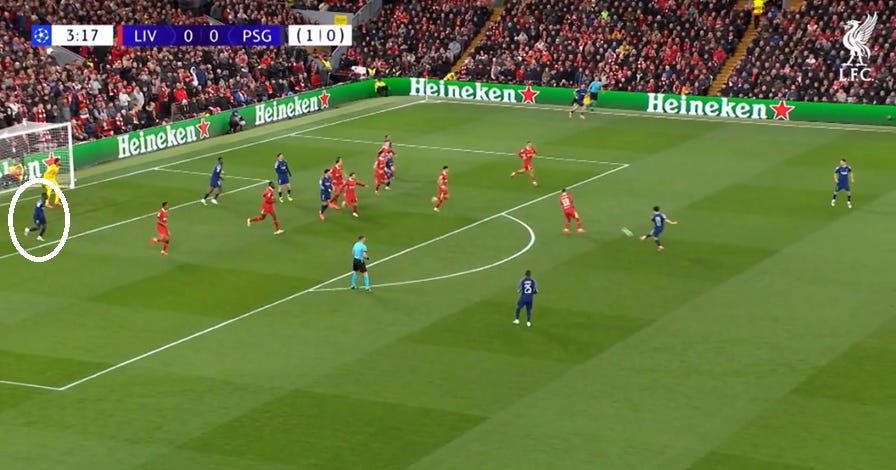
Don’t misunderstand the intention here, the purpose is not to suggest that Liverpool were just as good as PSG. The French side had four chances of higher value than the Reds’ best, after all.
But any analysis that says Liverpool were outplayed to the extent that they deserved no hope of advancing may be a touch wide of the mark too. Paris Saint-Germain shot often and shot well, just not from as many big chances as you might have thought. In fact, they barely dominated the quite good chances.
Thanks for this. An interesting perspective on the match. I thought after the Paris match that PSG didn't create that many chances in the box. Same last night in some ways. Trouble was Liverpool couldn't seem to create many real big chances in either game. Not sure if this is a comment on the effectiveness of our attack at the highest level or how well PSG defended and how Enrique organised them.