
Long, Long, Long
Long balls are back in fashion as Liverpool have discovered to a punishing extent.
“It’s not about the long ball or the short ball, it’s about the right ball.”
BOB PAISLEY
Bob Paisley’s famous quote wouldn’t have been so memorable had he been managing a team against Liverpool in 2025/26.
“So, Bob, what was the secret to your win today?”
“It’s the long ball, Gabriel.”
“Oh right, thanks. Back to the studio.”
The secret is out, except that it is no secret. Some of the statistics in a recent Opta Analyst article on the phenomenon of long passes against the Reds this season were truly startling. All nine of Liverpool’s opponents have attempted an above-average number of long balls when facing them. The three highest long pass totals by match in the 2025/26 Premier League have all been against the Reds. At Anfield, Manchester United had their highest long-ball proportion in a league game since December 2017 against Arsenal (which coincidentally was another match they won when the balance of chances suggested they shouldn’t have).
Using FBRef data, some further points of interest. The proportion of passes Liverpool have faced that were deemed long is 22.4 per cent this season when it was not above 18.6 in any of the preceding seven campaigns. Similarly, the Reds’ long ball possession - their share of the long passes attempted in their games - is 48.2 per cent when it was at least 53 in six of the last seven years.
This shift may not last. Three of Liverpool’s next five league games are against sides in the bottom six for long passes per match this term. Even if these teams amend their plan against the Reds, they are not as geared to play in this way as the likes of Brentford. How effective have these long opposition passes actually been?
Assessing this using data is challenging. FBRef defines a long pass as travelling further than 30 yards, WhoScored’s glossary states they use 25 yards, while the Analyst article mentioned “at least 32 metres in length,” which is essentially 35. It’s all Opta data so can’t they just get along?
The picture grows cloudier still. A fair assumption would be that one of the bigger boys who has been bullying Liverpool would’ve created the most chances via long passes. Not so. Any ideas which club leads the way on WhoScored?
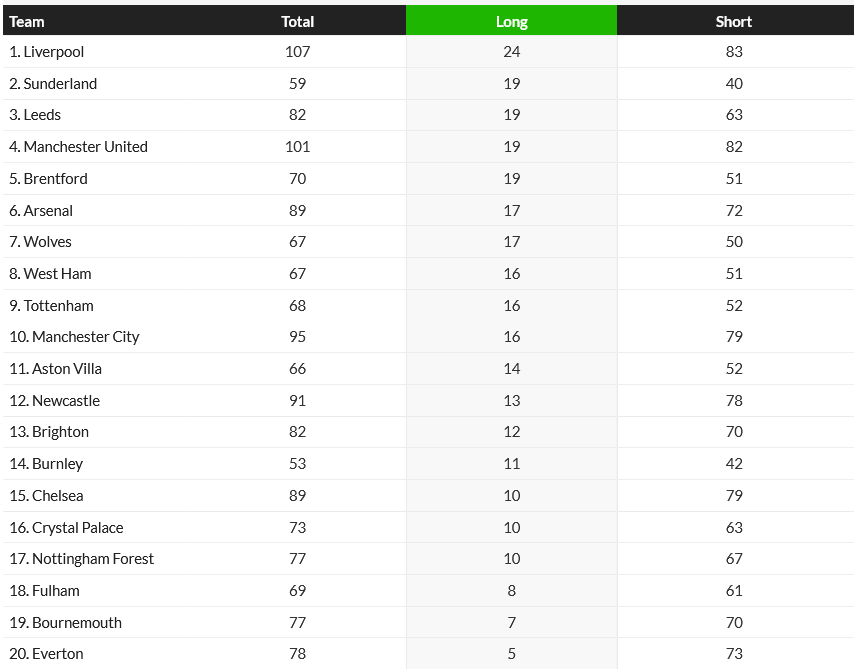
If that hasn’t confused you enough, get ready. Determined to find these 24 long, chance-creating passes the Reds have played, I went through game-by-game to check the chalkboards.
I found six, possibly seven. But certainly not 24.
It appears WhoScored include set pieces which meet their distance criteria for long; to the back post area, most likely. From long passes as you would think of them, there were six that created chances for Liverpool’s opponents too. Who had the edge when it came to expected goals?
The opposition, obviously. Their advantage was all of 0.01 xG, a massive problem. Each ‘side’ scored once each; Mohamed Salah to seal the win over Bournemouth, Kevin Schade to kick the Reds in the teeth at Brentford.
While our priority here is to agonise over defensive weakness, it’s interesting that four of the Reds’ long ball key passes went to Salah, with one each for Hugo Ekitike and Alexander Isak. The sources? Ibrahima Konaté (twice), Ryan Gravenberch, Alexis Mac Allister, Wataru Endō and Cody Gakpo. We lament the loss of the Trent Alexander-Arnold to Salah pathway but the potential to replicate it exists.
Back to the back. Not only are opposing teams not creating many chances with long passes, they’re not even completing many of them. Liverpool are currently allowing the lowest percentage of successful opposition long balls in the last nine seasons of Premier League football.
It’s not a question of possession but position, getting up field over anything else. Teams are playing for territory against Arne Slot then battling for the ball if they can.
That the bottom three teams in the above table are all in the class of 2025/26 suggests they will regress over a full campaign. The same is likely true for aerial duel success rate, as the Reds of this season are ranked fifth best in the Premier League since 2017/18, with their Newcastle counterparts 19th. How Tottenham are dealing with long balls so well when ranked 173rd for aerial duels is a mystery, but that’s for their fans to decipher. Not all long passes fly through the air, after all.
Winning the header has not been the issue for Liverpool. Newsletter subscriber Stephen posted the following comment on the post for the Manchester United loss, which led to a brief look at headed passes.
“I can’t recall another match where, in aerial duels, we win the first ball under limited pressure and head it no where near a red shirt, leading to lost possession on the 2nd ball.”
Having initially found the figures for 2025/26 to post in reply, I’ve now located them for last season too. The contrast is all too apparent. The Reds have completed 47.1 per cent of their headed passes this term, 10.9 per cent fewer than in their title-winning campaign. Four of the six worst performances since the start of 2024/25 on accuracy have occurred within the last six games.
The 6.3 per game rise in volume (likely brought about by opposition long balls) has been almost wholly transferred to the unsuccessful headed pass total: an extra 5.8 per match to lift the total to 15.1 going astray on average. There have been seven games featuring at least 11 misplaced headed passes in this campaign after 13 such matches across the entirety of last season.
Not all of these possession losses will have been costly, as only 51 of the 136 inaccurate headed passes ended in their own half. With the total averaging 5.7 per match, it’s clear why it stood out more against United (11). Again, though, the volume isn’t huge in most games.
If not quite an imaginary bogeyman hiding under Liverpool’s bed (which presumably still has Rafa Benitez’s blanket on top), the long ball/second ball issue has not been as costly as it has felt. The real problem is that the Reds are susceptible to whatever problem the opposition poses in a given game, be that Bournemouth’s counters, Newcastle, Brentford or Palace’s throws, Chelsea’s long range strikes or United’s long balls.
It would almost be better if it was one bad problem. It’s far from all about the long ball or the short ball, Bob.
A bit of weird problem here. The long balls aren't an issue... until they are an issue.
I guess if we see Villa and City doing it to the Reds in the next week then we'll know every team will try it.
I saw Fabian Hurzeler say this about defending them ahead of Brighton's game with Man United:
"When the long ball is played, there are two things that are very important: that you try to win the second ball, and that, if you don't win the second ball, you have good positioning for the third ball. Make sure that, with your last line, you always cover the inner line, so when they try to flick the ball, especially with [Benjamin] Sesko, you can defend against the deep runs from [Matheus] Cunha, from [Bryan] Mbuemo, from [Mason] Mount."
Hopefully Arne has also read it ;-)
When Liverpool press high and commit numbers forward, the long pass becomes the most efficient countermeasure; not elegant, but brutally logical.
The real concern, however, isn’t one tactical flaw, but a kind of systemic fragility of a team that bends to whatever shape the opposition chooses to impose.