
Mohamed Salah and the Defensive Intensity Puzzle
Has benching Salah helped Liverpool defensively? And was he doing close to enough when he did start?
It is one of the random quirks of football that Liverpool have a better record without Mohamed Salah compared with when he plays. He’s the third top scorer in the history of the club, the Premier League record holder for goal contributions for a single team, and the Reds are stronger in his absence.
This isn’t solely in reference to the recent period in which Salah has been omitted from the starting XI either. Liverpool won eight of their nine matches when he was involved at the Cup of Nations in the past. A similar hit rate over the next month would be most welcome.
Having lost three straight games by three goals prior to Salah’s benching, the Reds have since collected three wins and two draws. Clearing a Leeds corner in the 95th minute at Elland Road would have made those numbers four and one respectively, with the Egyptian King unlikely to help with that had he been on the pitch.
Liverpool were not, however, close to perfect in this period. The Reds were flat against Sunderland, lost a two-goal (and 3-2) lead at Leeds and conceded almost two expected goals to Brighton. Replacing Salah with Dominik Szoboszlai on the right of the attacking midfield trio has not solved all of the issues.
Equally, the switch can’t have hurt given the 33-year-old’s lack of defensive contribution. An article on Sky Sports highlighted the decline in Salah’s physical statistics as part of the explanation for why he was benched.
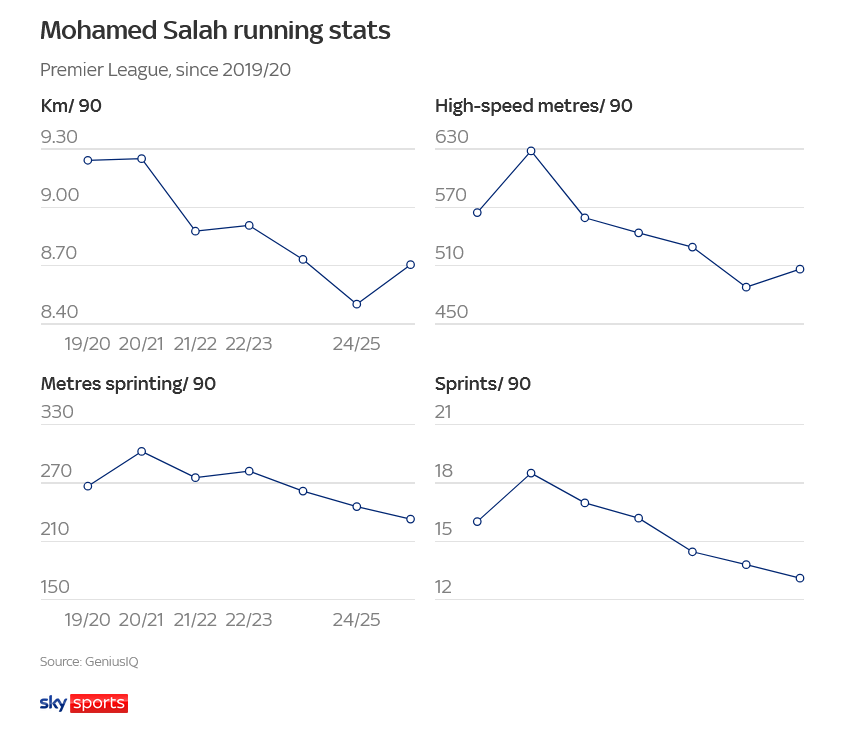
This does not tell the full story. Some of the lines on the above charts have gone up since last season, while the scales used mean any change isn’t as dramatic as it first appears anyway. Fotmob’s physical data for the Champions League suggests Salah is sprinting roughly as hard as many of his teammates this season.
When, and in which direction, a player sprints given the match situation clearly counts for a lot though. Another table in the Sky piece highlights that Salah doesn’t track back anywhere near as intensely as his positional peers when their team is in defensive transition.
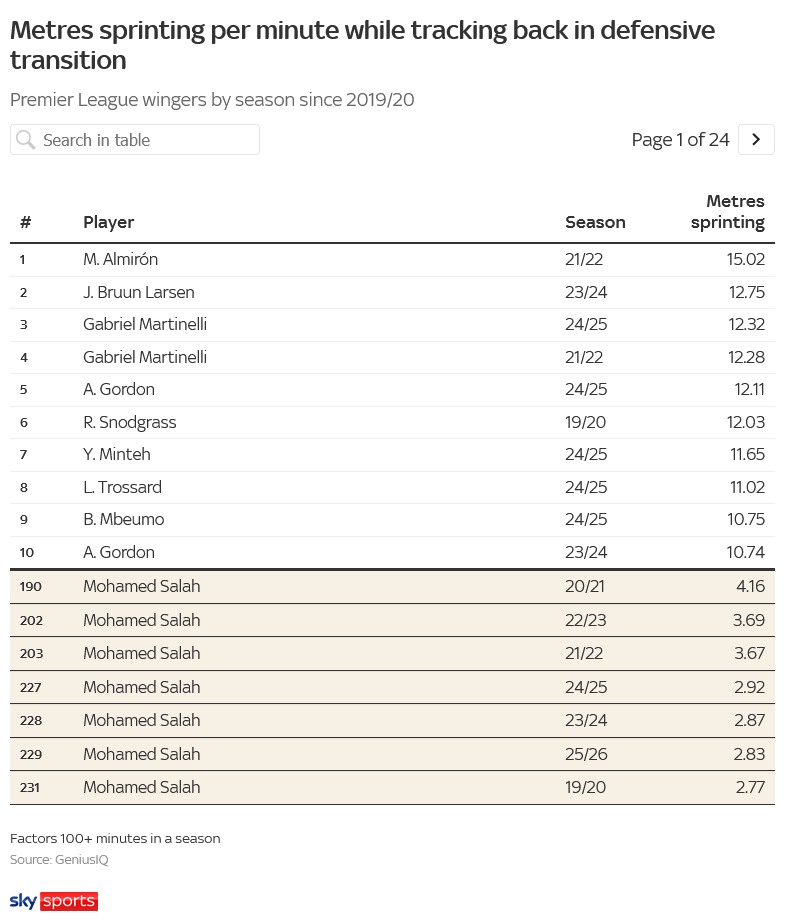
The ultimate issue for Arne Slot is whether Liverpool defend better as a unit without Salah. What the player himself does is not as relevant as the greater good. The number 11’s supposed lack of effort has not been portrayed fairly, though.
When you scroll through the pages on the above defensive transition chart, you find ‘Sadio Mané 20/21’ below any of Salah’s seasons. There are other campaigns by the Senegalese forward in that vicinity as well as some for Luis Díaz and Diogo Jota.
Like anything a player does, physical exertion is at least partly down to tactical instruction. Indeed, Liverpool’s less intense style following the end of the Jürgen Klopp era was credited in part for them suffering fewer injuries last term. Again, though, the when is as important as the why.
Salah might be doing less in transition - the less said about his half hearted effort defending a PSV goal in that debacle, the better - but he is actually pressing slightly more than last season. As the Reds are having more of the ball than in 2024/25, the possession-adjusted margin looks more impressive.
He has also made 22+ pressures twice this season (against Brentford and Aston Villa) when he only hit that mark once in Slot’s debut campaign. Against Manchester United, only human battery pack Szoboszlai pressed more times than Salah.
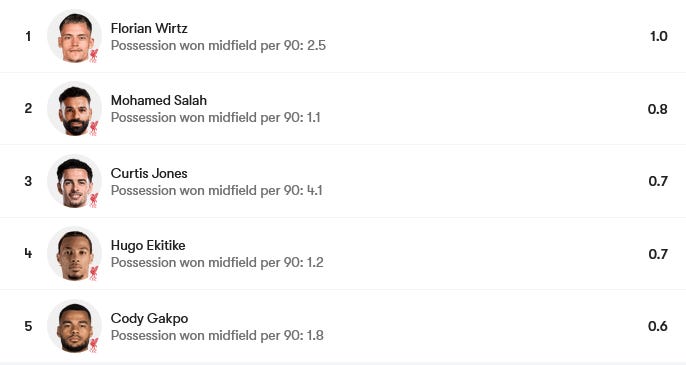
More interesting still is that the team’s regain rate on his pressures has risen from 15.6 per cent last season to 27.7 this time around. Factoring in that only Florian Wirtz averages more final third ball recoveries per 90 minutes makes one wonder if Salah’s defensive deficiencies are being somewhat unfairly over-emphasised.
It is all relative. Salah’s low off-ball work rate didn’t matter last season when he was delivering the output of his life to help the Reds win most weeks. When the goals, assists and victories dry up, people expect to see improvements elsewhere, whether that is a realistic aspiration or not.
But again, team before individual. Liverpool’s pressure regain rate is 32.0 per cent, the second best in the 2025/26 Premier League. With Salah starting, it was 30.6; in the four league matches since it has been 32.3, 34.3, 44.3(!) and 36.9 for a combined average of 37.0 per cent.
The potency has improved too. Liverpool parlayed 85 high turnovers - possessions starting in open play no more than 40 metres from goal - into 15 shots and three goals in their opening 12 league matches this season. They have recorded 27, 14 and two respectively since Salah was benched, so despite making slightly fewer per match they’re producing more goal attempts from them.
Whether you think Liverpool’s press is better and more productive because of Salah’s absence from the starting line-up is up to you. He featured in some of these games, he wasn’t entirely uninvolved in the improvement. Maybe it’s just random? Perhaps Slot dropped a few truth bombs after the dismal run that have exploded in the right minds?
Whatever the reason, the pressing trend is encouraging. The time Salah spends at the Cup of Nations should reveal just how important his contributions to the defensive process have been.
Salah is criticised unfairly AND Liverpool press better without him. Both things can undoubtedly be true!