
Mohamed Salah's Perfect Penalty Placement
Mohamed Salah scored a penalty to give Liverpool the lead against Chelsea. Data shows the difficulty his spot kicks must present to opposition analysts.
Mohamed Salah gave Liverpool the lead from the penalty spot in their 2-1 win over Chelsea last weekend. How confident were you that he’d score?
His record for the Reds suggests you should feel supremely calm when he steps up from 12 yards. Salah’s success rate has been 83.3 per cent for the club, with 35 converted from 42 attempts; only one of the other four men to take at least 40 for Liverpool has been better, with Jan Mølby tucking away 42 of his 45 penalties.
The 32-year-old might have won a penalty himself, prior to Curtis Jones being fouled by Levi Colwill. But after winning six league spot kicks across his first two years with the Reds, Salah has only won six in the five-plus seasons since. The Liverpool winger has had almost 500 touches more than any other player in opposition penalty boxes in that time too, yet six men have been awarded more penalties.
As on Sunday, the Egyptian’s goals from the spot have usually been important, with only six scored with the Reds already two goals up in a game. If you can put one away in a Champions League final, you’re probably calm in any situation thereafter. Pressure be damned.
Salah has been more mortal in recent times, though. His impressive average is helped enormously by converting 17 in a row after missing his first for Liverpool. Since that run ended, the Reds’ number 11 has beaten goalkeepers 75 per cent of the time, with six misses from 24 attempts. It is below average, if hardly at a disastrous level. Equally, had Salah scored just once more in that spell, he’d be above the par line. The super human has perhaps become human at last.
Opta Analyst noted at the end of last season that the trend for success from the spot in the Premier League is rising. With goalkeepers now forced to keep a foot on the line and VARs picking up on any encroachment, the already-favourable balance of probability has been tipped further.
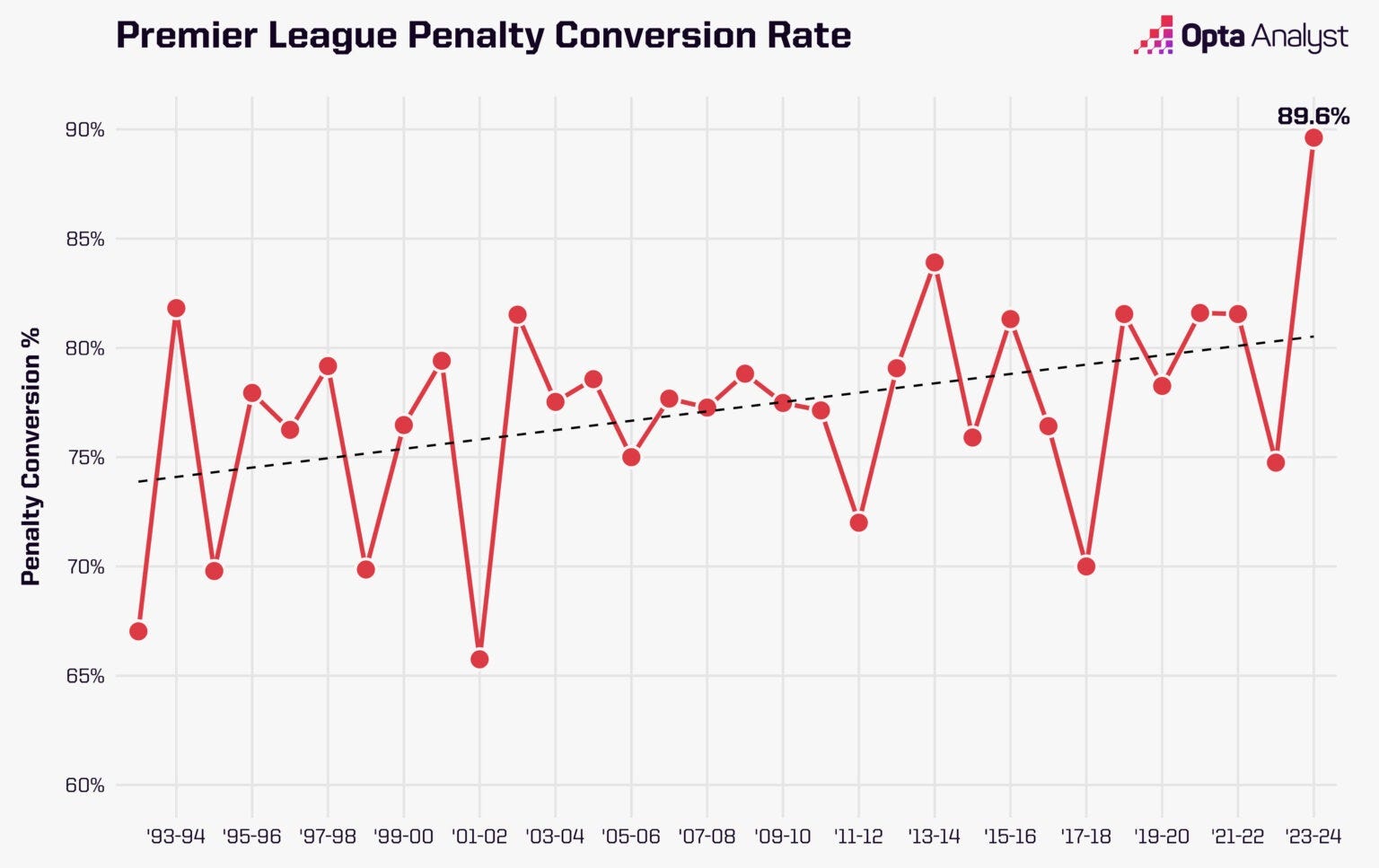
It is, however, now over two years since the review crew at Stockley Park last enforced a retake. Players learn new behaviour eventually. And although tweaks to the rules have given him an advantage, Salah does what he can to push that further through varying the placement of his penalties. He’s on a remarkable streak for not regularly repeating himself.
A penalty is a fascinating psychological battle, which has become even more keenly fought in the data era. The goalkeeper and the shot taker will have been presented with research on how their adversary usually behaves in penalty situations, in terms of placement or dive side respectively.
There’s more to it than placement too. In his book Twelve Yards: The Art and Psychology of the Perfect Penalty, Ben Lyttleton made reference to an Italian study into the angle at which shooters run in before striking the ball.
“It was clear that players whose angle of approach was either too wide or too straight had less chance of scoring,” he wrote, with the study noting the conversion rate was 61 per cent with a 15° angle, 67 per cent for 45° but 80 per cent for 30°. Salah often uses a slightly mazy run up before making the main approach at about 45°, arguably going against conventional wisdom (at least based on his last penalty, below).
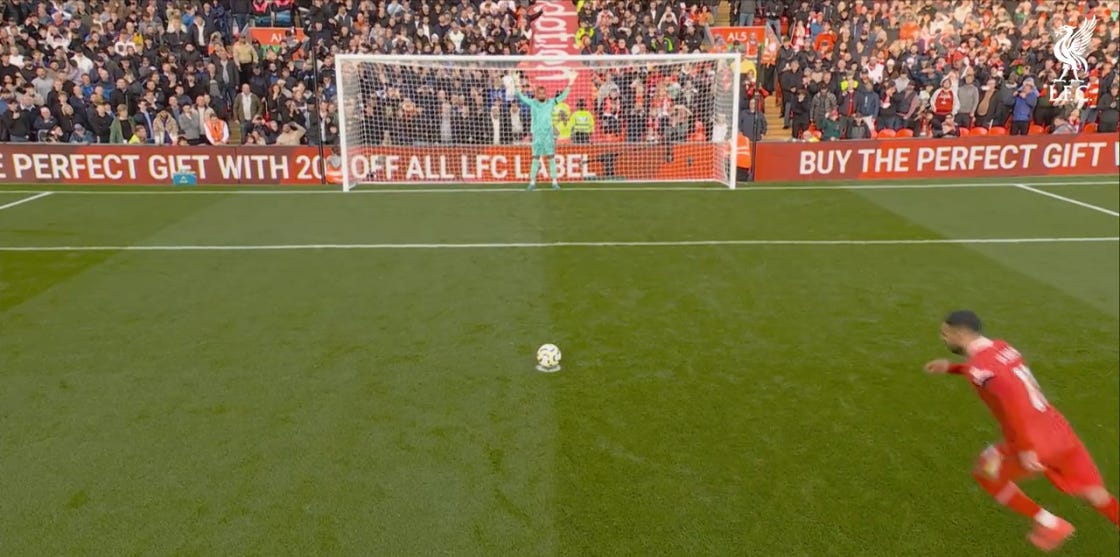
As much as there may be a science to this, a player has to feel comfortable with how they approach the ball. Whatever the angle of their run, the placement of the shot will still take precedent.
Opta divides the goal into six sections for all efforts on target. Over 12(!) years ago, I researched an article for The Tomkins Times on how conversion rates vary for all shots on target depending on whether the shot is low or high, left, centre or right within the goal frame. Here are the findings from 2012, which were based on almost 13,000 shots. With a sample size that big, any changes to the rates in the years since will likely have been minimal.
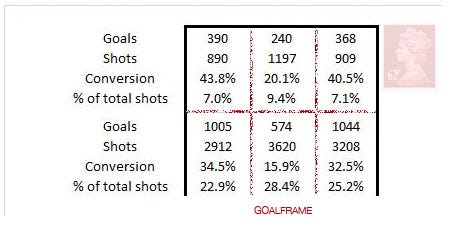
Obviously the conversion rates are far higher for penalties, but the same trend holds for Salah, at least in the lower half of the goal where most of his spot kick shots have gone. He has converted more often when placing left or right rather than down the middle.
Nothing is written in stone. Salah’s penalty in Madrid against Tottenham, the most important of his Liverpool career, was fired into the central low zone. Hit it where the goalkeeper ain’t, ultimately.
As much as having an idea of a goalkeeper’s preferences will help, a player can’t follow that to the letter. Salah’s excellence with penalties is summed up by him not yet putting more than two consecutive attempts into the same sixth of the goal.
Among his 42 Liverpool spot kicks, there have only been six instances of him firing to the same zone for two in a row. He has scored both times in the last five of these pairs too. With so much variation, it’s easier to bluff or double bluff.
It made me wonder what Salah’s penalty placement shot map looks like over time. I suggested on Twitter that someone with skills could make a Whack-a-Mole game of them. That’s beyond me, but using Fotmob I have been able to get a screenshot of every penalty he has taken since the start of 2020/21. Even without details of the games, you can see the variety Salah deploys when viewing them in order.
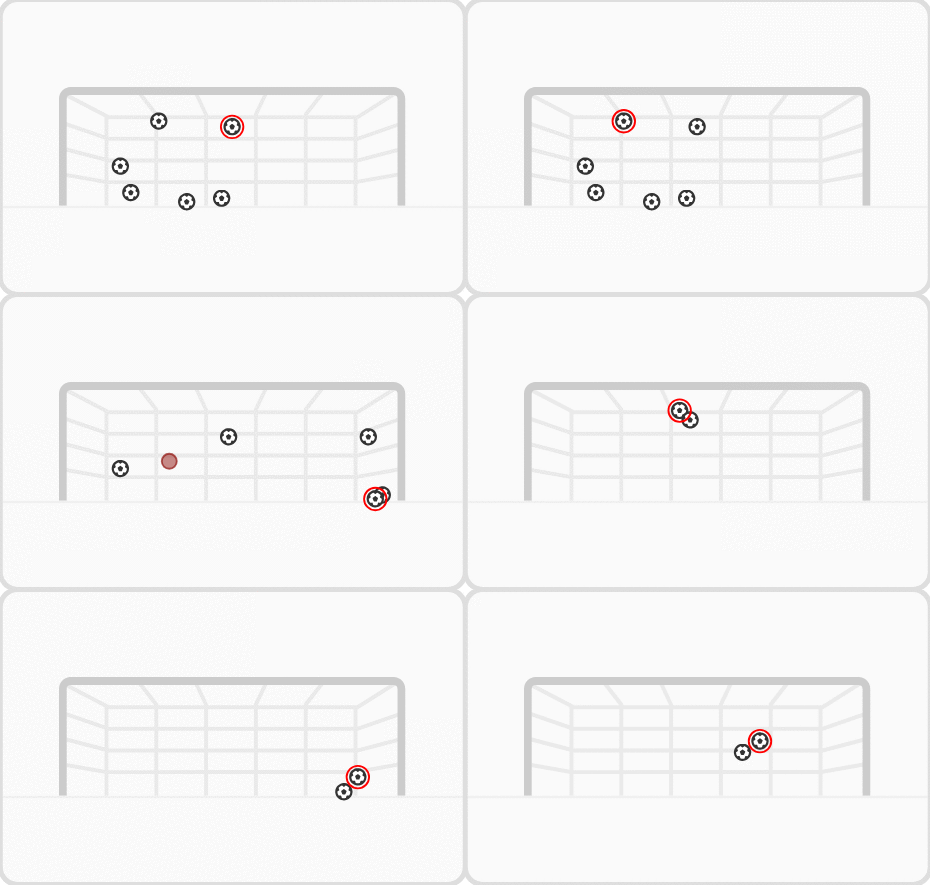
It is likely that all regular penalty takers behave in similar fashion. A lack of variety can only lead to failure eventually. There is only one thing you can say to opposition analysts who have to prepare their goalkeepers to face a Salah spot kick, though: all the best.