
Premier League Penalty Bias
There's an uncomfortable question which needs an answer
I didn’t watch Manchester City’s win over Aston Villa on Sunday afternoon. There was, however, one topic which briefly dominated chatter on social media.

As I write this, I have no idea if Jack Grealish dived or not. For the purposes of this, it doesn’t really matter. The fact City had won a spot kick that was being questioned reminded me of an article I wrote earlier this week, in which I noted Liverpool really don’t win enough penalties in light of how much time they spend in opposition boxes.

The controversy today inspired me to check Mohamed Salah’s figures for penalties won since he joined Liverpool. They make for strange reading. His Premier League ranking for touches in the penalty box by season, starting at 2017/18 and going forwards, are:
1st, 1st, 1st, 1st, 1st and 1st.
Yet his standing in the penalties won chart are:
Joint-13th (with one), 2nd (five), joint-14th (one), joint-fifth (two), joint-fourth (two), joint-32nd (none).
Thanks to his haul from 2018/19 (which he has only equalled in the 3.5 campaigns since), Salah is mid-table for box touches per penalty won if we look at the top 15 players for the first half of that stat across the last six seasons.
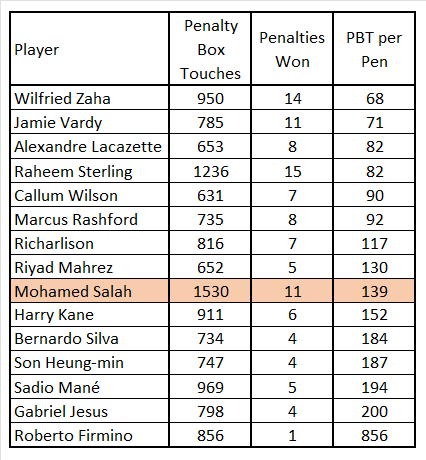
What stands out is how few English players are below him and how many are above though. Since the start of 2017/18, a Premier League penalty has been awarded for every 202 penalty box touches which have occurred; for players listed as English on FBRef, that figure is 183, so advantageous but not wildly so.
But of course, there are a lot of players from all countries who stand very little chance of winning a spot kick. Goalkeepers, for starters, but plenty of others too. How about if we look at the penalty winning rates for players who are deemed forwards (FW) on FBRef? Then what?

The gap between English forwards and the competition widens markedly. Why have they won 78 per cent as many penalties as everyone else from only 47 per cent as many touches? I’m not the first person to ask why they’re receiving preferential treatment but the question remains unanswered.