
Question Time, Episode One
Don't panic, there isn't anyone from Reform here. Just me answering questions on Arsenal, the Ekitike & Isak partnership and the success of Liverpool's academy.
There is an open message thread in the chat section of the newsletter for anyone to submit a question. You can view and add it to here.
One query regarding injuries, rotation and substitutes was answered recently. Now it’s time to tackle a few more questions.

“Have there been any signs of the ‘next’ idea in football yet? Really hoping the Arsenal way doesn’t become the Premier League blueprint for the next few seasons...”
It’s a great time to consider this question. Arsenal lost their last match 2-1 at home to Bournemouth. Bookmakers had given them just shy of a two-in-three likelihood of winning the game beforehand.
And they deserved a victory, at least according to the expected goal data. The Gunners missed four Opta-defined big chances. It can happen.
But three of them were headers, which are hard to convert. The same number came through set piece situations, the goose Mikel Arteta hopes will lay the golden egg of the Premier League title.
His side laid an egg in a different way on Saturday. Arsenal mustered 0.18 expected goals in open play with 52.4 per cent possession in a must-win home match against a mid-table side. Liverpool essentially matched that (0.17) with 26 per cent possession in their widely-panned performance in Paris versus the European champions. Adam Bate noted earlier this week for Sky that it isn’t especially strange for Arsenal to be so blunt in open play:
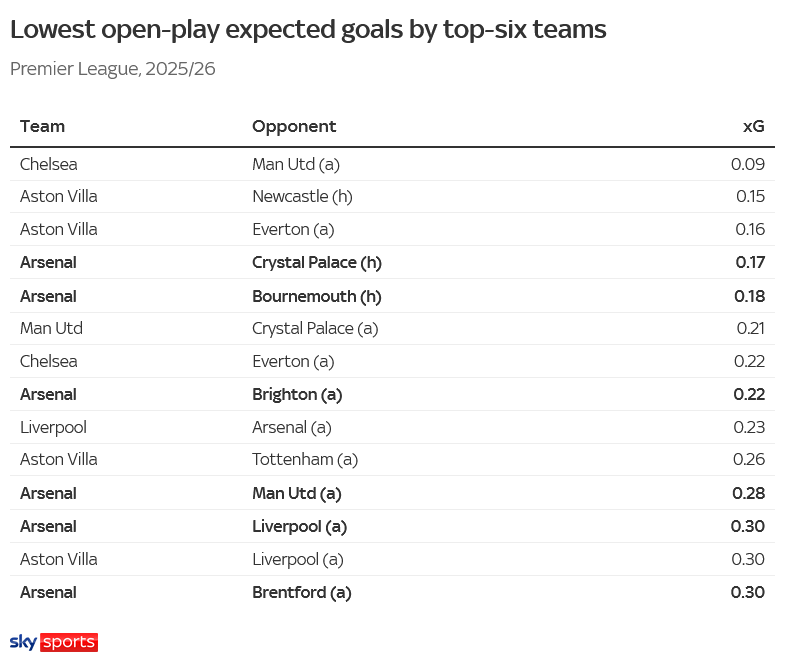
The Gunners need more than a goal per game over the final six matches to equal Liverpool’s record tally of 26 set piece goals, set in 2013/14. Whether they manage that or not, they won’t get 25 more in open play to match Brendan Rodgers’ Reds in that regard.
A team could be the most potent set play side ever seen, they’d still need probably double that amount of goals elsewhere. Even when set pieces are accounting for their highest percentage of Premier League goals since 2010/11, it’s still only roughly a quarter of the total.
This is a long winded way to say I don’t think Arsenal’s strategy will definitively become the Premier League blueprint for years ahead. Even if they win the title, this way of playing is certainly not flawless.
We’ve seen extreme examples of what can happen. Chelsea’s 2-1 defeat at the Emirates saw all three goals come via corner scrums. It was an utterly depressing match between two of England’s Champions League representatives. The 22 starters averaged around £130k per week each in salary; they should be capable of so much more.
I do wonder if high profile sludge-fests like this are carrying a little too much weight when shaping the view of the quality and/or approach in the Premier League at present.
If Arsenal win the title, as still looks likely, their fans won’t care how they played. Nor should they. Equally, Arteta’s methods will be questioned, panned and dismissed if the Gunners finish second for a fourth consecutive season. Even they might have to move beyond dourball before long, especially if the natives become mutinous.
As for what comes next? The leading eight players for open play expected assists in the Premier League include Bruno Fernandes, Rayan Cherki, Enzo Fernandez (who are the top trio), Adam Wharton and Florian Wirtz. It’d be nice to think that creative midfielders/number 10s can thrive. The football would be more watchable, for starters.
“I would love to know from a data-based perspective how Isak & Ekitike would fare in a two-man strikeforce.”
This is an interesting one as Liverpool haven’t played consistently with a front two for what feels like decades. Indeed, that might be accurate; would Gérard Houllier’s pairing of Emile Heskey and Michael Owen be the most recent example?
We haven’t seen much of Alexander Isak and Hugo Ekitike in tandem. They had 45 minutes in Frankfurt, which was rare enough to prompt me to write a whole article on how they dovetailed that night.

That might be a better answer than I can provide here, simply because they haven’t played together very often since then. Only twice have the summer striker signings been on the pitch for more than 13 minutes, both in Champions League away games. It’s hardly a fair weighting for the potential of their partnership.
What can be said is that the goal total during their shared pitch time is 5-1 to the Reds. They’re up 2.9 to 1.2 on expected goals, 21-18 for shots. The team works.
One pertinent statistic stands out a long way. The duo themselves have exchanged just three passes in their 168 minutes together. Unrepresentative fixture difficulty sample be damned, that’s no connection whatsoever.
The Frankfurt match showed how the pair could work, with Isak the spearhead remaining high with Ekitike dropping deep or wide the more often of the two. Whatever the plan, they will still need to link up more often.
We can set them a target of sorts. I found five matches in 2013/14 in which Daniel Sturridge played with Luis Suárez as a front two with one assisting the other for a goal. While the sample is biased towards their more productive games, they exchanged an average of 14.3 passes with 2.3 chances created per 90 minutes.
Ekitike and Isak are at 1.6 and 0.0 respectively. There’s work to be done.
“I watched Barca play in the champions league and was once again amazed how many players come from their academy, La Masia.
I would like to see a comparison of the six seven top clubs in the PL with Barca and Real Madrid how much success they have with their academies and their own homegrown players.”
We’ll have to bow to Transfermarkt’s definition of academy players here, as we’ll be using their data. They “must have played for the youth teams in the past (minimum U17) and must also be in the current squad of the first team.”
The findings raise an interesting question. In measuring the success of your youth program, is it better to provide multiple players of reasonable standard or would you be better served with one superstar?
Liverpool had effectively ticked both boxes for a while. Then Trent Alexander-Arnold left.
The Reds currently have eight academy graduates in their senior squad, the most of any team in the Premier League. However, it would take an injury crisis for the ages before several of them would be chosen to start a game by Arne Slot.
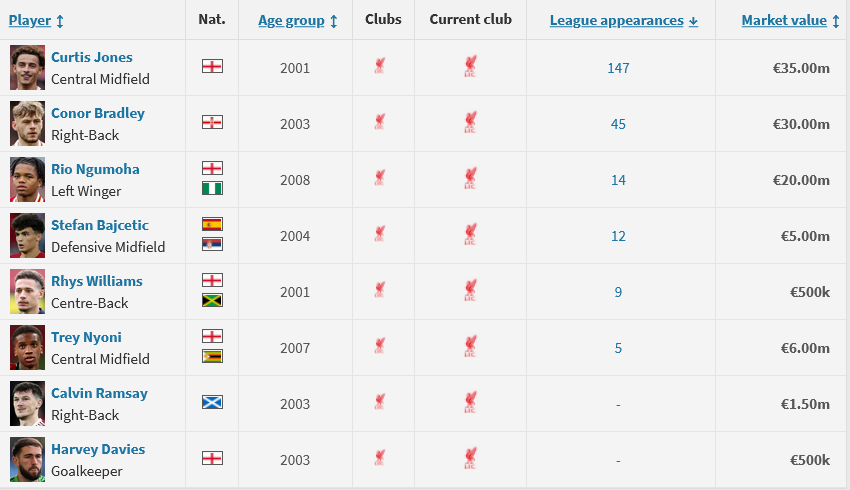
Real Madrid (with nine academy players) and Barcelona (10) are only marginally ahead of Liverpool in volume. Their more significant edge is in how many league appearances these homegrown heroes have made; 52.6 and 71.3 per player respectively.
Madrid exactly match the average across Europe’s big five leagues for this, which is slightly ahead of the Premier League (48.7). Liverpool are below that (28.9) with Curtis Jones accounting for almost two-thirds of the total league appearances by the current crop of youth team graduates.
He is also worth about a third of the Reds’ players’ combined market value, albeit Transfermarkt have yet to catch up with the reality of Rio Ngumoha.
The figures make clear how much difference a superstar can make. If Liverpool still had Trent they’d be in line with Real, while Barcelona would be dragged back closer towards the norm without Lamine Yamal.
How you measure academy success may come down to personal choice; I’d say Liverpool have done reasonably well of late. Let’s meet back here in five years time to see how the figures look once Ngumoha has fulfilled his enormous potential.
Thanks for the questions - add more here if you have any:
https://andrewbeasley.substack.com/publish/chat/post/10a5c183-7bad-41f5-920a-582e73357af8
Not a big fan of the academy as we seem to have spent millions for very little reward, almost like a feeder club and are we including lads signed from other teams ie Rio as academy?