
Stat of the Match: Nottingham Forest 1-1 Liverpool
Did Liverpool gain a point or drop two at Nottingham Forest? Your view of the Premier League title race may shape the answer.
The City Ground hosted the biggest clash of Nottingham Forest and Liverpool for over 40 years on Tuesday night. Both teams may not yet know how to feel about the result.
Based on his side’s performance in the first hour, Arne Slot should be reasonably satisfied that the Reds recovered to earn a point. “I couldn’t have asked for more today,” he said after the game. “I think most people talk about the second half - that they are really positive about the second half. If you ask me, I am also more positive about the second half than the first half.”
With good reason, Arne. Liverpool were not completely blunt in the opening 45 minutes, just wide of the mark. According to the club’s official The Reaction podcast, their nine shots was their most in the first half of a Premier League match without putting one on target for 11 years. It’s safe to assume that occurred in 2014/15, rather than at the end of the season before.
Even though Forest scored in just the eighth minute, Liverpool had already taken four shots. The problem was that they did so in a fashion that suited the home side, with pops at goal taken from areas with little-to-no chance of hitting the net (aside from a reasonable chance for Ryan Gravenberch).
An early dearth of ideas in the final third led to a quartet of efforts collectively valued at 0.11 expected goals. Chris Wood’s chance more than doubled that (0.25) when he opened the scoring. The game was already being played on Forest’s terms, with the Kiwi’s strike then ratcheting that up a notch.
By full time, the visitors had completed more passes in the final third than their hosts did across the whole pitch. For some teams this would’ve been hell; the home side lapped it up, with Murillo setting the season record for clearances in a Premier League game.

While they condensed their best work into the final half hour of the match, the Reds attacked far better here than they had against Forest at Anfield. In that game, five of Liverpool’s six shots in the central ‘danger zone’ of the penalty box had been headers. Granted, their equaliser was nodded into the net, but Diogo Jota had a further two Opta-defined big chances with his left foot in excellent locations. It is rare for so brief a cameo to feature so many high value efforts.
Unfortunately he ran into Matz Sels, the Belgian who is leading the race for the Golden Glove award this season. He has saved 2.2 goals more than expected in 2024/25, per FBRef, with 0.9 occurring in this match. Adding in the reverse fixture shows that Sels has been +1.5 against the Reds, +0.7 versus the rest of the division combined.
Nonetheless, Slot had clearly learned from his previous encounter with the Tricky Trees. He made a subtly different tactical change by the banks of the Trent than he had at Anfield, which helped immeasurably.
We’re not just talking about two substitutes using their first touches to assist and score either, as gratefully received as that (surely unique) outcome was. In the defeat to Forest, the Liverpool head coach made three changes on the hour mark, the most notable of which saw Conor Bradley replace Alexis Mac Allister, with Trent Alexander-Arnold taking over from the Argentine in midfield.
Fifteen minutes later, Curtis Jones came on for Ibrahima Konaté. It left the Reds with a back three of Virgil van Dijk plus two full-backs, which Opta deemed to be a 3-3-3-1 formation. Whatever it was, it stank.
The broad strokes were the same this time around, with Jota replacing Konaté. In the latest Distance Covered podcast, on which I was the guest, Josh Williams pointed out that Slot did this to take advantage of Forest switching from a back four to a five-man defensive line. They regularly do this around 65 minutes into games, so it’s good that the Liverpool boss was prepared for this tactical amendment.
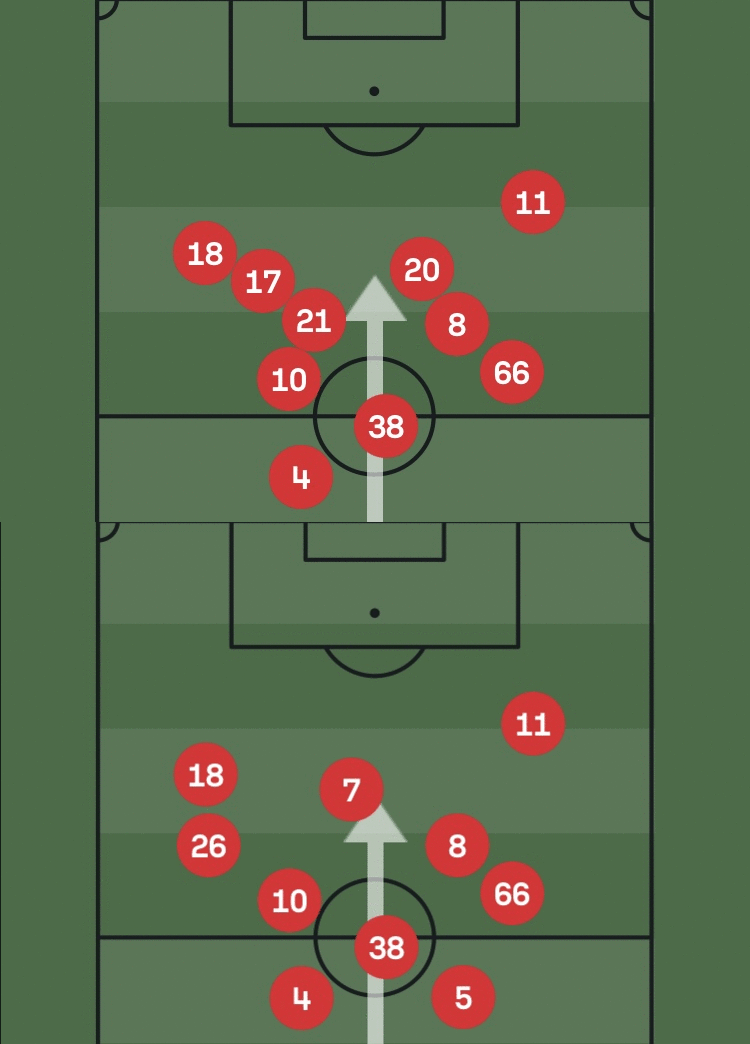
His own switch worked better this time. Gravenberch played the role of centre-back alongside van Dijk but immediately stepped forward into midfield as soon as the Reds had possession, in somewhat similar style as he had when Liverpool went down to 10 against Fulham. It in turn pushed other players up field. The below gif shows that the average positions of the three substitutes (17, 20 and 21) were front and centre, albeit Kostas Tsimikas’ location here is influenced by him taking corners from the right.
From Jota’s entrance to full time, Liverpool amassed 1.45 expected goals, a tally teams only bettered in five of Forest’s 20 complete league matches prior to this one. This season, the average away team in the Premier League has produced 1.38 xG across 90 minutes.
It’s also rare for the Reds to be so potent, so late. In only three matches in league or Europe this season have they mustered more from the 65th minute onwards.
As two of them included penalties, it’s only really the 4-0 win over Bayer Leverkusen which saw Liverpool be more effective going forward for the final 25 minutes plus stoppage time (with 1.58 xG). Even then, that was when 2-0 up at home, not losing on the road. Although the game state meant the Reds had to attack, the same was true against Forest at Anfield, with barely a shot in anger delivered in response.
This was a game against a Nuno Espirito Santo side, it was never going to be easy or free-flowing. The aggregate scoreline from Liverpool’s last four meetings with the Portuguese gaffer is only 3-2, the sort of goal tally they might muster in 20 minutes against Tottenham. Based on the chances a 2-1 win was warrented, though, as was the case in the recent draws with Fulham and Manchester United.

Rival fans and outsiders will look at this match as further evidence of Liverpool potentially falling away, suffering a blip, proving they will be unable to last the course in the title race. The numbers tell a different story. The form is a tale of a team still dominating games as much as they were earlier in the campaign, without having quite the dead-eyed finishing to close out matches as they should.
If this is Liverpool’s roughest patch of 2024/25, it’s a stretch in which they are taking fewer points than they deserve, not picking some up through good fortune. This recent run only strengthens conviction that the Reds will be lifting the Premier League trophy aloft come May.
A powerful finish to a great read—really highlights how strong our base performance is, even in adversity.
That said, we need to turn draws into wins now. Conceding first, especially away, makes things harder. Score first, control the game, and play on our terms.
If Arsenal close the gap further, momentum could shift. The points cushion has helped us stay composed when chasing games—we need to protect that edge.
Thanks for this and suspect Brentford is incoming. I wondered if you are looking at Trent's role and whether Slot's asking him to be more aggressive in passing forward much like Klopp did. I thought at Forest, and even Brentford, he was much more direct than in other games. I might be wrong. I flagged on TTT that maybe Trent reigns it in the first 15-20 minutes allowing the team to settle into a shape because we were caught a few times when Trent lost the ball.