
The Champions League, Premier League Grind
It's harder than ever to navigate the demands of league and Europe, especially with a fiercely strong Premier League. Liverpool picked a bad year to be below par.
English teams had a terrible three days in Europe last week. The media couldn’t believe it. As always, headlines blow this way and that depending on the outcomes. The eternal demand for content makes such rollercoaster analysis an inevitability.
“Champions League - why are Premier League sides dominating?” was a BBC Sport article in late January. They followed it with “The 24 hours that damaged the Premier League’s best-in-the-world reputation” after the first legs of the Champions League Round of 16.
Three English clubs lost by three goals. Liverpool have more of a chance of advancing but struggled to string three passes together. Arsenal needed an 89th penalty to secure a draw while Newcastle may regret not hanging on to their one-goal advantage to take to Barcelona. It was little better in the other European competitions, with Aston Villa the only victors (1-0), Crystal Palace drawing (0-0) and Nottingham Forest losing 1-0 at home.
If the subsequent media catastrophising was inevitable, little seemed to be made of the league results that followed for those clubs in gameweek 30 of the Premier League season. This is not as simple to unpick in the sense that four of them played each other.
Nonetheless, the league leaders needed two goals after the 88th minute to beat Everton (who have been notoriously poor away to big six sides for decades under David Moyes). Across town, Newcastle won 1-0 at Chelsea. None of the other sides who were in European action won, with five involved in draws and Villa losing at Old Trafford.
Just as it can be hard to separate Arne Slot’s shortcomings from the difficulties Liverpool’s players have experienced with form and grief this season, so something of an opposite effect is happening with Michael Carrick at Manchester United.
The Red Devils will play a total of 40 matches this season when the nine Premier League clubs in European competition have all gone past that already with an average of 45.3 games on the board. Whatever improvements Carrick has made at United, freshness of squad is very advantageous at this stage of the campaign.
Especially as the standard of opposition in England has never been as high. The collective Elo rating (which is an “estimation of [team] strength based on past results”) for the 20 clubs has risen above the already lofty vantage point of 2024/25. It’s why the champions this season and last will have had lower points tallies than those to which we had grown accustomed. Competition is too fierce to get into the mid-90s or higher.
As this weekend showed, it’s very hard to win matches in a hugely competitive Premier League following a match in Europe. This is not to excuse Liverpool for their performance against Tottenham, who themselves played away in the Champions League while having a more injury-ravaged squad.
Once you look at the data across the whole campaign, you realise it isn’t just the Reds who have struggled with domestic games after European adventures. Liverpool have had similar issues in previous, far better seasons too.
Tottenham were a weird old bird for the Reds to stumble across on Sunday. Their results have actually improved following their Champions League matches this season, which is absurd given their badly stretched roster. Chelsea have a better points-per-game average after midweek continental clashes too.
An obvious explanation would be the slight differences that occur in the gap between Champions League and league games, as Spurs have the widest margin at 4.1 days. Chelsea’s 3.6 is the narrowest, undermining that idea.
Fixture difficulty obviously plays a part. It can be hard to assess, in that Tottenham are 16th whilst having the sixth highest wage bill (per FBRef). Even with injuries they will field a more highly paid XI than your average relegation-threatened club would.
League position feels the fairest method of weighting teams. This again works as an explanation for Spurs but not Chelsea, as the former has had easier league matches after European games whereas the Blues have had tougher assignments.
These findings at least work as feasible reasonings for the slumps Liverpool and Newcastle have endured when they’ve played Champions League football in midweek.
Perhaps we’re trying to be too complex here. Maybe Chelsea have had better results simply because they’ve had the good fortune to play seven of the nine games at home. Even though it didn’t help them against Newcastle on Saturday you can imagine how it would most of the time. Here’s the full record of Premier League matches that have directly followed Champions League games this season.
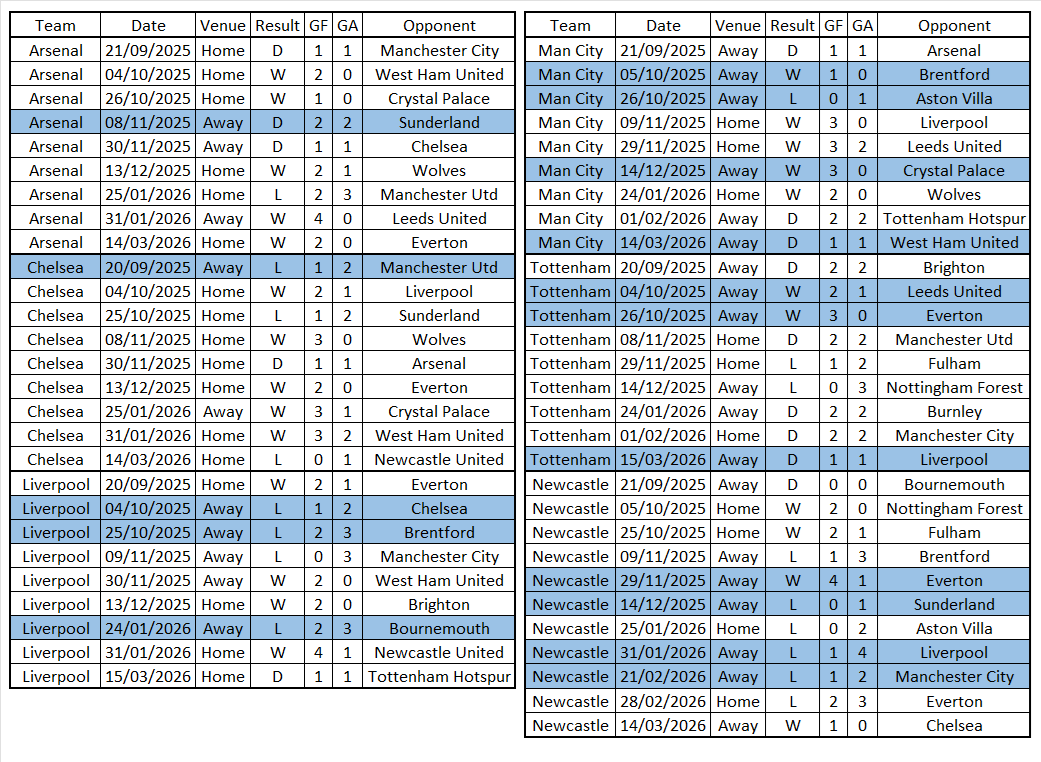
Can you identify the theme connecting the matches marked in blue? These are the toughest combinations that exist: away at the weekend having been away in midweek. Let’s call these nightmare scenarios AA for short.
Liverpool have lost all three of their ‘blue’ league games, not that there has been much success elsewhere. What should be the six best teams in England (or five best and Tottenham) have collectively averaged just 1.13 points-per-game in their AA fixtures. They’re operating at 1.78 for their other league matches that occurred directly after European involvement.
Only five of the 16 league games produced by these sub-optimal fixture scheduling outcomes have been won. Even then, the expected goal data suggests that Newcastle’s 4-1 victory at Everton was the only win in the quintet that was deserved. A three-goal margin from an xG advantage of 0.8 potentially flattered the Magpies that night too.
By contrast, the teams have played 13 home league games after home Champions League matches (HHs), the ideal scenario. The eight wins in these matches include both of Liverpool’s such fixtures, against Everton (2-1) and Newcastle (4-1).
This is where Slot has been a touch unlucky. Not so much against some of his current peers but the Liverpools of the past. Not since 2018/19 has the club had to play three AA fixtures. Back then there were also five HH matches to balance it in their favour though.
The current season is the first since the club returned to the Champions League under Jürgen Klopp in which they have had more AAs than HHs. Despite this, the Reds have seen bigger slumps following European matches than have occurred in 2025/26.
The problem for Slot is that a little fixture list misfortune is just one of many factors that have eaten away at his chances of success this term. A flat performance against Tottenham isn’t the end of the world in isolation, even allowing for them having played in Europe too. The Reds had further to travel, which might have made a difference.
The issue is that confidence was utterly dismantled by losing nine games out of 12 in the autumn. Subsequent matches like the 1-1 draws with Spurs or Burnley can’t be written off as one (or indeed, two) of those days with what went before. The difficulty of balancing Champions League and Premier League demands is an important factor but it cannot justify everything we have seen.
The financial success of the EPL + new EPL club owners who are richer and/or better operators + new MCO models has increased competition ... punchline: clubs 7th thru 15th in the EPL can beat its top 6 clubs on any given match week.
In contrast, it's getting easier for best of Europe's elite outside the EPL. The Big 3 in La Liga, Bayern and PSG can and do rest their best players in more than half of their league matches. The Buli & PSG have 10% fewer league matches, enabling mid-season breaks to re-charge. While Serie A and the Buli are more competitive for top 4, their clubs are poor in the bottom half of the league.
The 10th, 11th & 12th placed EPL sides (Bournemouth, Fulham & Brighton) can compete for the same players as the top clubs in the other leagues except for the 4-5 elite clubs. These clubs can be very successful in UEL & UECL because they are richer & more talented that their continental opponents.
Here's the 10th-12th clubs in the other top 5 leagues ... Athletic Bilbao, Osasuna, Girona, Sassuolo, Udinese, Parma, Augsburg, Hamburg, Borussia Monchengladbach, Brest, Toulouse, Angers. Every EPL club (including promoted sides) would be favorites to beat them. They'd all get relegated if you moved them to the EPL.
Unless the EPL reduces the # teams (not gonna happen) or this mosh pit football starts to turn off viewers and sponsors (forcing rules changes), it's only going to get tougher for EPL clubs in UCL.
Other than COVID which impacted all teams pre-season and the season when the world cup was in the middle of it. Do we have any other comparisons where a team has in essence lost a third of their pre-season and the over arching impacts of that loss?