
The Defensive Work Rate of Liverpool Forwards
Some forwards score and others defend. Has anyone done both consistently for Liverpool? And for what sort of balance is Arne Slot looking?
One of the pieces of advice you often see given to aspiring writers is to read as much as you can and to write as much as you can. While reading can expand your vocabulary and wider view of the world, it can also provide a good source of ideas.
Writing for the EFL site Not The Top 20 this week, Ali Maxwell devised the concept of Total Workload, by combining various defensive metrics (tackles, interceptions, recoveries) with fouls and aerial duels.
“I’ve been increasingly of the opinion that the amount of work that modern-day strikers are asked to do outside of the act of shooting leads to them being physically and mentally fatigued when it comes to the moment of truth,” Maxwell wrote, with this his attempt to explain why Championship strikers are struggling to convert chances this season.
The findings showed no real correlation. Blackburn Rovers’ Yuki Ohashi was the top man in the sample for workload and has scored 1.1 non-penalty goals more than expected from his chances. Elijah Adebayo, the biggest underachiever against xG, was third for workload but there are likely other factors which help explain his wastefulness.
Still, it’s hard not to think there must be a relationship of some kind. If you had to name a Liverpool forward who a) scores loads and b) doesn’t do that much defensively, you’d picture Mohamed Salah. Casting that net further afield brings Kylian Mbappé or Cristiano Ronaldo to mind as fitting this description.
Then there is the inverse; Roberto Firmino was the ultimate work horse, press leader and team player, who frequently sacrificed his own goal tally for the good of the team. Correlation or not, it will be interesting to see how Liverpool players shape up. A comparison with the Feyenoord of Arne Slot will be instructive too, as most of the data available inevitably covers the Jürgen Klopp era.
A change from the Reds’ previous manager to their new head coach which is less obvious than some is the sharp downturn in the amount of aerial duels the team contests. Liverpool have averaged 21.7 per Premier League match in 2024/25, when the lowest in the preceding seven campaigns was 24.7 two years ago.
Battling for the ball in the air is far less of a factor than in the Championship study which inspired this post. It’s rare for a Reds forward to record over five aerial duels per 90 minutes, whereas going over seven isn’t unusual in the second tier. It’s a different world down there.
As we’re assessing a team which doesn’t go in for that sort of thing, we’ll exclude aerial duels. We’ll also factor in possession in simple fashion, using season-wide averages for clubs, rather than trying to figure it out for games in which a player featured. Even stat nerds have a limit.
We are therefore looking at PAD: possession-adjusted defending, which encompasses fouls, interceptions, recoveries and tackles won in the Premier League since 2017/18. It’s far from perfect, as it features the winning and conceding of free-kicks. Watching a few Liverpool games quickly reveals that some players receive favourable treatment from officials.
The starting point for testing any metric is to ask if it passes the eye test. If you created one to measure attacking over the last 20 years, you’d better have Lionel Messi appear at the pinnacle else it’s back to the drawing board.
The Premier League’s top 20 men for PAD since the summer of 2017 certainly looks plausible, albeit it’s almost entirely populated by defensive midfielders. Again, though, if Rodri is top of something like this, it can’t be all wrong.
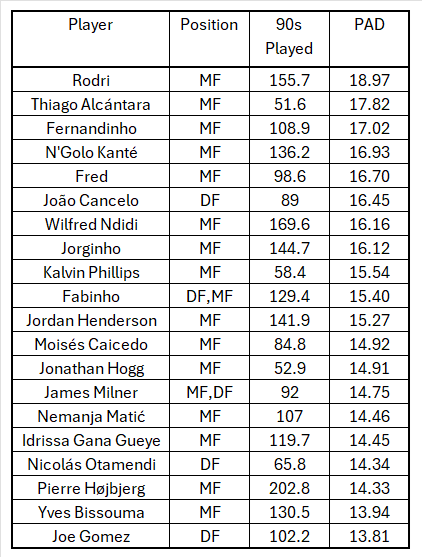
Credit to Joe Gomez for sneaking on to the chart. We’re here to look at forwards, though, and another (ex) Liverpool man highlights the difficulty in doing so. Fabinho played at centre-back in 2020/21, so has been picked up here as a defender and midfielder. Many forwards also get classified as midfielders, particularly if they play in wide areas.
Therefore, the top 20 below is of players who have recorded at least three seasons with FW (forward) listed as their position, even if they have others as ‘FW,MF’ (or whatever) in their sample. The gold and silver medallists had to go to three decimal places to determine a winner, with both happening to be Reds players.
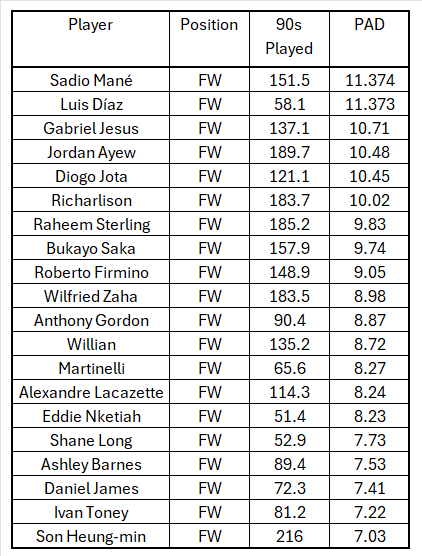
Had this included pressures, you’d have to assume Firmino would be higher, as would ‘pressing monster’ Diogo Jota. Taking out fouls won pushes the Brazilian to the top of this group too. Even so, this basic model illustrates the demands Klopp placed upon his forwards, with their need to defend from the front. Sadio Mané was perhaps underrated in this regard.
For the Liverpool specific rankings, the bar of entry has been lowered to 2,700 minutes, to ensure the current crop feature. The leading current midfielder is Alexis Mac Allister, though unlike the majority of players on the list his figures include time representing a different club too.
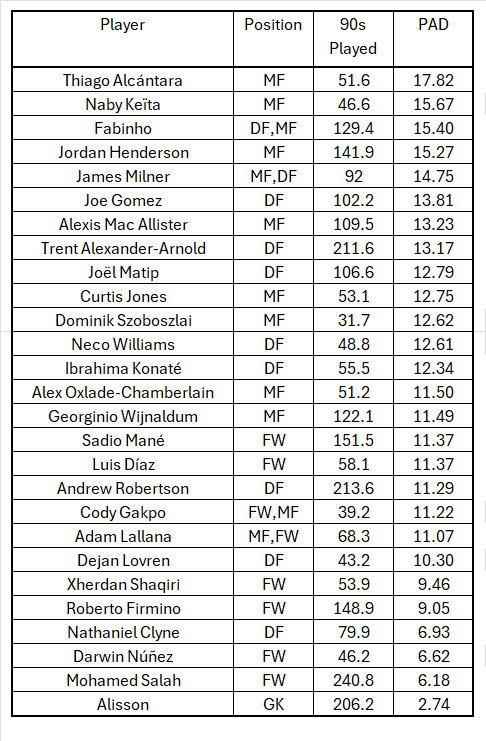
If there is any link to show defensive workload affects finishing, it hasn’t helped Darwin Núñez. Salah, meanwhile, has his best figure for any campaign this season, albeit by the barest of all margins. Even if it later tails off, there has been no collapse in his efforts as yet.
Conversely, both Luis Díaz and Cody Gakpo are recording their lowest figures with the Reds in 2024/25. As they are in strong form in front of goal, a slight dip in PAD isn’t the worst side effect (if a link exists, that is).
Slot’s most consistent forward for this metric was Alireza Jahanbakhsh, who hit 12.4 or better in Arne’s first two seasons with Feyenoord (though he didn’t top 17.3 per 90s either year). The former Brighton man was up 1.3 against his non-penalty xG across those seasons too, albeit he fell under by that margin the following year.
If we set bars of at least 17.3 per 90s with a PAD of 12 or better, we find three qualifying seasons from Liverpool forwards.
Top of the pile is Gakpo last season, with 12.6. He scored eight league goals from nine expected. A bigger shortfall was amassed by Mané in 2020/21, when he scored 3.1 non-penalty goals fewer than his xG while also making 12.4 possession-adjusted defensive contributions per 90. Both worked hard, both scored fewer than they should have.
But the year before, the Senegalese star scored 18 times from 13.2 xG and hit 12.1 on the PAD scale, helping hugely both on and off the ball as Liverpool won the league. If not purely so by goals and assists output, was this the greatest single season by a Reds forward?
It certainly felt like it at times. Slot will hope Díaz or Gakpo can recreate his efforts from the left forward position. Recent history suggests they can.