
The Evolution of Liverpool's Set Pieces: Arne Slot's First Year and Beyond
Jürgen Klopp's Liverpool did one thing with corners, Arne Slot's Reds quite another. A newly appointed analyst may push things further.
Liverpool have hired a new set piece analyst. Lewis Mahoney has left Southampton to work alongside Aaron Briggs, who is now a dedicated set piece coach after completing the role alongside other duties last season. The new duo have much work to do.
The Reds had a strange campaign with dead ball situations in Arne Slot’s first year in charge. They finished the 2024/25 Premier League with 10 set play goals, fewer than in any of the nine Jürgen Klopp seasons. Liverpool averaged 15.4 a year under their former manager, peaking with 20 in 2018/19.
It wasn’t just the goal drop that was unusual. They pivoted from ice cold to red hot as the season reached it’s conclusion. Slot’s men were almost 3.5 goals behind expectation with only seven games to go, then finished broadly at par. The cumulative goals versus expected goals graph highlights the oddness of the campaign.
Expanding this data across all competitions puts them at 15 from 15.4 xG, maintaining the theme. The issue was not of converting chances in the long term, it was of not creating enough in the first place.
By using Understat data we can look back at the underlying set play numbers from before even Klopp came in. Liverpool amassed 11.7 expected goals on their model last season, their fewest since 2017/18. More notably, their xG per shot in these situations (0.09) was last lower under Brendan Rodgers.
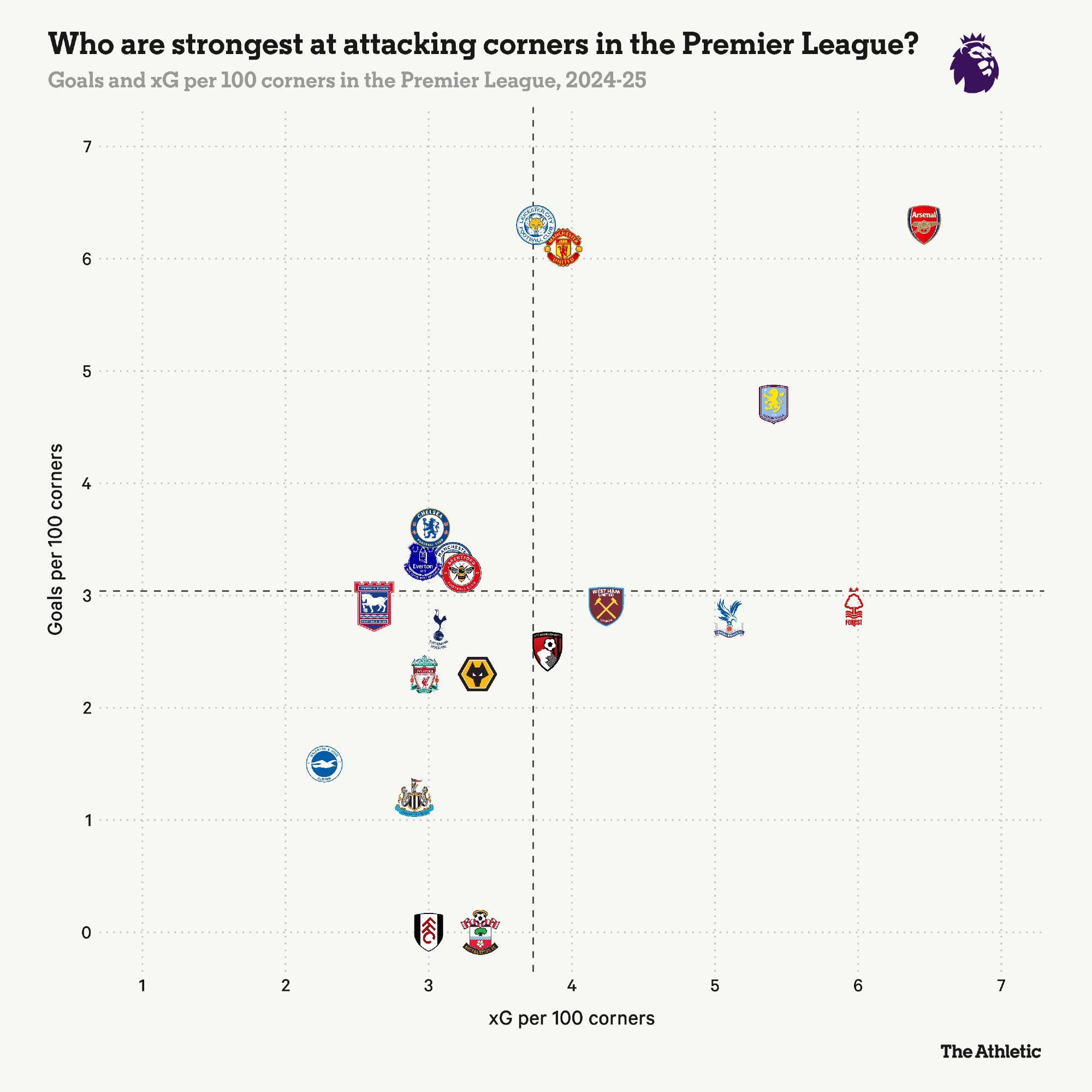
A recent article in The Athletic presented another interesting way to look at the issue: expected goals per 100 corners. With an average of 3.13 last season, the Reds ranked 12th out of the 17 Premier League clubs that remain in the division this term.
Mahoney’s former side Southampton are not one of them, so their figures were not disclosed. However, they were a little ahead of Liverpool on this metric midway through the last campaign (as per the below chart). With better set piece takers aiming for Virgil van Dijk, the former Saints analyst should be able to generate a greater level of dead ball offence.
Southampton scored four goals through non-corner set plays in 2024/25, a total Liverpool only bettered in one of the last six seasons. It’s also as many as the Reds netted in the previous two campaigns combined.
There’s every chance Mahoney doesn’t simply transfer his previous set piece play book to his new side. Opposition analysts will know what to expect. Even so, we can learn from the dead ball offence he built that arguably outperformed Liverpool.
Before we get to that, a theory. Maybe two. Think of it as a Dutch ballad about set plays.
It’s plausible Liverpool took time to get going at converting corners last season because their strategy had inverted. Or in-swung, maybe.
If we disregard straight or short deliveries, 61.6 per cent of Premier League corners are in-swinging. The Reds swam harder against that tide than any other club. There were seven instances of a team dipping below 35 per cent across the final seven years of the Klopp era. His side were responsible for five of them.
Željko Buvač left at the end of 2017/18, then Pep Lijnders returned to the club. It may have been he who instigated a change to favouring out-swinging corners.
The strategy was abandoned following Slot’s appointment. Southampton’s in-swinging rate last season was even higher than Liverpool’s, so maybe it will increase further for the defending Premier League champions in 2025/26. The very early, too-small-a-sample-to-matter numbers suggest it will.
Southampton’s best example of their potency occurred in a defeat at the City Ground. They were 3-1 down as the match entered injury time, having yet to create an Opta-defined big chance.
Mateus Fernandes then delivered two inswinger corners for a pair of golden opportunities. Paul Onuachu converted the first before Jan Bednarek saw his effort cleared off the line. Set plays almost earned a point for a side that collected just 12 all season. Here are the clips.
You will notice the connection was made at the near post in both instances. Liverpool also scored directly from a corner at Forest last season, except that Diogo Jota was in the centre of the six-yard box when he met Kostas Tsimikas’ cross.
Van Dijk was also central (albeit further back) for his West Ham winner. He met a delivery closer to the near post for his goal at Stamford Bridge though.
His shot in west London was nine yards out whereas the two Southampton efforts at the City Ground were from six. It’s hard to find patterns this early into a new season, but it’s interesting that Hugo Ekitike had a near post effort just four yards out against Bournemouth.
It came thanks to an in-swinging corner too. Liverpool only had six set piece delivery-powered efforts from that distance or closer in the main two competitions in 2024/25.
Southampton scored from similar range via a corner against Arsenal, the media-appointed kings of set plays who somehow conceded the third most goals from them last season. This time it was at the back post following what looks a straight (or slightly out-swinging) delivery.
Variety is important, chance maybe more so. Researching the Saints’ set pieces has highlighted how random such things can be. Their seven league goals included a penalty rebound and a throw-in that the opposition’s leading centre-back and goalkeeper failed to clear.
These were both against Liverpool, in case you’ve forgotten.
That leaves three that aren’t included above. The first saw Southampton score in the second phase of a set play at Bournemouth, having generated a shot on target with the initial attempt:
They were later immediately successful with a free-kick delivery on the opposite flank against Fulham (thanks to Jack Stephens’ header). It was near-post contact once again:
Southampton’s other set play goal occurred earlier in the aforementioned defeat to Forest. The move laughed a throaty laugh when asked about the concept of random.
A free-kick on half way was launched to the edge of the box, where Onuachu lost an aerial duel. No matter, the ball fell to Lesley Ugochukwu, who hit a shot destined for closer to the corner flag than the back of the net. Thank goodness, then, for Bednarek, who deflected the wayward shot over Matz Sels into the goal.
All just as Mahoney had planned it, no doubt. Slot has spoken about the importance of having a positive set piece difference in games. While Southampton understandably didn’t achieve this too often, Bednarek’s unusual goal helped them to do so against Nuno Espirito Santo’s side.
Creating high value chances increases the likelihood of outscoring the opposition on set plays. Liverpool’s expected goal average last season was 0.27 xG per game from dead ball situations, with 17 matches of 0.28 or better. Despite far fewer attacking opportunities, Southampton hit that latter mark 13 times.
The 0.86 and 0.79 they posted against Brentford and Leicester respectively topped any match the Reds could offer in response. That’s impressive given the talent imbalance in the two squads.
Understat’s figures had Southampton generating just 0.46 fewer expected goals from set plays than Liverpool last season. Even if we can’t know how many free-kicks were in the sample, they had 100 fewer corners. The appointment of Mahoney could help the Reds close one of the few gaps Arsenal hold over them. At the very least, keep an eye on Ekitike when Liverpool have a corner at Turf Moor.
Swing in or swing out, sister? That is the question.