
The Hole in Liverpool's Corners
Liverpool have started scoring from corners in the Premier League. A post-Briggs shift or random chance?
An uncomfortable truth for those that wish to see Arne Slot sacked by Liverpool is that his side have the best open play expected goal difference in both the Premier League and Champions League. A data-driven organisation is unlikely to dispense with a coach that has delivered that.
Leaving aside the uncontrollable factor that their penalty difference is -2 in the league when it was +7 last season, the real issue in 2025/26 has been with set pieces. The Reds haven’t scored enough while paying a heavy price for the 14 they’ve conceded in the league.
Someone else who paid a toll for this failure was Aaron Briggs. The set play coach was dismissed at the end of last year, with Liverpool’s dead ball goal record improving in the aftermath.
This was highlighted by Sky Sports after a Mohamed Salah corner enabled Virgil van Dijk to score the only goal of the Reds’ win at Sunderland. Their central point was that Liverpool have used in-swinging deliveries far more often in recent weeks.
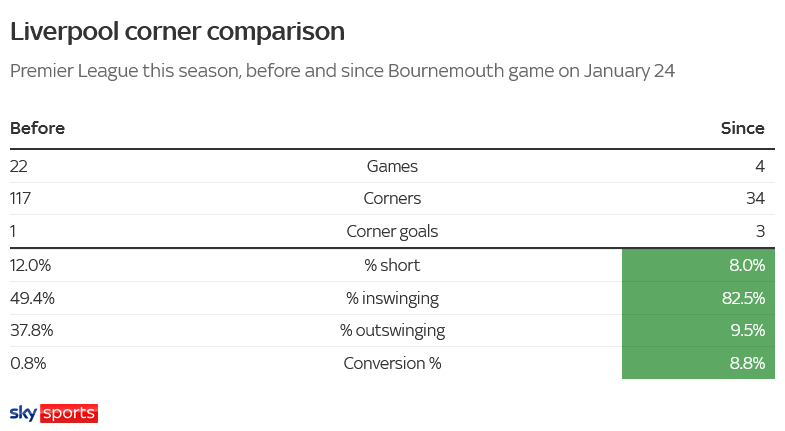
The implication is that this explains the upturn in output. Yet the Reds have been incredibly streaky with their set play goals under Slot.
After scoring nine times via set piece situations in their first 49 matches in all competitions in 2024/25, Liverpool then netted in six games in a row. They recently repeated that in the sextet of matches prior to the FA Cup victory over Brighton, after scoring eight times in the opening 32 matches of this season.
It’s also dangerous to assume that in-swinging corners are automatically better. Just 18.5 per cent of the Reds’ deliveries went that way in 2021/22 when they netted 15 goals from corners, the joint-most of any side in the Premier League in the preceding eight campaigns.
The demise of FBRef’s detailed data makes their recent improvement harder to analyse. We can still dig around in Liverpool’s corner numbers on Understat. Briggs will be interested to see if the uptick in goals has been reflected in the underlying statistics.
He should be more concerned with the Reds’ horrendous looking numbers on his watch. Not that we should be too critical of Briggs when he was essentially handed the role by default of being there, promoted above his station. The kindest thing we can say about his efforts at the opportunity is that he took a swing and missed.
Never mind making contact with the ball, was Briggs even holding a bat? Only four teams have generated fewer expected goals via corners in the 2025/26 Premier League, three of whom are in the bottom four in the table. Liverpool scoring fewer than expected from the chances produced is academic when the process has been this ineffectual.
Arsenal’s attacking with corners is absurd. As much as they appear to be an implausible outlier, they’ve only improved by 0.04 xG per game on last season. They have been this good for a very long time. Doubling the Reds’ figure would put them second in the Premier League but it wouldn’t get them close to the Gunners.
The xG data is not made better for Liverpool by factoring in the number of corners that each team has had. They have inevitably had more than most. That is reflected in this chart which shows expected goal average per 10 corners at each end of the field. Arsenal break the axis once again.
This shows the twin daggers that did for Briggs (as discussed in the previous article on him). He was unable to craft an efficient attacking system while being hideously undermined by performance against xG at the back. Combining the two data points shows the Reds’ matches have the lowest expected goal per 10 corners average in the division. That seems absurd given how many goals there have been.
We must still determine if anything of note has changed. A chart in the Sky article shows that Liverpool have been aiming a higher proportion of their corners towards the centre of the six yard box in their last four matches. That appears to be a decisive shift.
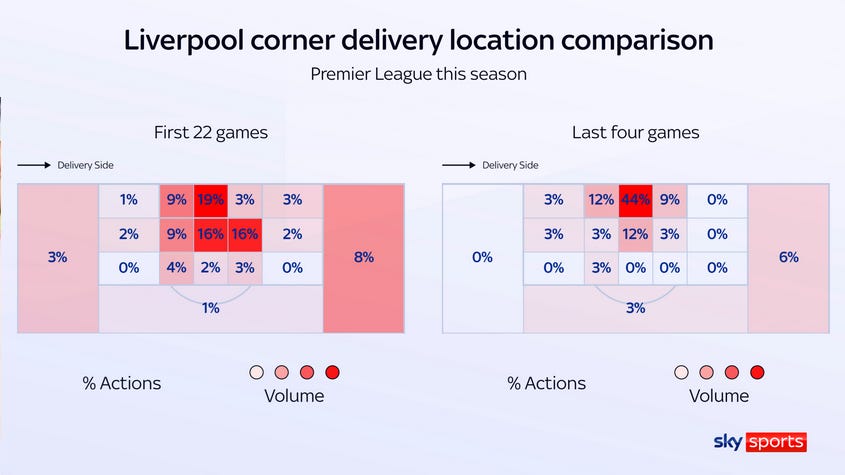
Has this had any real impact though? After all, the first of the three corner goals scored in the recent period came off Virgil van Dijk’s shoulder when he was in the left of Bournemouth’s six yard box.
This was followed by the hugely emotional Ibrahima Konaté goal against Newcastle. The delivery that led to it was at least into the centre of the box. However, had Nick Pope held onto the ball rather than dropping it after running into his own players, there would have been no way for Liverpool to score.
Only the Sunderland goal meets the criteria of a Reds player making contact with the ball in the centre of the six-yard box to score. Even then, had Habib Diarra (number 19) remained by the goalpost instead of stepping away, he may have cleared van Dijk’s shot.
In one sense this doesn’t matter. Football is always random. The last two goals highlight why José Mourinho believes so firmly in the notion that “the game is won by the team who commits fewer errors”. From their defensive point of view, the goals against the north-east clubs were undoubtedly avoidable.
But scoring a couple of goals with a degree of good fortune certainly matters if we are taking them as evidence that Liverpool’s broken set piece attack is now fixed. Arsenal can afford to score at below their xG on corners thanks to how much they create. The Reds cannot be so carefree. That’s truer than ever now their corners have become less threatening since Briggs left.
Yep. You read that correctly.
Liverpool have gone from producing a shot every 2.6 corners in their first 18 league matches to a 3.9 average in the last eight. This helps explain why their xG per 10 corners has dropped by 0.06 to 0.31. The latter is worse than the Reds averaged in six of the previous seven seasons.
Their expected goals per match average has increased, from 0.19 to 0.23, largely because their corner rate has risen by 2.3 per match. The recent goals have been welcome, it’s just important to thank the elements of luck that led to them rather than an improved process. Briggs’ bad luck seems to have no end this season.
Sorry to burst the set piece optimism balloon, everyone!!
There is a major overall improvement in the second half of the season to date.
First 20 games F 32 A 34
Last 19 games F 41 A 15
Can you pinpoint that?
Started when Salah was dropped, but has continued in his revised role.