
The Liverpool Back Four That Made The Best Defensive Wall This Season
Which combination of defenders had the best xG conceded average for the Reds in 2024/25? Their best individual for this stat will surprise you.
It’s hard to quantify an individual player’s contribution to their team’s results. If they score more goals and provide more assists than anybody else in their league, maybe. But for everyone else?
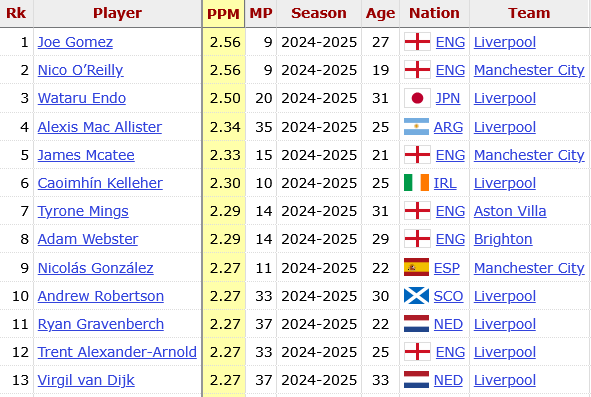
FBRef carries data on the points-per-match players earn from the games in which they featured. Setting the bar at a minimum of nine appearances in the 2024/25 Premier League sees Joe Gomez joint-top.
Wataru Endō leads the way once we hit double figures, then Alexis Mac Allister is king once we pass 20 matches. As interesting as the numbers are, it’s clear which of this trio was most integral to Liverpool becoming kings of England.
We could also look at how a team’s goal difference (expected or actual) compares when someone is on the field with when they are not. Almost everyone with the best figures plays nearly every match though.
Virgil van Dijk was rested for one game this season, which Liverpool lost 3-2 at Brighton after drawing on xG. As a result, the data for 2024/25 says he improves the Reds’ goal difference by 2.2 for every 90 minutes he plays. As phenomenal as he is, that simply isn’t true.
A better use of this data is to look at the underlying statistics for the relevant end at which a player does their work. You’d expect the best attacking players to help their side generate expected goals, just as it seems logical that the best defenders would prevent them at the back.
Here are the top 10 defenders in the Premier League this season for lowest xG conceded per 90 minutes on the field. The bar for entry is set at 1,710 minutes (half a full season).
Calling this article ‘Here’s why Trent Alexander-Arnold is Liverpool’s best defender’ would’ve seen hate-clicks roll in en masse. Even so, he was at least 0.11 better than the three other members of what most people would call the Reds’ best back four combination.
How much of this was directly down to the departing #66 is debatable, of course, but you wouldn’t have anticipated these findings, would you? It makes more sense to look at the backline as a unit to get a better grip on defensive performance, as inspired by this message:
The sample sizes vary hugely, so the findings can’t possibly be definitive. Nonetheless, the back four of Alexander-Arnold, Ibrahima Konaté, van Dijk and Andy Robertson was not Liverpool’s most effective this season.
It’s not possible to measure this as accurately as with the individual data which FBRef provides. The numbers which follow do not account for substitutions made during games. Not even I have the will to try to pick all those statistics apart, it’s too complex a task.
Defending isn’t solely about the back line either; as we saw in a recent article, few players can match the pressing intensity of Dominik Szoboszlai. His presence will have helped those men stationed behind him.
With those provisos in place, let’s look at the starting back fours Arne Slot deployed across his side’s 56 matches this season. Only four of the 18 combinations used began more than two matches in all competitions.
These figures are fascinating. The signing of Jeremie Frimpong and a new left-back notwithstanding, what might be Liverpool’s back four next season had the worst record of the four options.
However, their sample includes two post-title dead rubbers, with two of the four spot kicks the Reds conceded baked in too. Their non-penalty xG allowed in four matches which mattered was below 0.5 per game, with each man playing at least 87 minutes in three of those fixtures. Context is everything with this data.
The other notable discovery is that three-quarters of the preferred back line performed better with Kostas Tsimikas than they did with Robertson. The team allowed 0.89 xG per 90 when the Greek played in league and Europe this term, a decent margin better than the first choice left-back’s 1.06 average. Frimpong, at 1.04, was in this region in the 2024/25 Bundesliga too.
The group including Tsimikas played eight matches including Champions League games with Milan, Leipzig and Leverkusen, plus tricky trips to Selhurst Park and Brentford. All four players featured for at least 65 minutes in every game, 73 in all except one.
Remember too that the away tussle with Crystal Palace saw Vítězslav Jaroš replace Alisson Becker in the second half. Factoring in the identity of the goalkeeper matters when it’s the world’s number one versus more mortal options, even if it dilutes the samples further.
The best back four from our previous chart perhaps inevitably performed better with Alisson rather than Caoimhín Kelleher between the sticks, as did the quartet we’d label as the first choice group. Some of these players will be stationed in front of Giorgi Mamardashvili at points next season; there’ll be an article on his 2024/25 campaign following later this week.
The leading quintet on the above chart is the only one that recorded below 0.8 expected goals conceded per start. This is a pertinent benchmark as Arsenal allowed 0.78 across 17 league matches starting with Jurriën Timber, William Saliba, Gabriel Magalhães and one of either Riccardo Calafiori or Myles Lewis-Skelly. While the Reds were the better team this season, the Gunners had the stronger defence, so there is a target at which to aim next season.
The outcome of replacing Alexander-Arnold in the Liverpool back five with Frimpong promises to be fascinating, especially if a new left-back also joins as looks likely. Maybe Tsimikas should not be written off too quickly.
Surprised? Tsimikas in?!