
The Liverpool Puzzle
There are a few pieces missing that are not yet in the box. How have the rest fitted together this season?
Liverpool maintained a very settled line-up last season, with 10 of their players starting at least 28 of their league games. The only club with more such men in the preceding nine seasons was the Leicester City side of 2015/16. Magical things can happen when you keep your best players on the pitch.
It’s impossible to do this without keeping everyone fit. Milos Kerkez is the only one of the Reds’ signings from last summer who has yet to suffer an injury this season. The Reds also bade farewell to Trent Alexander-Arnold and Luis Díaz, two of the 28+ club in 2024/25. It has been impossible to keep the starting XI stable.
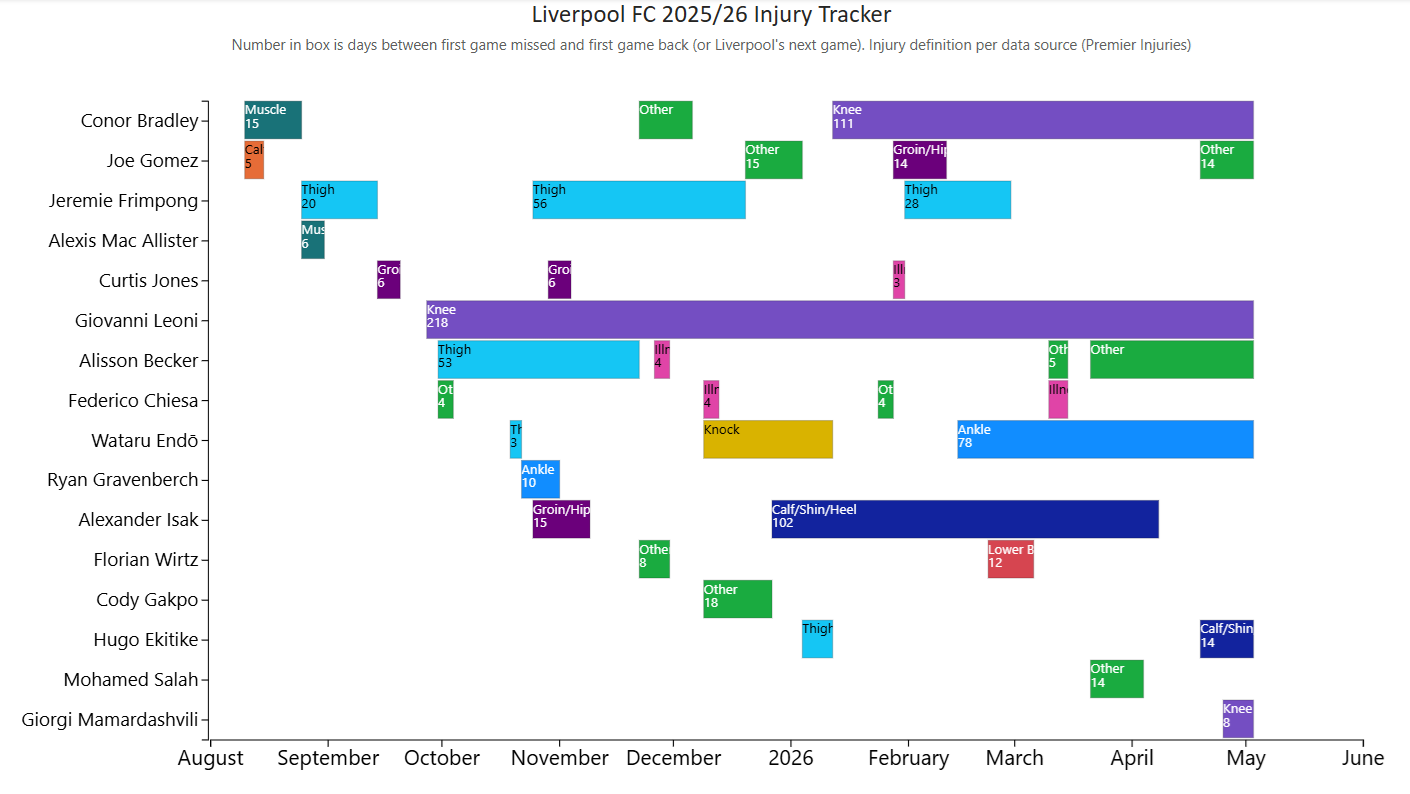
Except that it has been, more or less. As noted on here recently, Arne Slot is only making marginally more adjustments to his Premier League starting XI from one game to the next than he did before the title was won last season. The equivalent of 28 starts in a 38-game season is 24 after 33 matches; the Reds have nine players at that mark.
The devil is in the detail, as he so often is. Seven of the eight players Liverpool reportedly paid at least £150k per week in Slot’s debut campaign made 28+ league starts, with Federico Chiesa the exception.
With 24 our current benchmark for starts this term, we find six players in that financial bracket that have appeared often enough. One difference is that there are 11 eligible squad members in 2025/26.
The other is that only three of the seven men on over £150k have more than 23 league starts on their ledger. Mohamed Salah, Hugo Ekitike (who have both made 21) and Alexander Isak (seven) won’t make the season-long target of 28. The Egyptian King will make his fewest league starts for any club since he warmed the Chelsea bench for the first half of 2014/15.
The prompt for checking these figures was the latest episode of the Distance Covered podcast. Guest Mo Stewart highlighted how little Rio Ngumoha has played with the club’s principal centre forwards. “Before the Ekitike injury, I think 32% of Rio’s minutes this season have been with either Ekitike or Isak, which is not enough,” he said.
Too right. Ngumoha has spent more time on the pitch for Liverpool with Tyler Morton than Isak, Wataru Endō over Ekitike, Joe Gomez rather than Salah. His left-back split has been roughly 75/25 between Andy Robertson and Kerkez; useful for his development, less beneficial as we contemplate life without the Scot.
Another pertinent fact is that Ekitike, Jeremie Frimpong, Isak, Kerkez and Florian Wirtz have yet to grace a Premier League pitch together. Maybe performance this season would have been stronger if they had. We might have a better idea regarding the direction of travel for the next iteration of Liverpool at the very least.
As that has not been possible, it’s worth reviewing how the Liverpool jigsaw has slotted together this term. Even a simple look at the points won when certain pairs of players have both started is insightful.
This chart shows which games each player has started in all competitions, sorted from most to fewest. Generating an interactive version sadly lies beyond my skill level so it’s worth opening the image in a new tab (here) to get a better look.
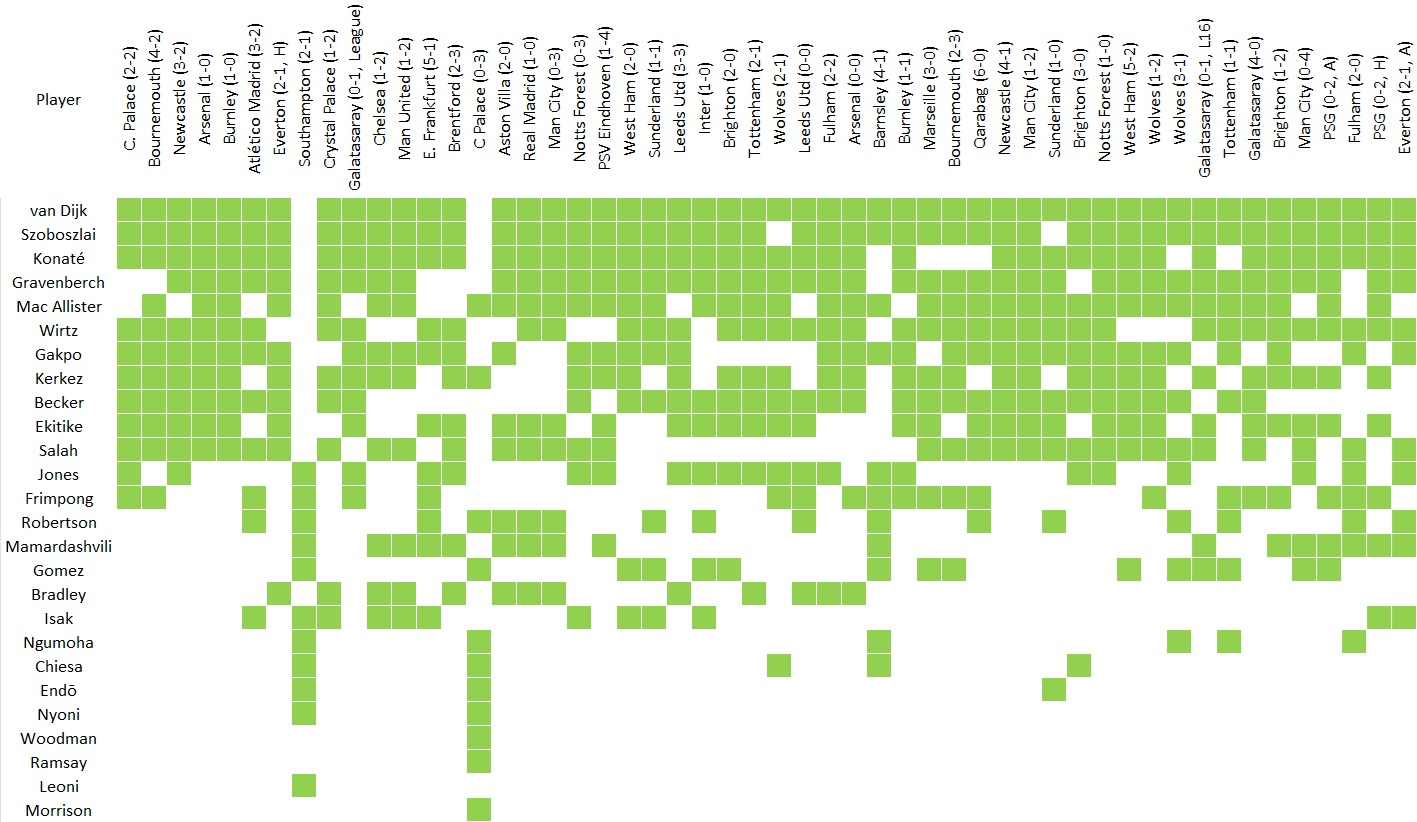
The early rounds of domestic cups grant inclusion for several players who would otherwise be omitted (though perhaps not Freddie Woodman after the forthcoming match with Crystal Palace). Here’s the league-only version, with the separate tab image here.
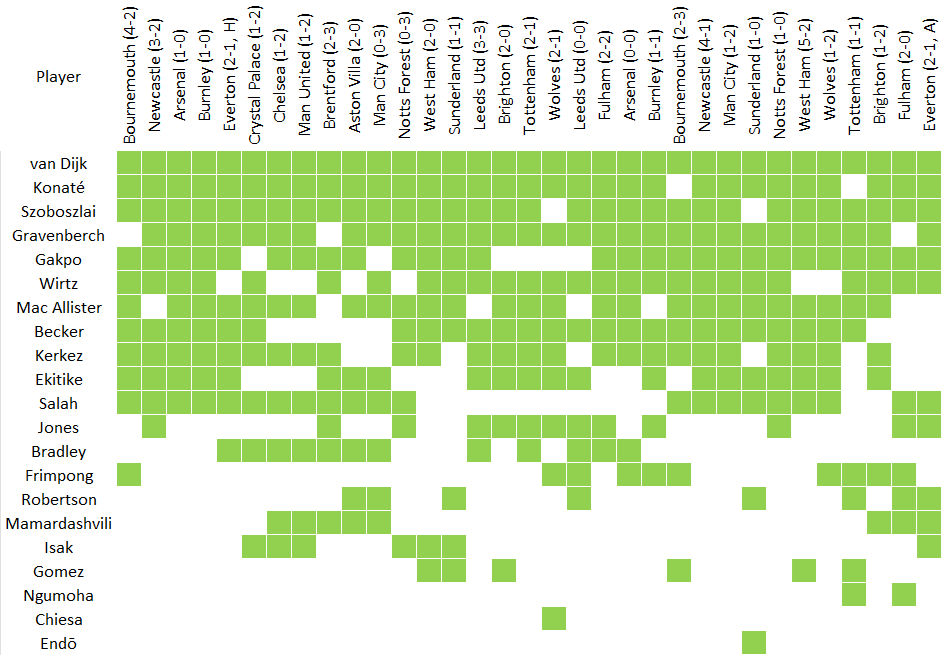
This again broadly reiterates the earlier point about rotation. Most of the players you would’ve expected to have seen starting most weeks when the season began have largely done so.
Isak is the most obvious exception. Or is it Salah? As six of the matches he missed were thanks to participating in the Cup of Nations, his row wouldn’t have looked wildly different even if he’d enjoyed another campaign from the gods. Maybe he’d have spent longer in Morocco had that been the case anyway, dragging Egypt to the title (before the hosts took it back on a technicality of some kind).
Most fans might have predicted some of Kerkez’s green squares to be in Robertson’s row. At least the two players have aligned to ensure a career left-back has always started in that position; you can see many matches without any of Conor Bradley, Frimpong or Gomez. That in turn weakened the midfield, even if it kept likely starters like Curtis Jones or Dominik Szoboszlai in the XI.
FBRef has long provided points-per-match averages for games in which players appeared. If we apply this to league starts only (and ignore small samples) then it could be argued Ekitike has been the Reds most important player. Not great news for the remaining five matches but a badge honour for the Frenchman.
Liverpool have won 2.00 points-per-game when Ekitike has started. Jones is next - maybe start him more, Arne? - on 1.92, with Alisson Becker (1.84), Wirtz (1.77) and Ibrahima Konaté (1.74) filling out the top five. As the team averages 1.67, you don’t have drop much lower to start finding below-par players.
Let’s assemble our jigsaw. There are 55 pairs of players who have started at least 14 times together in the league. This shows how many points-per-game the Reds averaged in those matches.
Two things stand out. If you start your strongest goalkeeper and most effective centre-forward, you’ll probably be alright; who knew? At the bottom of the chart, it’s eye-catching that Cody Gakpo and Kerkez have generated the fewest points on average when they seem to have little relationship on the left flank.
We’ve got some cornerstone pairings. Let’s add a third player to their respective puzzle and focus on those that have averaged two-points-per-game. While the sample sizes shrink, we can see which trios have performed at the level to which the Reds aspire.
Mac Allister’s presence in the top threesome seems odd in light of his struggles. But then this is a measure of results, not performance, plus the outcome of a match never rests with any three players either. This is just a glimpse.
As Virgil has started every game, adding him to a pair makes no difference to their points-per-game. Underneath his marker with Becker and Ekitike sit that pair with Konaté. We can therefore say that Liverpool have started (effectively) half of their games with their first choices at goalkeeper, centre-back and striker, going at 87-point pace when they have done so.
We could keep adding players with the aim of finding the optimum line up at the cost of rapidly diminishing sample sizes. The Reds’ most recent Champions League-winning XI didn’t play a single other match together, to prove as much.


The more important point is that there are groups of players with whom Liverpool have performed at title-challenging level this season, just not often enough. Retaining these pieces while adding the missing ones this summer should solve the Reds’ squad profile puzzle.
Fascinating analysis!
I'd be hesitant to draw conclusions on these pairs and trios without some sort of correction for strength of opponent. Some of the differences might be due to lineup changes in matches where the manager feels like he can still get a result without playing his strongest team, or the strength of opponent for matches in which a player is suspended (Szoboszlai's numbers prompted that thought). It would be interesting to see each grouping's PPG plotted against expected points (as a +/- value) in the relevant matches, if there is a trustworthy model for expected points.