
The Match, The Stat: Crystal Palace 2-1 Liverpool
This game saw more big chances than ever before. Some chances are bigger than others though.
Crystal Palace have equalled the longest unbeaten run in their history. All they had to do to achieve that was end Liverpool’s perfect start to 2025/26. For two theoretically immovable objects, it was far easier for the Eagles than it should have been.
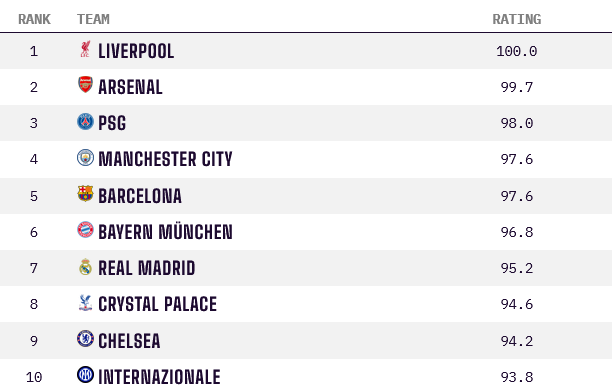
Not that we should underestimate just how good Oliver Glasner’s side are. Palace sit eighth in Opta’s team ranking of clubs in world football. The next match up the difficulty ladder from a trip to Selhurst Park is going to the Santiago Bernabéu Stadium; would you expect the Reds to win there?
Some have called it Liverpool’s worst performance under Arne Slot. Due to the chances they created, that seems a stretch. Only once has the away team mustered a higher non-penalty goals tally at Selhurst Park in the Glasner era. To do that when behind from Palace’s first shot through to the Reds’ final goal attempt isn’t nothing. If there is a shred of positivity to be taken here, it is this.
Nonetheless, the opening 45 minutes might have been the worst half of the head coach’s reign. Opta’s Michael Reid has written that the Eagles’ xG tally of 2.07 before the break is the second highest on record (since 2012) in the first half of a Liverpool league game. Slot’s experiment with starting Florian Wirtz on the left - "to overload the midfield” in his words - did not pay off.
With Palace potent at first then Liverpool roaring back in the second half, the shot count headed off the scale. This was the first of the 2,720 Premier League games since the summer of 2018 in which both sides had at least six Opta-defined big chances. Having only conceded one across a four match spell against Arsenal, Burnley, Atlético Madrid and Everton, it was a spectacular defensive collapse from the Reds.
While Palace edged the big chance count, they only did so by one. Some chances are bigger than others, though, as we shall see. The frustration for Slot will be that many of the home side’s best moments did not requite incisive play, just Liverpool mistakes. There’s only one place to start: Ibrahima Konaté.
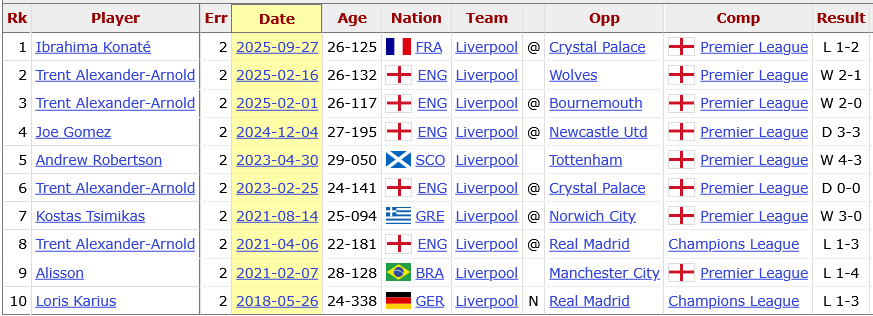
If you knew nothing about him as a player, you would think he could handle a physical battle. That does not seem to be the case. Konaté made two Opta-defined defensive errors leading to shots, recording just the 10th instance of a Liverpool player plumbing this statistical depth in league or Europe since 2017. It’s a list that should perhaps give Real Madrid pause for thought.
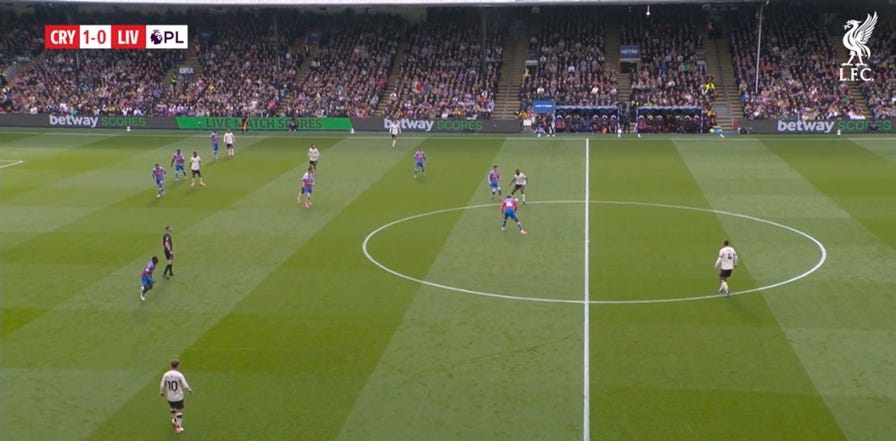
The Reds were already behind before Konaté erred, with Palace opening the scoring through the first of their seven clear-cut chances. The Frenchman was then culpable for the next two, starting with one in which he dribbled himself into trouble under relatively little pressure:
Where is the overloaded midfield Slot was aiming for? The next big chance was arguably worse in that Palace played through the centre of the pitch with relative ease. Konaté lost a duel with Jean-Philippe Mateta, giving him a free run at the wall that was Alisson Becker.
Things then calmed down for about 20 minutes. However, Liverpool’s composure or ability to win battles didn’t really grow back. Shortly before half time, Adam Wharton beat Dominik Szoboszlai in the air to a ball Ryan Gravenberch had cleared only as far as just outside the Reds’ box.
I once wrote an article for Opta Analyst on the hidden value of chances created via headers. I doubt anyone has researched them more. Yet even I didn’t think it possible to set up a big chance with a headed pass when roughly 25 to 30 yards out. I was not familiar with your game, Adam. We’re now into first half stoppage time with a big chance score of 4-0 to Palace.
It was at this point the direction changed, with Liverpool recording five of the next six ‘should score’ opportunities. Whether several of them should have been converted is questionable.
The first came shortly before half time. Mohamed Salah attempted to lob Dean Henderson following a long pass into the penalty area by Konaté; he wasn’t all bad. Can a chance valued at just 0.08 xG be deemed to be big? Apparently it can.
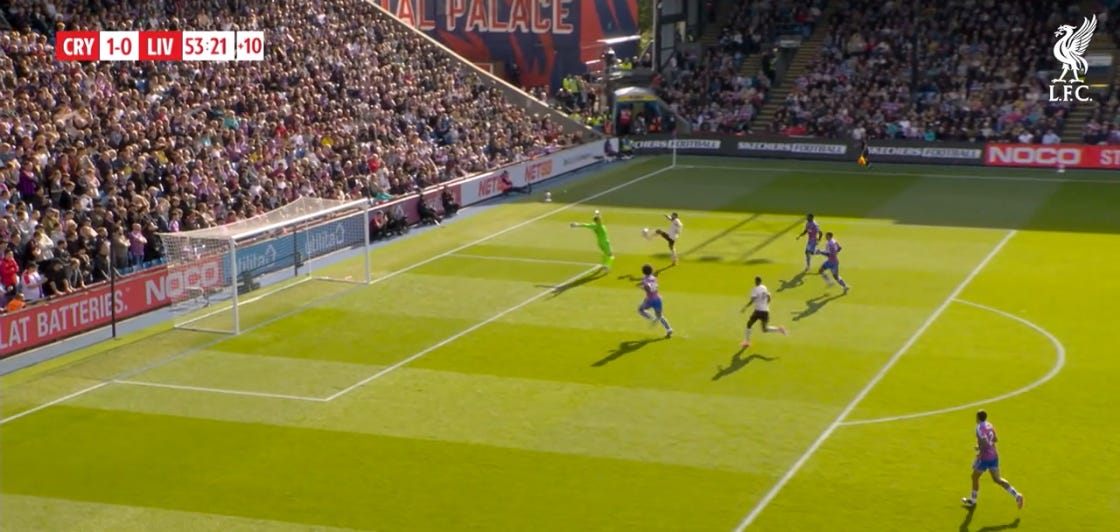
The next one was huge. Large, even. Wirtz was presented with Liverpool’s highest value chance of the contest thanks to a left-footed cross from right-back Szoboszlai. Is it possible to clone him so he can play in that position and midfield? The boffins at the AXA need to get onto that.
Even with it being the Reds’ best opportunity, the value was 0.37 xG and therefore below the average for a big chance (0.39). The Wirtz shot was followed by two for Alexander Isak (0.11, 0.30) then one for Salah (0.27). The latter wasn’t a chance so much as a deflection on a goal-bound Szoboszlai effort.
The Swede’s big chances fell either side of one for Mateta. Even though the Palace forward was offside, the Liverpool backline was once again taken out by a headed pass, this time by Yéremy Pino. Mateta also created a big chance for Eddie Nketiah in the 79th minute, crossing from the left flank to tee up the former Arsenal man for a free header.
And then came Fede time.
Federico Chiesa can do little more to impress Slot then contribute when given an opportunity to play. His Selhurst Park goal, which converted the Reds’ final big chance, was reminiscent of his decisive strike against Bournemouth.
When a cross wasn’t cleared, he pounced. Bam, 1-1. Interestingly, it occurred thanks to Palace’s third defensive error (per Opta) of the game. The Eagles collectively outdid Konaté, albeit he coughed up two clear-cut chances from his blunders to their one from three.
It would be nice if the review of the match ended here, wouldn’t it? Sorry, folks.
Liverpool went behind to Southampton at Anfield in March following a long throw. Another cost them a goal against Newcastle last month. At Selhurst Park, a hard point evaporated thanks to one.
As the ball came into the box, Szoboszlai, Virgil van Dijk and two Palace players went for it. The Hungarian got the touch without clearing it far. At this point, Will Hughes challenges Rio Ngumoha in the air; if not a ‘Dan Burn versus Alexis Mac Allister’ level of a mismatch, it’s no surprise who won.
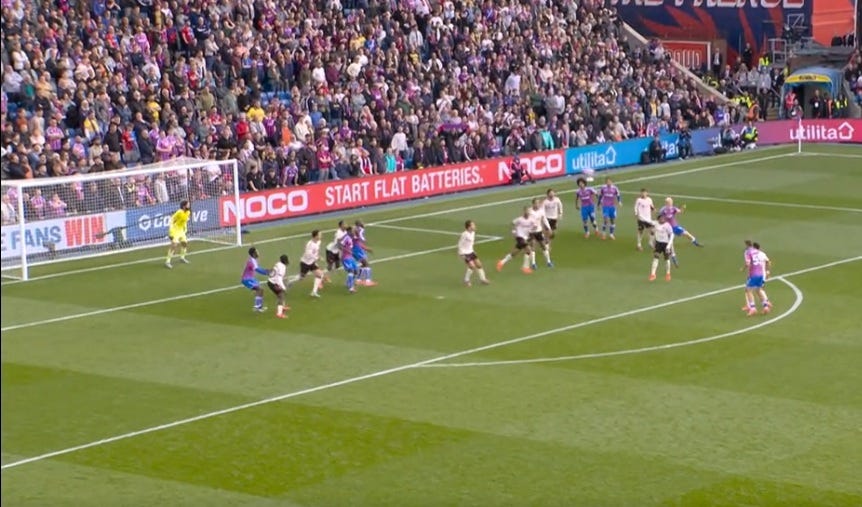
Liverpool look okay at the point Hughes heads the ball (above). There’s a two against two situation in the middle, with Jeremie Frimpong alongside Nketiah to the left. But Frimpong then goes towards the ball, which is madness given his height compared with the crowd he’s approaching. What can he achieve, other than to leave Nketiah in space? Marc Guéhi won an aerial duel, at which point my irony meter blew up.
The explosion didn’t even have the good grace to hamper my vision as the ball fell to Nketiah who thumped it home. Palace won two aerial duels in the Liverpool box across the whole match; at 96:57 and 96:58, to fashion the 13th big chance of the game which duly became its winning goal.
Slot has much to muse over. The Wirtz experiment failed, leaving his side fortunate to be just one goal down at the break. They did at least respond well, plus most of Palace’s big chances came at least part thanks to individual mistakes rather than systemic issues. Such problems should be eradicated, though little feels certain in the ever-evolving puzzle that is the new-look Liverpool of 2025/26.
Beez – really enjoyed this piece, and my head went when Nketiah did his Rio Rio Dancing in the Sand routine. A 4-2-2-2 against such a well-drilled Palace defence was always going to be awkward, but even in our usual shape we’d have struggled. It felt like December 2023 all over again: not as many chances conceded, but Palace kept skipping past our midfield with ease.
Nothing’s a problem until you lose, but once you funnel Mo wide it becomes a simple plan to blunt us. Bradley had a tough afternoon, though so did Frimpong once Szobo switched over. Did we miss Trent? I don’t think so. Watching Saka at Newcastle, you see how he ghosts past two men and straight into the box. That kind of low-block disruption is what we lack right now — despite all of Mo’s strengths.
And as you said a long while back, the chances are we’ll drop points in games we might not deserve to, or win matches we probably shouldn’t. Either way, this loss shouldn’t carry long-term weight in the context of the season so far — it’s about fixing the patterns, not panicking about the outcome. It will take time and need patience (as some bloke on another substack said 😉).
Beez - having watched and read a few reports after the Galatasaray game "duels" is a recurring theme. I might be wrong but we won 45 duels to Galatasaray's 58, which is a big difference. Against Palace it was closer in the home team’s favour (48-45) but we were way behind on ground duels (36-23). How does this compare to last season's start (duel "success") and is it just about bedding new players into our pressing system, opposition tactics, or other factors? For example referees.