
The Mystery of Trent Alexander-Arnold in 2024/25
The current focus on Trent Alexander-Arnold is understandably on his contract situation. But he is producing strange stats for Liverpool in the Premier League.
What do your stats say about Trent's performance this season? Personally I find it a bit underwhelming until now.
The best aspect of having your own newsletter is the ability to write about whatever you want. The above question was posted as a comment on the Stat of the Match article on Liverpool’s 1-0 win over Crystal Palace. My initial instinct was to agree with the sentiment, until I looked at Trent Alexander-Arnold’s numbers. They are worthy of a deep dig, so here we are.
The right-back’s performance at Selhurst Park was symptomatic of his campaign to date. Alexander-Arnold completed 70.7 per cent of his passes, in line with his season-wide Premier League average of 71. In only 2019/20 was it lower. He has played at least 71 minutes while completing no more than 56 passes in all seven league games this season; he did that nine times in total in each of the last three campaigns, seven in the one prior to that.
Trent completed 53 passes against the Eagles, which is above his rate per 90 minutes for 2024/25 (48.2) but well below his mid-60s average from each of the last five seasons. While the proportion of passes which Alexander-Arnold makes which are classed as short, medium or long is in line with years past, his completion rate for the latter two has never been lower.
His rate of being tackled (excluding take-on attempts) has almost tripled. The proportion of passes into the final third or penalty area has not been lower since he was a teenager. He’s completing the fewest progressive passes per 90 of his twenties too.
With Alexander-Arnold, his sublime passing ability is everything. Yet Arne Slot’s iteration of Liverpool are making far less use of this skill than Jürgen Klopp’s Reds ever did.
This feels, at least numerically, similar to how Diogo Jota is having far fewer touches than ever before. It has to be deliberate. Like the Portuguese forward, who is making goal contributions in 2024/25 at a rate above his Liverpool career average, Alexander-Arnold’s decreasing pass numbers have not yet impacted his creative output. There is, however, one simple statistic which explains perfectly why Slot would want his best passer on the ball less often.
Some of it may be down to the game state in which Liverpool have played most of their football under the Dutchman: rarely worse than level, frequently ahead. Without needing to chase results, there is less need for Alexander-Arnold (or any player) to be so frenetic going forward.
Above all else, though, Slot craves control, whatever the state of play. “Kill them with passes” he was heard to bark in pre-season, later adding: “every time you lose the ball, you lose an opportunity to score a goal.”
Few players can create a chance more frequently than Alexander-Arnold. Arguably nobody gives away possession as often either, though.
When compiling the pass numbers mentioned above, it stood out that the number 66’s rate for passes attempted per 90 and his completion percentage with them has remained fairly steady throughout his career. Whether the Reds were winning the title or struggling to finish fifth, Alexander-Arnold’s numbers stayed consistent.
It seemed worth investigating on FBRef. How many players in Europe’s big five leagues have had seasons in the last seven in which they averaged at least 80 passes per 90 while completing no more than 75.3 per cent of them. Here is the full list.
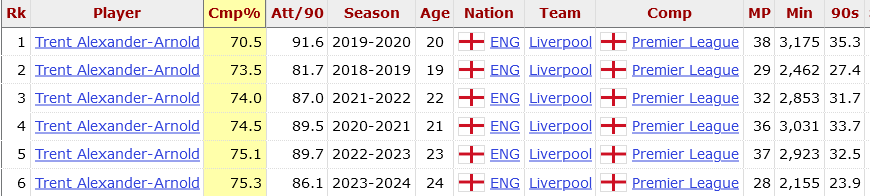
Okay then. Lowering the bar to 70 attempted passes only finds four more examples from players with at least 1,350 minutes in the season in question. Doing so also adds Alexander-Arnold’s breakthrough campaign of 2017/18 - 74.9 passes with 73.6 per cent success - to the pile anyway.
“I think we’re trying to find the balance between trying to create chaos at certain moments and trying to keep possession of the ball a bit longer in other moments,” Slot said in August. Any head coach focussed on the latter half of the statement would not want Alexander-Arnold on the ball as much; notice that 2024/25 doesn’t appear in the above table.
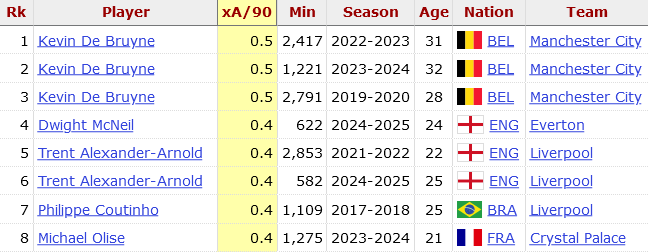
But he can still contribute superbly for the “chaos at certain moments” side of the equation. At present, 2024/25 is his third best year for expected goals assisted per 90, second best for expected assists (xA) as per Opta’s pass value model.
Alexander-Arnold averaged 0.41 for xA in 2021/22, 0.38 this term. FBRef’s search function only works to one decimal place but as it stands, the 26-year-old is putting together one of the eight best Premier League seasons in the analytics era for this metric. That he is essentially matching his career high when his pass volume has dropped by 25 per cent on three years ago is worth acknowledging too.
So, how is this possible? Reviewing Trent’s attacking dashboards provided an answer. He is operating on a tightrope.
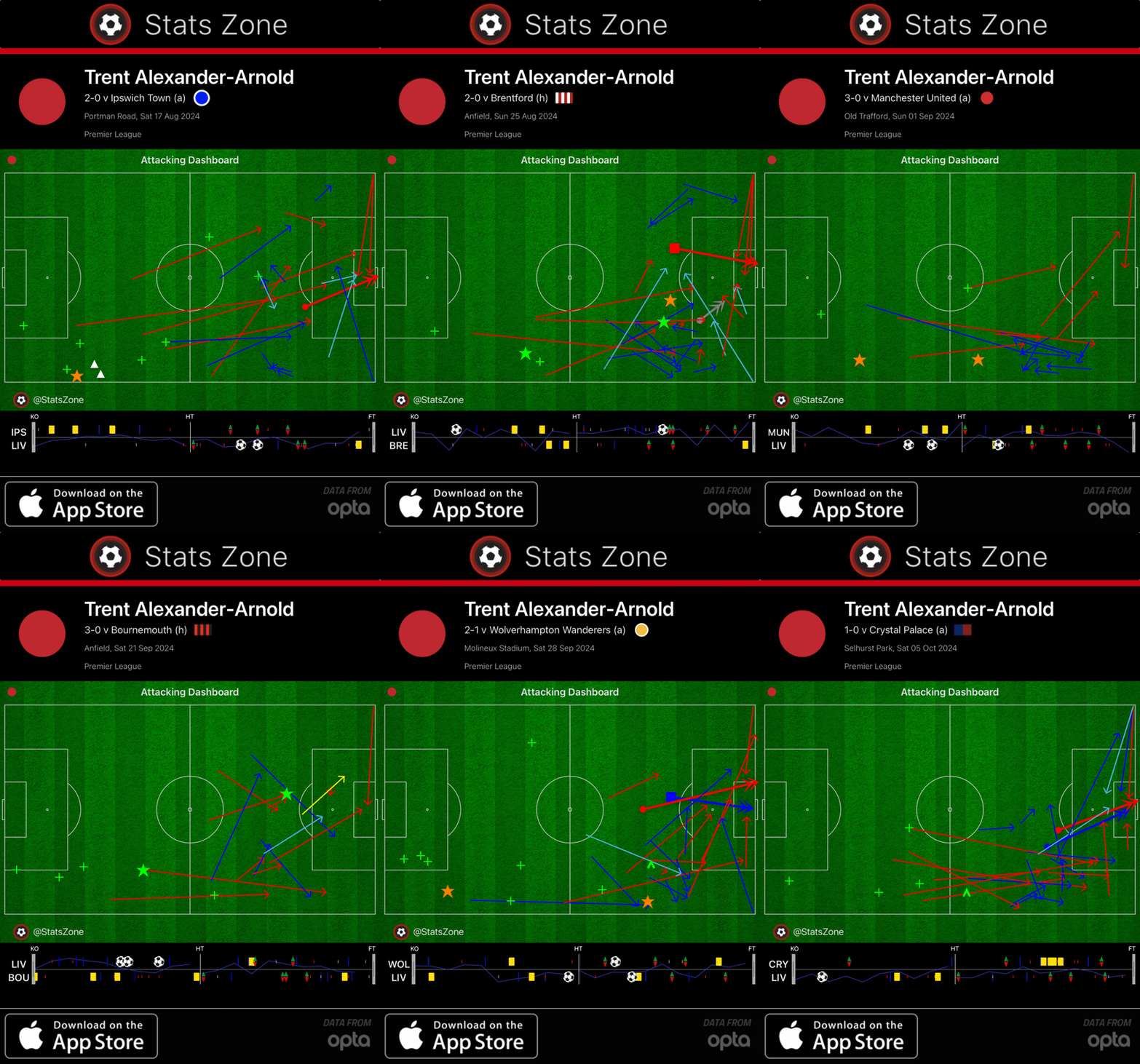
There is obviously a variety in level of contribution. Against Manchester United, the hardest fixture so far - very much in theory rather than reality - Alexander-Arnold didn’t complete a pass or cross into the penalty area (as denoted on the maps by blue arrows).
There are several other games without many, but the ones which occur are frequently very productive. Trent completed three box deliveries at Portman Road, creating two Opta-defined big chances with them.
He was two from two in this sense against Brentford, before his three penalty area passes versus Bournemouth laid on two chances, one of which became an assist. Alexander-Arnold also created two opportunities, including a big chance, at Palace. Adding in his set piece delivery for Ibrahima Konaté’s goal in the Champions League makes the right-back the Reds’ top creator of ‘player should score’ chances this season.
Can a player deliver more with the ball by being on it less? Instead of asking Slot, maybe we should defer to Bob Paisley.
"It's not about the long ball or the short ball. It's about the right ball,” he once said. To badly paraphrase the great man, it’s not about getting the ball into the box for the sake of it, it’s about doing so when there is a big chance to be created.
Maybe the numbers will settle down once the fixture list levels off too. You would expect Alexander-Arnold to be in possession more, not less, in easier matches though. The challenge now is for him to retain his place among the creative elite with fewer opportunities to influence matches. There seems little chance of him seeing the ball more under Slot, but maybe this season is proving that this is for the best anyway.