
The Relative Age of Arsenal, Liverpool and Manchester City
Pep Guardiola recently selected his joint-youngest Manchester City side. How does the relative age profile of the City, Arsenal and Liverpool squads look?
Most of the trivia which emerged from Liverpool’s recent 2-0 win at Manchester City related to Mohamed Salah’s latest record setting feats. One less obvious nugget that was arguably of greater interest was this:
“The average age of Manchester City's starting XI in this game was 25 years and 68 days - their joint-youngest in a Premier League match under [Pep] Guardiola.”
It’s a statistic worth digging into as that isn’t an absurdly young team by any means. Eight clubs in the top flight have started a younger XI at least once in 2024/25, with every single Chelsea team selected by Enzo Maresca fitting the bill. Guardiola began the match with three players in their thirties, bringing two more off the bench. The City rebuild has begun but they don’t merit a Pep’s Pups style nickname just yet.
As was recently assessed on this site, the age balance of the Liverpool squad, particularly in midfield, is in good shape. Such things can improve relatively quickly, in one transfer window, even. The Reds proved that with their combination of recruitment and player exits in the summer of 2023.
An issue back then was the heavy use of Fabinho, who - per the below chart - was a 29-year-old who had played the career club minutes of someone seven years older. Having previously looked at Liverpool’s squad in terms of age, it occurred that reviewing it alongside their contemporaries at City and Arsenal via this data could determine how old in playing terms each roster is. It’s not the years, honey, it’s the mileage.
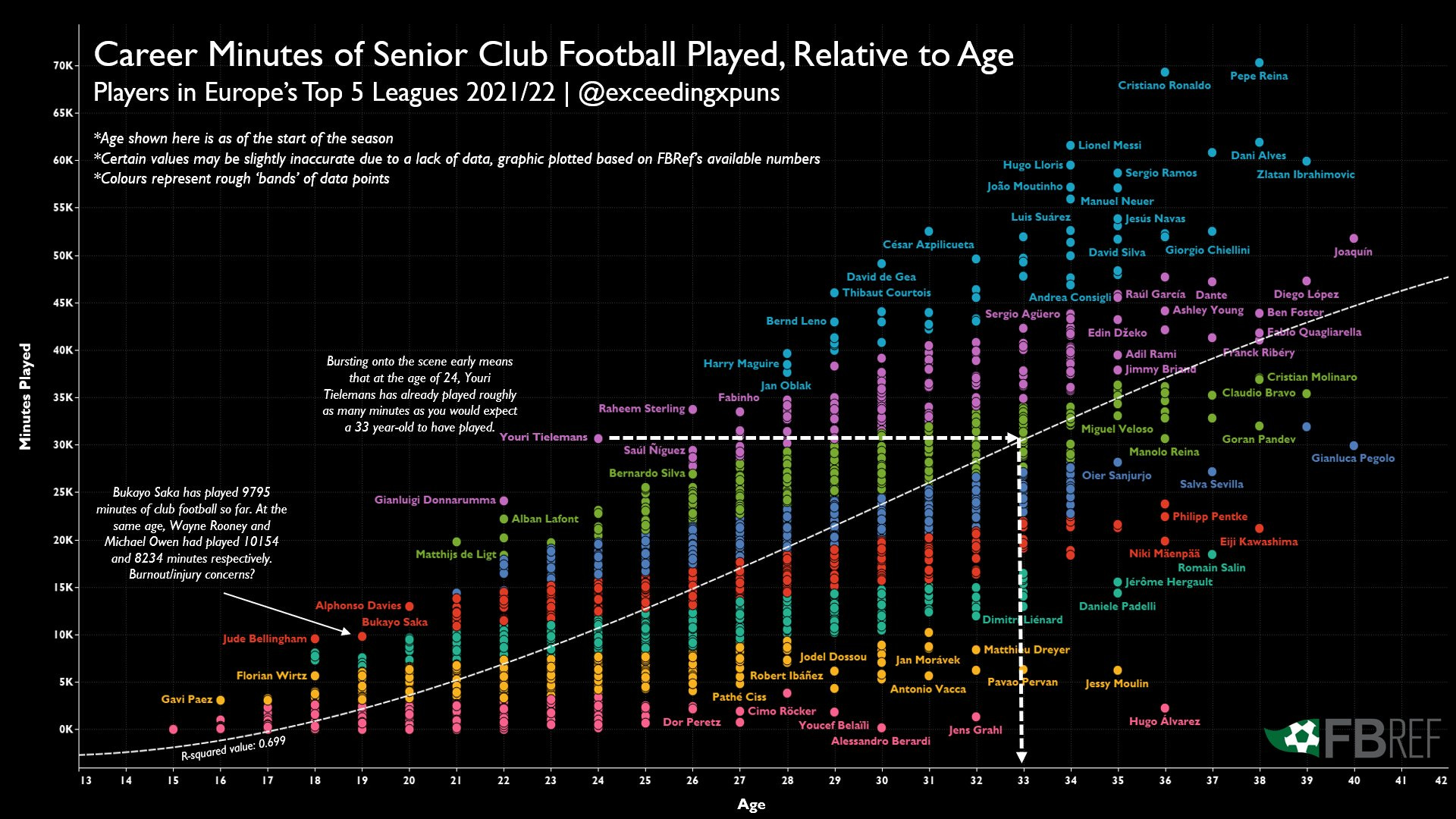
However, players at top clubs have all accumulated a way above average total of minutes. It quickly makes sense why; if roughly a third of clubs qualify for Europe, then two-thirds of players inevitably play markedly less football. The big clubs also expect to go deep into continental competitions, increasing the burden. Even Arsenal, occasionally.
As such, we’ll disregard the relative age chart to focus on the club playing minutes of the squads at our three clubs of interest. Based on starting XI’s, the Reds have been the fourth oldest side in the 2024/25 Premier League, with the Cityzens seventh and the Gunners 14th. The data for career minutes played tells a different tale.
On FBRef, it’s easy to find out how much playing time any footballer has put into their legs, international football aside. Each club has a Player Career Details page which carries the information; Liverpool’s is here. You get a snapshot of the previous three seasons, plus their career totals. Here’s an example.
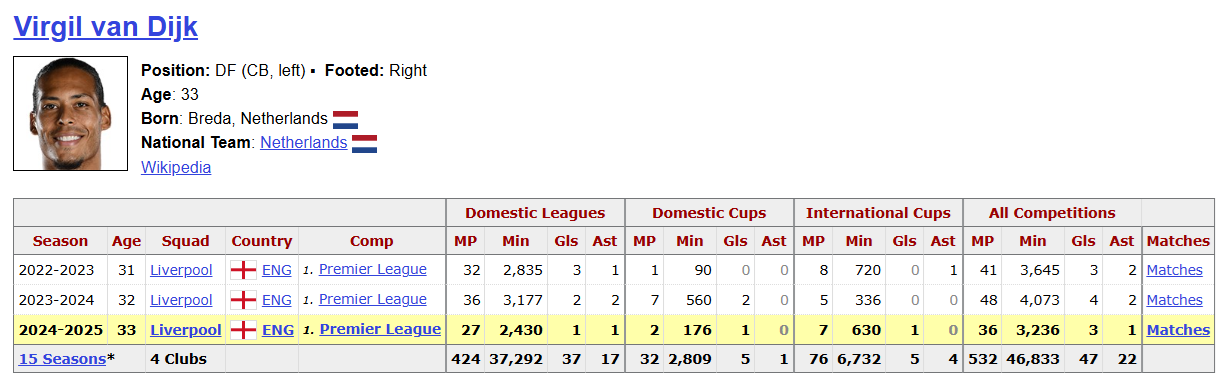
Over 46,000 minutes, Virgil? You’re a 41-year-old on the above graph, not that I’d like to be the one to tell you in person. It’s broadly the same total as Kevin De Bruyne, a few thousand minutes fewer than Kyle Walker. The Liverpool skipper has at least played a greater proportion of his playing time in a more languid style than either of the City men.
These are the oldest players in the study so of course they have played the most minutes. Plotting the outfielders with at least 50 per 90s of club playing time highlights a few outliers. A few of interest are named on this chart, plus you can hover over any dot to see the identity of the player in question. Bear in mind that the trend line is simply for the men shown, not the wider Premier League or European football.
The trio of İlkay Gündoğan, Andy Robertson and Raheem Sterling have all had campaigns below the high standards to which they have held themselves across their careers. It’s interesting that despite their differing ages, they are within about 24 per 90s of each other.
Maybe the 40,000 club minute mark is the point at which burnout kicks in? The presence of Salah suggests otherwise, albeit his superhuman dedication will always separate him as an exception from any footballing pack.
Further down the age range, we see names like Kai Havertz and Bukayo Saka a fair distance from the trend line, both of whom have suffered serious injury this season. While not so hampered by fitness issues, Trent Alexander-Arnold and Erling Haaland have missed big games too.
Ryan Gravenberch also deserves a mention. With his form dipping a little in recent weeks, it was suggested that the cause could be thanks to him playing more minutes in 2024/25 than in the previous two seasons combined.
As much as that likely played some part, notice that he has a reasonably similar career minutes total to Cody Gakpo, Joe Gomez and Ibrahima Konaté, all of whom are at least three years older. The price to pay for becoming the youngest player in the history of Ajax is being older than your years in footballing terms.
Arsenal have used 32 players in all competitions this season, City and Liverpool one fewer. It makes it easy to compare what proportion of their deployed squads have fallen into different brackets of career playing time (rather than relying on age).
The clubs have used a very similar number of players who have yet to reach 9,000 minutes in club football. From there upwards, though, differences emerge. Remember that the Reds have selected the oldest starting XI on average in the Premier League from these three, yet their proportion of players with under 200 per 90s in their careers is by far the highest.
This shows the breakdown across each roster but it is too simplistic. Liverpool’s two most used players are also their top pair for career minutes, in Salah and van Dijk. Sprinkling youngsters into the side for domestic cup matches or dead rubber Champions League games does not compare to veterans playing every single fixture of note.
Let’s weight the playing time to try to account for this. Imagine we have three players who have conveniently accrued exactly 100 per 90s of pitch time in their club careers. The first has played 100 per cent of the possible minutes in 2024/25, the second half of them and the third 25 per cent. This weights their career time at 100, 50 and 25 per cent respectively. The Reds’ squad has accumulated fewer per 90s in total than Arsenal’s but their heavy use of veterans puts them ahead once weighting is applied.
There’s no right or wrong here. Title-winning teams tend to blend youth with experience, rather than having too much of one or the other; it’s another reason why Chelsea were never likely to win the league this season. It should prove interesting to return to this in a year’s time to see if City are still relying upon their elder statesmen, though. Their rebuild still has a very long way to go based on these figures.
Data correct to February 25, 2025
Is this a good way to assess the relative age of a squad? Age alone doesn’t seem to quite cut it once you look into this stuff.
Further to the chart in this and the suggestion of 40,000 minutes as a breaking point, a new article from Jonathan Wilson has suggested 500 games https://www.theguardian.com/football/2025/mar/01/all-played-out-raheem-sterling-in-startling-decline-after-hitting-the-fateful-500-mark It’s a rounder number, though as he notes in the piece, an appearance can be very short.