
Too Many Changes at Liverpool?
It's time to turn and face the strain affecting the Reds.
The downside to spending over £400m in the transfer market is the difficulty you face in integrating the new talent into your team. Liverpool are experiencing this as they stumble through the early weeks of 2025/26.
Milos Kerkez has started every league game, as has one of two new players at centre-forward. With a price tag potentially rising to £116m, you can bet Florian Wirtz will be in the XI far more often than not too.
The disruption does not end there. When the Reds conceded a 96th minute winner to Chelsea, they did so with a back four containing two midfielders and their now second-choice left-back trying to protect their back-up goalkeeper’s net. That situation was reached via a combination of poor performances, injuries and managerial choice, but even so, it’s not a defence that screams solidity.
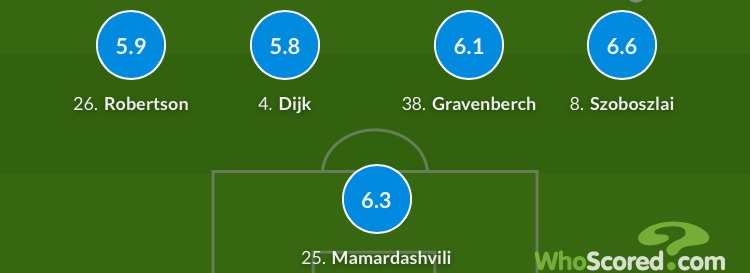
If quantifying this type of disruption is nigh-on impossible, we can certainly assess starting XIs. A previous newsletter which evaluated the success of Liverpool’s transfers in the last decade included a pertinent statistic provided by Ian Graham, the club’s former Director of Research.
“About a quarter of the starts get replaced season to season. So players that weren’t at the club or weren’t part of any line up last season, they make 25 per cent of the starts on average in the next season”
The Reds of 2025/26 are in-line with this expectation, as 21 of their 77 league starts (27.3 per cent) have gone to new players. Their rate is likely to rise, at least in the short term, with Giorgi Mamardashvili deputising for the injury-prone Alisson Becker. Jeremie Frimpong will add to his one league start too.
The total of 21 line-up inclusions allotted to newbies is already 21 times as many as occurred for Liverpool last season. The tally is also closing in on the 32 new player starts recorded by the title-winning side of 2019/20. Does this vastly increased level of turnover mean the Reds can’t win the league or that they are destined to struggle throughout this season? Let’s assess the previous nine seasons of Premier League football to find out.
Player quality will always take precedent, even before we consider managerial changes. Across the last nine years there has been close to no correlation whatsoever between the percentage of starts given to new players and the change in points from the preceding season.
However, a division-wide study contains a lot of club performances that bear no relevance to the Reds of today. They don’t need to massively improve on last season points-wise, just aim for about the same mark to see where it takes them.
The sample contains 11 examples of team seasons in which they came in after amassing at least 80 points, only to then post a lower total. These sides gave an average of 15.3 per cent of their starts to new players.
Should this fate befall the 2025/26 Liverpool team, they are on course for the second highest turnover rate (27.3) behind the Chelsea of 2017/18 (another title holder, on 30.6). There are only six instances of 80+ point teams improving; their average is 11.4 per cent of starts going to players who didn’t start in the season before, their peak the Arsenal of 2023/24 (24.9).
Small sample notwithstanding, it looks hard to maintain form at the elite level once you’re handing more than 10 per cent of your starts to players who hadn’t contributed the season before.
A closer look at Liverpool’s data reveals a minor flaw. Alex Oxlade-Chamberlain started 17 games in the first championship season having drawn a blank the previous year due to injury. He wasn’t new, even if he hadn’t begun a league game in 2018/19. There’s also the issue of players coming through the talent pipeline at a club; Rio Ngumoha would count as a new player this season due to not starting any Premier League matches last term.
As such, there may be a better way to investigate this issue. Think of what you have lost, not of what you have gained, as turnover works both ways. It doesn’t matter how much precedence the regular starters take, it isn’t 1963/64. Football is a squad game, with clubs needing far more than 11 players.
Let’s consider the number of starts from the previous season that a team loses. Players that filled a third of the Reds’ starting berths in 2024/25 have yet to start a league match for the club this season. The figure of 140 ‘lost’ starts should fall, as you’d figure Arne Slot will give the nod to Andy Robertson at some point, Joe Gomez too. Equally, it feels unlikely either veteran will start lots of league matches as things stand.
If we look at Liverpool’s history, there isn’t a strong correlation between the number of starts lost and success, even with the top two entries being title winning seasons. The Reds improved by an average of 18 points in the three prior campaigns in which over 100 starts-worth of talent from the preceding campaign didn’t make the XI at any point.
There can be a risk in not freshening things up too. The Liverpool of 2020/21 fell away after using most of their title-winning squad, with Newcastle suffering a similar fate (at a lower level) two seasons ago. Both were affected by injuries, some of which may have been down to burnout as much as the unpunished madness of Jordan Pickford (no, you let it go).
But let’s consider some of the other teams who lost very few of their starts from one season to the next. Tottenham (none!) and Manchester City (seven) in 2018/19 were Champions League finalists and domestic treble winners respectively. City only lost a further four three years later when they won the league by a single point once again, the swines.
Then there is Manchester United, who had their best league campaign in the post-Ferguson era in 2017/18 after losing just 23 starts from the season before. The problem is that even fewer went missing the following year (18) as their tally shrank by 15 points. There are examples that can steer you in which ever direction you wish here.
We will only know in May how much the personnel changes since 2024/25 impacted Liverpool’s points tally this season. The tragic loss of Diogo Jota hasn’t solely been felt on the pitch either, with an unquantifiable weight burdening the hearts and minds of the squad.
While Slot’s grief shouldn’t be overlooked, he at least has experience of improving a team in the face of extreme player turnover. His three seasons at Feyenoord saw 44, 61 and 28 per cent of starts go to new players respectively, for an overall average of 45 per cent across the three campaigns.
They earned more points with each passing year in spite of this. The challenge now is that this will obviously be harder to replicate in the Premier League than it was in the Eredivisie. Whatever happens, the Reds should be stronger in future for having gone through this season, even if the journey itself proves bumpier than anticipated.
Ch-ch-ch-ch-Changes!
Is this the heart of Liverpool's current issues? History suggests it *might* be...
Pickford and Ramos. I find it impossible to let go.
Your point was made by Alison and Salah with both saying that this season would be a huge challenge.