

Let’s say you’re lucky enough to have a season ticket for a Premier League club. Congratulations (maybe). The price will vary depending on the team, but the average cost across the division for the cheapest option is reportedly just shy of £550. A little over £200 of that is spent not watching football.
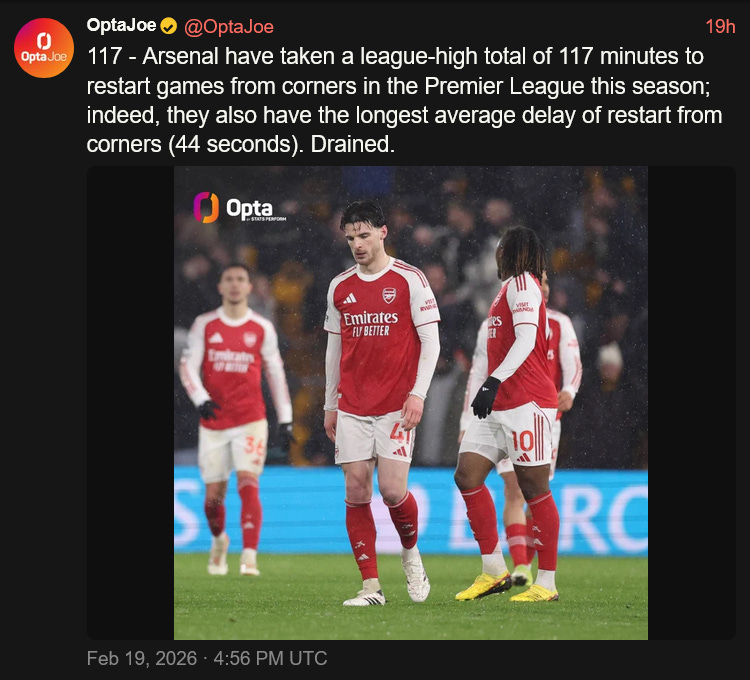
It’s spent on a full-back drying the ball with a towel before taking a throw-in. It goes down the drain when their meat wall lines up against your meat wall before a corner. It disappears into the ether as the goalkeeper places the ball for a goal-kick, moves it slightly, then moves it back.
It’s not all bad. Some of your lost £200 is eaten up by goal celebrations. A little will go towards applauding the player of the match off the field when they are substituted late on. It’s fine if it’s your team doing the limbs and the clapping, rather less so if you’re on the wrong end of it. That’s football.
Maybe you don’t mind the other time wasting if your team is the underdog in the match or if it helps them win. Football is unfair enough financially so who can blame the smaller clubs if they take advantage of gamesmanship when they can?
Except it isn’t just the relative minnows, is it? We saw in the recent review of time wasting in Liverpool’s 2025/26 season that Aston Villa, Tottenham and Newcastle (twice) have been among the worst offenders in Reds matches. They’re among the top eight Premier League teams in terms of wage bill, not newly promoted scrappers.
The efforts of the Magpies in their home defeat to Liverpool remain the worst example of time wasting in the Premier League this season. Multiple different teams appear in the top 10 though, with only five of them winning (with two of those were against Wolves at home). Was the gamesmanship even worth it?
In a one-off set of circumstances, anything can happen. The real issue is the persistent offenders and the referees who enable them. They’re wasting everyone’s time and money.
It isn’t just the officials on the field who are a problem either. The 365Scores data includes a section for what it terms ‘Significant VAR Checks’, the shortest of which this season was 1:55 long. Perhaps it becomes offensive if it takes longer than Liar, Liar by The Castaways?
Fans at Stamford Bridge could’ve enjoyed Station to Station by David Bowie in the 10:03 spent by VAR Michael Salisbury and ref Rob Jones on a significant check during Chelsea’s 2-0 win over Fulham.
The latter were also held up for 7:10 at Old Trafford (thanks to James Bell and John Brooks) while Burnley’s trip to Manchester United saw 7:48 used up on the VAR checks of Stuart Attwell for Sam Barrott. Stockley Park’s Alex Chilowicz combined with Selhurst Park’s Jarred Gillett for another review stoppage of 7:10 when Crystal Palace drew 3-3 with Bournemouth too.
Liverpool haven’t been affected quite that badly but had VAR checks lasting north of five minutes in recent matches with Fulham and Manchester City. If it’s reasonable to file significant VAR checks under ‘lengthy’, it’s safe to assume they all relate to borderline or questionable calls. Only three teams have experienced more of them than the Reds this term, with Arne Slot’s men involved in the most in away matches.
As fewer than one in five matches has featured one of these lengthy stoppages, they are not that big an issue. Even the game with the least time wasted - Crystal Palace 0-0 Aston Villa - saw 31:43 disappear without need for a notable VAR check.
Liverpool’s win at St James’ park is at the opposite end of that scale, as it lost 1:04:44. Silver medal on the time wasting podium goes to United’s 4-4 draw with Bournemouth (1:00:30), with Chelsea 1-3 Brighton (59:23) taking bronze. Out of interest, who were the referees for these three matches?
Simon Hooper, Simon Hooper and Simon Hooper.
He may be unfairly tarred by his involvement in the biggest VAR blunder in Premier League - probably football - history but Hooper seems to have a serious problem when it comes to policing time wasters. Say what you will about Michael Oliver (people frequently do), at least he keeps the ball in play.
Weak or strong, referees’ figures will be influenced by the teams of which they take charge. To assess the heroes and villains, we have to measure possession against each club’s share of total time wasting in their matches. A team that attempts a lot of passes can only do so with the ball in play. While the correlation is not solid, it stands to reason that teams without the ball will be the higher time wasters.
The best example for differences in approach is shown by Aston Villa and Brighton. Just 0.5 per cent apart in possession average, the former is responsible for 9.7 per cent more of the time wasting in their matches than the latter.
Perhaps both the Seagulls and Liverpool would’ve eaten up more of their matches through time wasting if they had led more games. Not necessarily; the split between winners and losers in non-drawn games for most time wasted is split 59.2-40.8 per cent in favour of the victors. It’s one-sided, though maybe not as much as you’d assume.
It’s not in the slightest bit uniform across the league either.
Everton have wasted more time than their opponents in all 10 of their wins. Liverpool have only done this in three of their 12, the lowest proportion in the division.
This is what the Reds are up against. Much was made of them relying upon late winners in their first five games even though only Bournemouth had seen less ball in-play time ahead of matchweek six. No wonder it takes a while to score if the matches are artificially short.
Time wasting is not a game state issue, not really. It is a mindset problem, both on the part of certain teams and in the outlook of referees who allow it to go largely unchecked. They are the ones that are wasting your time and money. Liverpool are mainly just caught in the crossfire from time to time.
Any surprises here? Probably not.
Fascinating piece Beez.
I don't go to matches very often, but had been a Sky Sports subscriber since 2003, which I cancelled last month for a variety of reasons.
It would be interesting to see if time wasting has increased over the years (it does appear that way), but assuming it's been static I must have spent thousands watching nothing over almost 23 years.
I now get much better analysis and content from Substack, LFCTV and the odd YouTube video. Much better value and far less paying for dead time.