
Who would you say are Liverpool’s two fastest players? Mohamed Salah? Luis Díaz? Virgil van Dijk, even though he so rarely ever has to prove his pace?
A recent article on Sky Sports revealed the answer, with what many people might consider a surprising player taking the Reds’ silver medal. “[Curtis] Jones' top speed of 34.77 km/h puts him behind only Luis Diaz among Liverpool players and just ahead of Mohamed Salah. He is 30th among 459 Premier League players overall.”
This is a far from perfect way of assessing speed. Jones might have clocked the second fastest pace among Liverpool players this season but would he beat his teammates over 100 metres? Thirty-two years ago, League Cup sponsors Rumbelows held a competition to find the league’s fastest player, with their 100m final at Wembley.
Tracking data wasn’t invented in 1992, pal. It was much later, hence the race. The showpiece 100m sprint was won by Swansea forward John Williams, who collected £10,000 after winning in 11.49 seconds. A very tidy payday for a player from Division Three in the early 1990s.
Williams’ speed translates to 31.33 km/h, which would sit him between Ross Barkley and Mario Lemina in the 2024/25 Premier League, albeit we’re clearly comparing apples with oranges (or Swans with Wolves). A player’s top speed in a game bears no comparison to what they might sprint without the ball, nor their average for the whole match.
Nonetheless, such data seeps into the public domain so infrequently that it’s interesting to see what it shows on the rare occasions that it does. Here are the kilometres per hour figures for Liverpool players with a decent sample of minutes across the first 11 league matches (as the source article was published prior to the win at Southampton).
The differences are negligible. Converting the statistics into metres per second reveals that Díaz was about 35 centimetres ahead of Ryan Gravenberch in their given peak second. Such margins can matter in elite football, but he’s not leaving him to eat his dust.
With the data for every player, we can calculate the theoretical top speed of all 20 clubs in the Premier League. Liverpool are in the bottom half, until a deeper dig into the numbers tells a vastly different tale.
When you watch Liverpool blitz downfield on a counter attack, it seems hard to believe that they would not possess one of the swiftest rosters of players in the top flight. Thinking of the Reds in this sense begins to reveal why they are 11th in the above table.
Based on their top speeds this season, Arne Slot can call upon five of the 40 fastest players in the Premier League: Díaz (26th), Jones (30th), Salah (32nd), Trent Alexander-Arnold (34th) and Cody Gakpo (36th). Only Wolves, with six, have more.
Similarly, Liverpool have 16 men who’ve clocked a speed above the league average of 31.72 km/h, which only Tottenham (with 18) can better. How can a squad full of players with impressive top speeds rank so lowly overall?
The answer lies between the sticks. Goalkeepers don’t have to sprint too often, even if they occasionally have to dash out of their penalty area to make a clearance. Only two first choice shot stoppers scrape into the top 400 out of 459 players in the study, with the Reds’ Vítězslav Jaroš rock bottom of the pile and Caoimhín Kelleher only five places above him.
By having to field three goalkeepers this season, Liverpool’s average of their top speeds never stood a chance. Let’s strip the ‘keepers out of the data set.
Filtering the data in this way sees Liverpool’s figure rise by 1.19 km/h, comfortably the biggest move in the division - West Ham are next, on 0.84 - and way above the 0.39 km/h average shift across the 20 clubs.
Scrolling to the bottom of the data set revealed something else which hampers these figures, though; a lot of the slowest outfield players have barely seen any action in 2024/25.
Think about it. If your only appearance of the season was to trot on for the final few minutes of a game which was effectively over, you’re unlikely to have been sprinting around in that time. Only four of the 40 slowest non-goalkeepers have seen as much as 270 minutes this term.
It therefore made sense to look at outfield players who logged at least 5.5 per 90s across the opening 11 games which the data covers. That should ensure the sample is restricted to semi-regular outfield starters.
Adding this clause shows that defensive midfielders don’t have to sprint, with the bottom three becoming Kalvin Phillips, Adam Wharton (perhaps surprisingly?) and Casemiro. The presence of İlkay Gündoğan with Bernardo Silva in the bottom 18 hints at why Manchester City have struggled to keep up with opponents at times this term. Here are the updated figures.
There’s no way to make Liverpool top of this chart, no matter how the data is framed. Micky van de Ven set the Premier League record for top speed last season and leads the division again in 2024/25. Timo Werner (seventh), Destiny Udogie (18th) and Heung-min Son (21st) provide able support, frequently down the left.
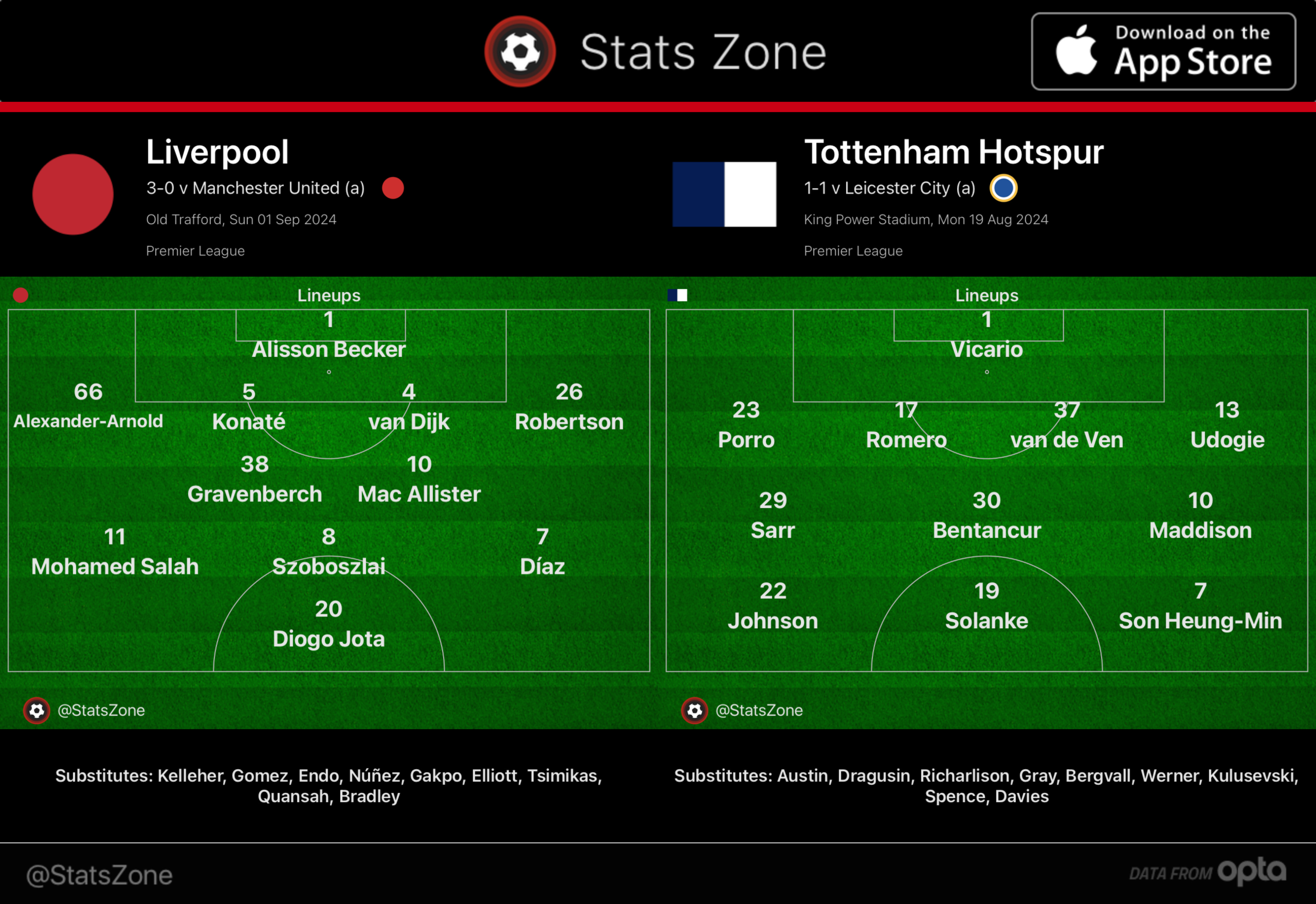
It will be something to watch for when Liverpool visit Tottenham for their final match before Christmas. The below line-ups are the fastest each club has fielded this season, with Bournemouth (once) the only non-Spurs side who have used a swifter starting XI than these Reds. With two such fast teams, it’s no wonder offside calls get messed up in Tottenham-Liverpool games, is it?
The Reds are running very hard towards the Premier League title. At this speed, it will be hard for the competition to keep up.
Great stat and an enjoyable read.
Watching the Bayern-PSG game yesterday made me wonder how important sprinting is for the success of the team. Both sides seemed to be constantly sprinting in and out of possession which made it a very chaotic game.
Would you say speed trumps tactics at CL/PL level?