
Who is Liverpool's Top Player for Goal Involvements?
Mohamed Salah leads Liverpool's standings for both goals and assists this season. But who is most involved in the build up to goals?
The term ‘goal involvements’ is becoming more common in discussions around football. It is a short hand way of totalling how many goals and assists a player has delivered.
For Liverpool, Mohamed Salah has no equal in 2024/25. Cody Gakpo is second in the Reds’ squad for goal involvements this term, with 16; his Egyptian colleague has both scored (21) and set up (17) more than that for a total of 38.
In the Premier League, Salah has already enjoyed one of the best campaigns for goal involvements in the modern era of English football, even if he does not kick a ball again this season. Despite being only half way through Arne Slot’s rookie year in charge, Salah’s total of 31 is the joint-36th most a player has recorded since 1992.
The 32-year-old has already matched or bettered the best campaigns offered by players of the stature of Dennis Bergkamp, Eric Cantona, Romelu Lukaku, Wayne Rooney and Heung-min Son to name but five. The 38-game record of 44 goal involvements, jointly held by Erling Haaland and Thierry Henry, is a very realistic target.
Salah can not reach such heights alone. The veteran has teammates who cover his share of the defensive work, easing the burden on his legs. Almost all of the amazing things he does with a football are only able to occur because a teammate gets it to him, frequently in the final third. No other player in Europe’s big five leagues has received as many progressive passes as Salah in 2024/25.
Thanks to Opta’s match centres, it’s possible to see which players have been involved in the build up to every Liverpool goal this season, Salah-powered or otherwise. As an example, the below video shows Gakpo’s goal against Manchester United from the relevant Analyst page. Alexis Mac Allister got the assist, with the possession sequence also involving Trent Alexander-Arnold, Virgil van Dijk and Ryan Gravenberch.
By collating this data for every game, we can see which players contribute most often to goal build up, who starts scoring moves most frequently, and who plays a part in goals which give Liverpool the lead, the best goals of all. The only addition I’ve made to the Opta sequence data is crediting a player who wins a penalty. We can also test if the Reds adhere to analytics pioneer Charles Reep’s discovery that “over 80 per cent of goals result from moves of three passes or less”.
Liverpool have scored 70 goals in all competitions so far this season. Salah has been on the field for 64 of them which is hardly surprising when he has played 89 per cent of the possible minutes. He leads the standings from van Dijk (60), Gravenberch (57) and Mac Allister (56).
The former Roma man has scored, assisted or help set up 46 goals, 71.9 per cent of the total that occurred during his playing time. Again, predictably, Salah is top for this, though in proportional terms it is Gakpo (64.3), Luis Díaz (60.4) and Curtis Jones (55.9) who trail him most closely.
With Salah having accrued 38 goal involvements in the recognised sense, this means there are only eight which featured him earlier in the sequence alone. This could be my favourite stat of the year: that puts him level with Caoimhín Kelleher and Jarell Quansah.
Even though Salah is rarely involved beyond setting a goal up or applying the finishing touch, his other contributions have mostly been in important moments: go-ahead strikes against Brentford, Real Madrid, Leicester and West Ham, plus the equaliser against Brighton (which happened just two minutes before he scored the winner, naturally).
With his more traditional contributions included, Salah has been involved in 18 goals which gave Liverpool the lead. That’s more than any of his colleagues in total or in pro-rata terms, but there are nine men who have seen a higher proportion of their contributions put the Reds a goal to the good.
Top of the tree is Ibrahima Konaté. Ibou’s 13 involvements include eight when a game was 0-0. These include his assist against Bournemouth and goal at Wolves in successive Saturdays. Konaté also featured in the openers against Bayer Leverkusen and Madrid, lovely additions to this very niche footballing CV.

Díáz’s strike against the Cherries merits another mention, as it came at the end of the longest possession sequence Liverpool have turned into a goal this season. It shows how random this stuff is, though, with the first 13 touches of the 16 pass sequence achieving little more than getting the ball back to Kelleher. He then found Konaté, who fired it forward to Lucho. He took care of the rest.
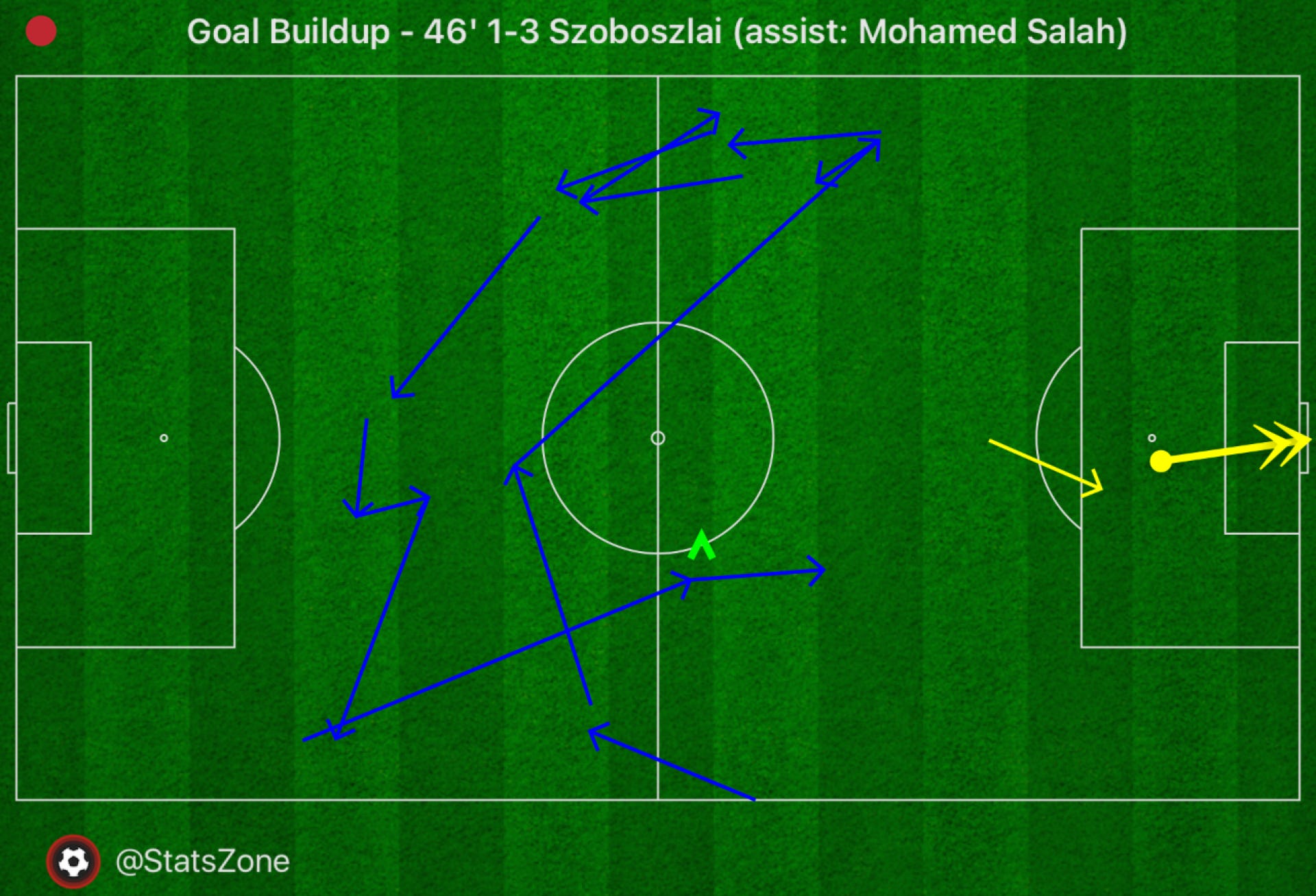
The move for this goal featured nine different players. We are yet to see the first with all 11 in the Slot era - there were two instances last season - but four goals have seen 10 men have a touch in the sequence. The most recent of them was Dominik Szoboszlai’s effort to put Liverpool 3-1 up at Tottenham, with Mac Allister the odd man out.
The Argentine’s lack of involvement here was a relative rarity. Mac Allister’s importance to the Reds’ buildup play is laid bare on the chart earlier in the article, which shows he has accumulated the most build up goal involvements.
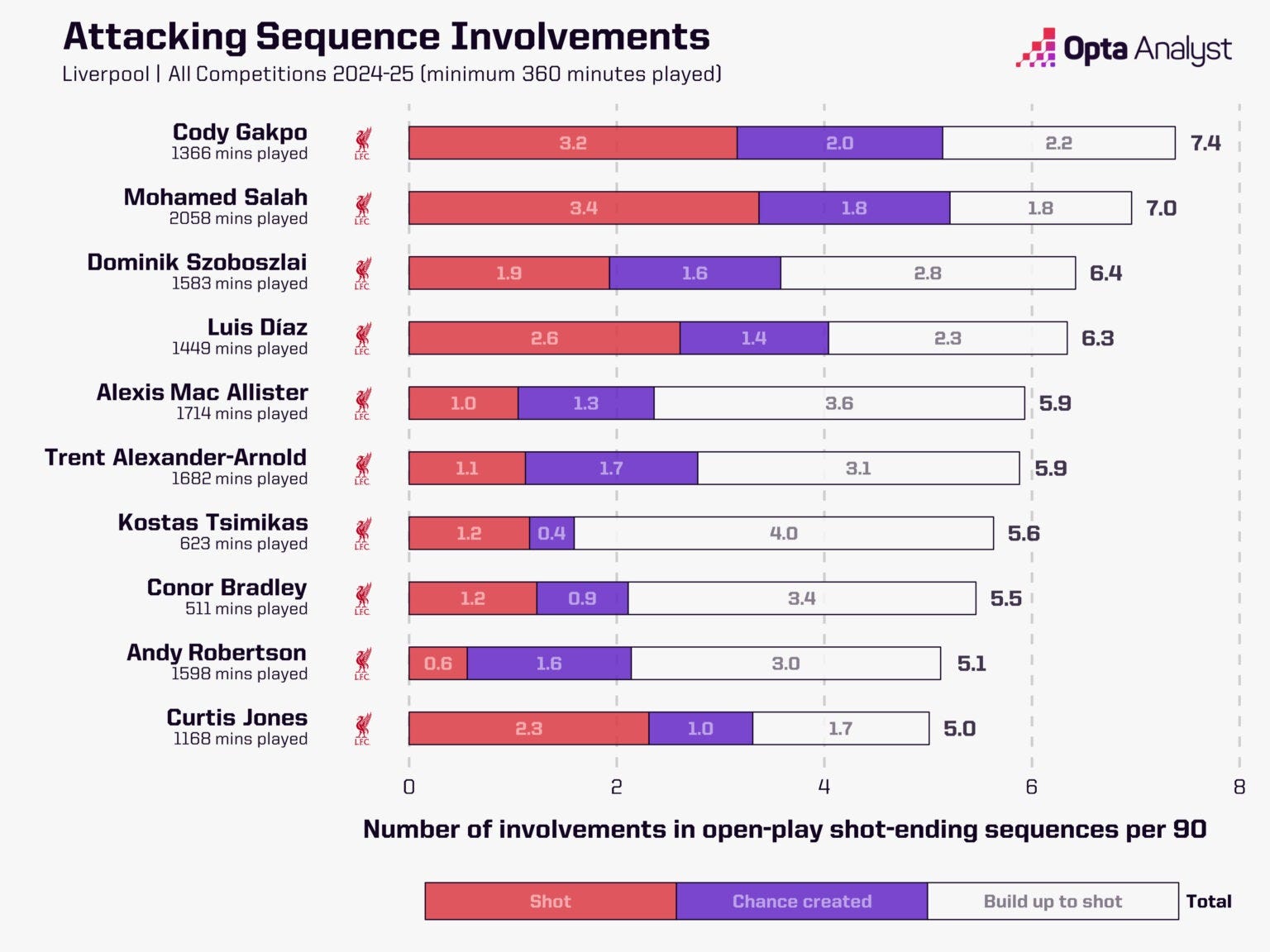
As with regular assists, this study needs the ball to cross the goal line for an involvement to be recorded. However, a recent Analyst article on Gakpo showed that Mac Allister is frequently involved in sequences which lead to shots (see chart below), so he deserves to top the goal involvement standings. His influence is growing too, having played some part in 17 of Liverpool’s last 28 goals, a run which began with him scoring against Real.
Andy Robertson is second on the list of non-goal or assist goal involvements. He deserves credit for contributing more than people would assume in what has become a difficult campaign for the Scot. The king of other involvements per 90 minutes played, though, is Joe Gomez.
While he trails Robertson and Alexander-Arnold for starting goal scoring moves - they have done so nine and seven times respectively - the England international centre-back is top for this on a pro-rata basis too. It is natural for defenders to feature highly in this regard, as they are frequently the first to have a touch when an opposition attack breaks down.
Full-backs often take throw-ins, with Liverpool’s also taking lots of set plays, which helps to start goal moves too. If you’re looking for the top non-defenders for starting sequences which led to Slot’s side scoring, Gravenberch and Mac Allister, with six apiece, are your men.
In the Reds’ case, short sequences leading to goals which were started by the full-backs have mostly been in dead ball situations. We’ll finish with a look at the length of the open play possession chains, to see how ‘Reepian’ Liverpool have been this season.
While short sequences dominate, they don’t hit the heights they once did. Sorry, Mr. Reep, the thinking around the game has unsurprisingly moved on. The long ball has it’s place (when it’s the right ball) but Slot would rather ‘kill them with passes.’ In this regard, it’s Mac Allister who has been his commander in chief in the field.