
Alisson's Starting to Flatten
Mohamed Salah's departure will feel like the end of an era. Giorgi Mamardashvili may supersede Alisson Becker and usher him towards the exit door soon too.
Back in the early days of amateur football analysis, it was hard to learn much about goalkeepers as the data was very basic. The demise of FBRef’s offering has somewhat returned us back to the dark days of the early 2010s. Have you seen that new show Luther, it’s silly but great.
The only way to numerically assess goalkeepers at that time was save percentage. It’s far from ideal as it takes no account of the quality of the chance that the shot stopper faced. Simon Mignolet’s save percentage looked great at Sunderland because he was behind a low block that encouraged long range efforts. In the hurricane of Brendan Rodgers’ Reds, the Belgian was far less impressive.
As limited as the metric is, Alisson Becker has seen his figure dip to a career low in the Premier League this season. Only 12 goalkeepers with at least 25 matches played in the big five leagues have a worse figure. That’s far from ideal, how ever much of the blame lies truly at his door.
Mohamed Salah looks his age these days, so the same may be true for his fellow 33-year-old between the sticks. The noisy nature of save percentage means we shouldn’t be too hasty with condemning Alisson to an Anfield exit too soon though.
Former Crystal Palace goalkeeper Vicente Guaita was the worst performing 33-year-old for save percentage in the last decade in 2020/21, only to improve by 10 per cent the following season. His efforts in 2022/23 are the best by a shot stopper who was 35 years old at the start of any of the last 10 campaigns. Form fluctuates, both for goalkeepers and the teams they represent.
Another old school metric to assess goalkeepers is their record versus Opta-defined big chances (with penalties excluded). Becker’s save percentage for this has floated a shade above league average for the past two seasons when it was previously his superpower. Not that anybody in the Premier League with a decent sample since 2018/19 has a better success rate, even allowing for the recent cooling Alisson has experienced. That’s not a skill to shed from your backline too hastily.
With his pass accuracy at it’s lowest since his season with Roma and injuries taking a toll, it’s fair to ask if this summer will be the right time to handover the number one shirt to Giorgi Mamardashvili. While the detailed goalkeeper data is no longer neatly compiled on FBRef, we can obtain it elsewhere to start making a fairer comparison between Alisson, his peers and the Georgian waiting in the wings.
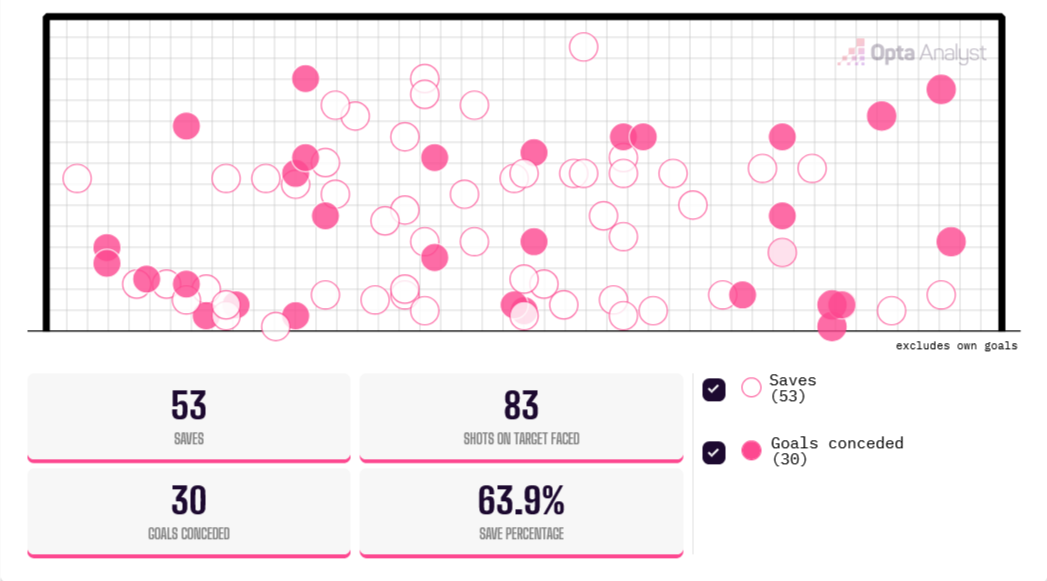
It would be easier to make a case for Mamardashvili to become first choice if he had enjoyed a better season. He doesn’t yet seem trusted by Liverpool supporters, even though his form in La Liga was at times spectacular.

Saving an Erling Haaland penalty aside, the 25-year-old has done little to impress Kopites. Losing seven of Mamardashvili’s 10 starts in league and Europe won’t have helped his case either, irrespective of his role in those defeats. Clean sheets against Real Madrid and Aston Villa are soon forgotten when losing to Brentford, Brighton and PSV, among others.
Mamardashvili also has a lower save percentage in the league than Alisson, both in total (63.3) and with non-penalty big chances (36.4 against the Brazilian’s 43.3). It is telling that the former Valencia goalkeeper has a career low for the former metric though. For both men to be in that position suggests it has to be a team issue to some extent.
We can get a handle on this with Opta Analyst’s xG on Target (xGOT) metric, also known as post-shot expected goals. Gut instinct says the figures can sometimes be a little off for a shot in isolation, but as with any data analysis the wrinkles should be ironed out over a larger sample.
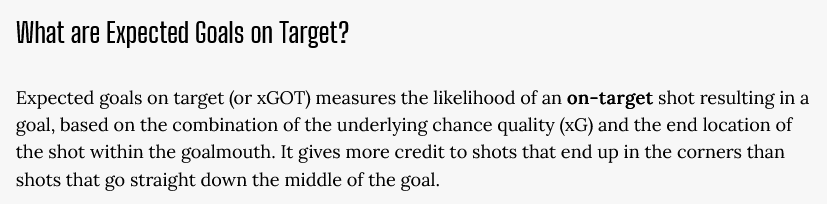
The average shot faced by Alisson in the 2025/26 Premier League has been worth 0.32 xG on Target. I didn’t record the figures for last season before they vanished from FBRef unfortunately, but that the number is higher than it was in five of his first six seasons in England. Suddenly Becker’s low save percentage doesn’t seem so odd.
Neither does Mamardashvili’s, seeing as his xGOT figure is 0.34. That’s at least three percentage points higher than it was for any of his four seasons in La Liga.
We can plot this number against save percentage for the goalkeepers in England, France, Germany, Italy and Spain this season to highlight a trend you would expect to see.
As much as the link is obvious, you’d hope to see Liverpool’s shot stoppers north of the trend line. The goalkeepers of Barcelona and Milan show what can be possible when facing shots of even higher average difficulty than their Reds counterparts.
We can also factor in Champions League data. Alisson will be grateful for this, Mamardashvili less so. Becker has conceded in line with the xGOT he has faced across the two important competitions whereas his deputy is 2.5 goals below par.
Something notable stands out with even a quick glance of the data though. Mamardashvili has faced roughly half as many post-shot expected goals as Alisson despite only playing approximately a third of the minutes. The younger man has had to deal with 29 per cent more shots on target and 38 per cent more xGOT per 90 minutes than the veteran. That’s going to make a difference to their performance figures as it hasn’t been a fair comparison.
There’s a stunning statistic in this simple chart. Liverpool’s collective opponents have improved the value of their chances through finishing when facing Mamardashvili. Every one expected goal they muster has led to 1.19 in the post-shot model.
That’s absurdly efficient. The ratio for the 2025/26 Premier League is 1 to 0.95, way below what Mamardashvili has endured. The nine players who’ve hit double figures for goals in the competition have collectively converted 21.4 per cent of their shots, over double league average. Even they have only improved their xG by 0.38 per cent as a group once finishing is applied.
For Liverpool’s Georgia international to have faced a 19 per cent xG improvement is ridiculous. To put it another way, it would be easier as a goalkeeper if every shot you faced was from 2024/25 Salah, whose xG improvement was 13.2 per cent.
The difference between Alisson and Mamardashvili here is fascinating. You’d understand if an attacker was put off when facing Becker thanks to his reputation as one of the best goalkeepers in the world. The shot stoppers themselves must play a part too, through narrowing angles, speed off their goal line and so on, but that’s impossible to measure with available data.
It leaves Liverpool with a very difficult decision ahead of next season, the last of Alisson’s contract. The data says he’s only performing at about average level yet that’s still above what his successor has offered. The latter has been tested more harshly but how much of that is down to his abilities? There are no easy answers for Richard Hughes, Slot or whoever holds their positions next season.
There might be a second goalkeeper piece later this week but I need to collect some data to test first...
Great article Andrew. Interesting points on Alisson - very much backs up my eye test.
For me, Alisson is probably the best goalkeeper I’ve seen play for Liverpool, from the latter Ray Clemence years through to now. Possibly the best one-on-one keeper I’ve ever seen.
When we signed Mamardashvili, I did wonder if this would be Alisson’s last season. I’ve been slightly disappointed with Mamardashvili so far, on two counts.
First, his kicking - though in fairness, Alisson’s own distribution has also noticeably declined over the past couple of seasons, so it’s not purely a Mamardashvili issue.
Second, positioning and angles. The best keepers often don’t need to make the spectacular saves because their positioning forces strikers wide. As your article touches on, this is arguably one of those qualities that the available data simply can’t capture - its value is real, but difficult to demonstrate statistically. I’m not always convinced by Mamardashvili’s angles, and getting those right could make a significant difference.
It’s also worth noting how dramatically goalkeeping has changed. The role now demands a level of physicality and aerial dominance not seen for decades, adding a whole new dimension to the skill set required.
As for Alisson, the intelligence is still there. I just wonder if the body can still take him where he needs to be.