
Giorgi Mamardashvili's 2024/25 Was Great, It Just Needs Context
The statistics for Liverpool's new goalkeeper look concerning for this season. There's a vital piece of context which needs to be applied.

Liverpool’s first signing of the Arne Slot era effectively became their first of this summer too. Two for one; a genius move from Richard Hughes.
Maybe not, eh? The Reds bought Giorgi Mamardashvili from Valencia last August, only to immediately loan him back for the duration of 2024/25. He should be part of the squad for Liverpool’s Premier League title defence next season.
Even if Alisson Becker remains number one as expected, his new deputy is likely to get opportunities. The Brazilian missed 10 top flight games due to injury in 2024/25 for the second consecutive campaign, after only totting up 15 across his first five seasons with the club.
This chart shows when Alisson missed league matches through injury (black), went off injured (grey), was sent off (red) or was absent thanks to suspension or compassionate leave (orange). Some second choice goalkeepers rarely feature; that won’t be the case for Mamardashvili.

Having given the Georgian the once over when his signing was confirmed (here), it’s now time to assess how he fared this season. Here’s what he is up against if he wants to become Slot’s preferred custodian.
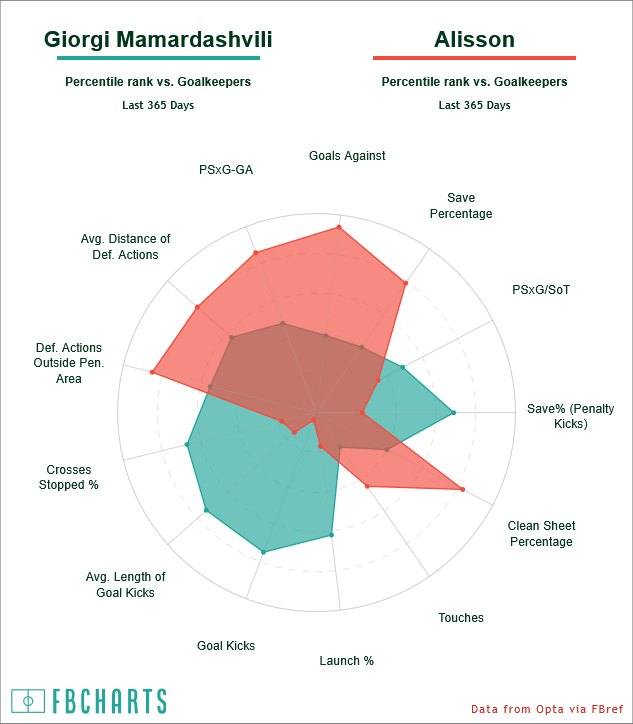
While Alisson was much the better performer against post-shot xG (PSxG), Mamardashvili was always likely to regress this term. By conceding 10.2 goals fewer than expected in 2023/24, the Liverpool new boy recorded one of the best campaigns of shot stopping in the advanced data era.
If you need evidence this form wouldn’t be maintained, Alisson followed a +10.1 campaign in 2022/23 by going a shade under expectation the following year (-0.3). Mamardashvili still saved 1.1 goals above the PSxG he faced this season, even if he couldn’t keep pace with the brilliant Becker.
When looking at data, it’s important to acknowledge the importance of factors beyond the player in question. This is arguably more true for a goalkeeper than for any other position. Were they stood behind a wall of bricks or a house of cards? It really matters.
Mamardashvili’s 2024/25 campaign must be viewed through this lens, thanks to a mid-season managerial change Valencia implemented. Splitting the stopper’s stats between the two gaffers reveals reasons for Kopites to remain very optimistic about the Georgian’s potential.
The Valencians began the campaign under Rubén Baraja, who was a midfielder in the side Rafa Benitez steered to glory at home and abroad two decades ago. He had been in charge since February 2023 but had to go shortly before Christmas with his side only off the bottom of the table on goal difference.
In came Carlos Corberán, fresh from West Bromwich Albion. Valencia were only one point shy of the fourth best side in La Liga across his portion of the season, finishing 12th overall.
Every stat of note improved for Mamardashvili under his second boss of the campaign, for one simple reason: he didn’t have to face chances of the same standard. This is measured using one of FBRef’s more potentially baffling abbreviations, PSxG/SoT. It’s post-shot xG per shot on target, where the higher the number means the efforts faced were harder to save.
Mamardashvili faced an average of 0.31 in 2024/25. It was 0.37 under Baraja, 0.28 for Corberán, though. That’s a chasm of a difference when all but three of the 96 teams in Europe big five leagues were between 0.37 and 0.25 this season. Valencia went from one of the worst defences around to slightly better than average.
That’s huge for a goalkeeper. These three graphs illustrate the difference it made.
Following the change of manager, the opposition chance quality dipped (as per chart one). Mamardashvili’s save percentage then rose (chart two) thanks to facing a lower standard of shot. This in turn meant his performance against post-shot xG went from below that of an average shot stopper to above it (chart three).
The 24-year-old essentially performed at Alisson’s 2024/25 level (+0.13 per 90 minutes) across his 20 league matches for Corberán. Mamardashvili’s figure for this part of the campaign was bettered by just 15 goalkeepers in England, France, Germany, Italy and Spain who played at least as many minutes this season. This was in his supposed down year, don’t forger.
The change in head coach saw stylistic changes in other aspects of the goalkeeping role. The rate at which Mamardashvili made defensive actions outside his penalty area rose on 2023/24 irrespective of who was in charge. He remains behind Allison but the gap is below one per game which doesn’t feel insurmountable.
A more interesting change occurred in terms of dealing with opposition crosses. Mamardashvili went from stopping 2.9 per cent of them for Baraja to 9.3 per cent under Corberán. The latter is in the highest echelons for this metric.
This is obviously a result of tactical choice, one which might appeal to Slot. His goalkeepers at Feyenoord stopped 9.5 per cent of crosses in their run to their Eredivisie title, lifting that to a division-leading 12.5 per cent last season. While he didn’t have the benefit of Virgil van Dijk heading the ball clear for him in Rotterdam, the Liverpool head coach may be drawn to this aspect of Mamardashvili’s game.
Stopping shots comes before anything else though. The Reds’ new goalkeeper has shown he is up there with the very best if given closer to the level of protection which Liverpool’s defence offers. Picking between Alisson and Mamardashvili should soon be a good kind of problem for Slot to solve.


I had been a bit concerned with some of Mamardashvili’s stats this season. Glad I looked into them for this!
Great piece. Thank you. He seems like an elite shot stopper but are the biggest questions about his passing?