
Arne Slot and the Question of Rotation
Arne Slot is renowned for keeping his players available but does he keep them fresh enough when it comes to a cup final crunch?
The Carabao Cup final concluded a run of nine games in 33 days for Liverpool. Their campaign will now finish with nine fixtures across 54 days.
If the recent match load doesn’t sound too onerous, don’t forget the Reds had a week off within that period. A run of five league games in 15 days was later followed by four (plus half an hour of extra time) in 12 across three competitions.
Two intensive bursts of intense games which saw five players start every match, with a further three men only out of the line-up once. The starting XI was very settled.
The question is whether it was too settled. Have the key men been ground into the dirt? Head coach Arne Slot would argue that he rotated within games, as only six outfield players completed more than 80 per cent of the minutes across the last nine fixtures:

The Dutchman’s excellent record for player availability with Feyenoord will justify the approach as far as he is concerned. Available and sharp aren’t necessarily the same thing though. It has been the bit-part players keeping the Reds’ offence afloat in recent weeks.
The only Liverpool starter to score a non-penalty goal in the previous four games was Darwin Núñez, who netted during his sole inclusion in the starting XI in the last nine matches. He also assisted a goal for fellow substitute Harvey Elliott in Paris, who in turn later set up consistent bench warmer Federico Chiesa for a Carabao consolation.
The likes of Cody Gakpo and Diogo Jota have not been justifying the more frequent opportunities they have been afforded. Money in the bank from past performances cannot last for ever.
People laboured the cliche that Newcastle won at Wembley because they wanted it more. It’s ‘Proper Football Man’ talk, with walking telegraph pole Dan Burn the human incarnation of PFM. As absurd as ‘wanting it more’ is as an explanation, it’s also too simplistic to look at the minutes in the players’ legs, an area in which the Magpies demonstrably had an advantage. Even so, should Slot have done more to combat this imbalance for a showcase occasion?
Whatever rotation he might have implemented, the price of success is having your players accumulate more minutes, now so more than ever. Liverpool played 10.3 matches in the Champions League, an amount that might have had you approaching half time in the first leg of a semi-final in previous years.
While it could be worse - four teams had an extra two games to exit the competition at the same point - it was a draining commitment that Newcastle didn’t have to accommodate. Almost all of the leading starters for minutes in 2024/25 at the Carabao Cup final were wearing red.
Slot’s team included seven of the top nine players on the chart. It would have been eight of 10 had Trent Alexander-Arnold been fit, as he’d be sat below Dominik Szoboszlai.
The Liverpool XI went into the game having collectively played an additional 45.5 per 90s this term, 49.5 if we exclude the goalkeepers. Is around 450 minutes extra per outfielder that much of a difference? It doesn’t feel excessive, particularly when one team has played 10 games more than the other.
A different way of framing the data highlights this, also implying that Slot has been more of a tinker man than Howe. He has made marginally more changes from one league game to the next, for one thing. A recent Opta Analyst article made a similar point regarding line up changes in all competitions.
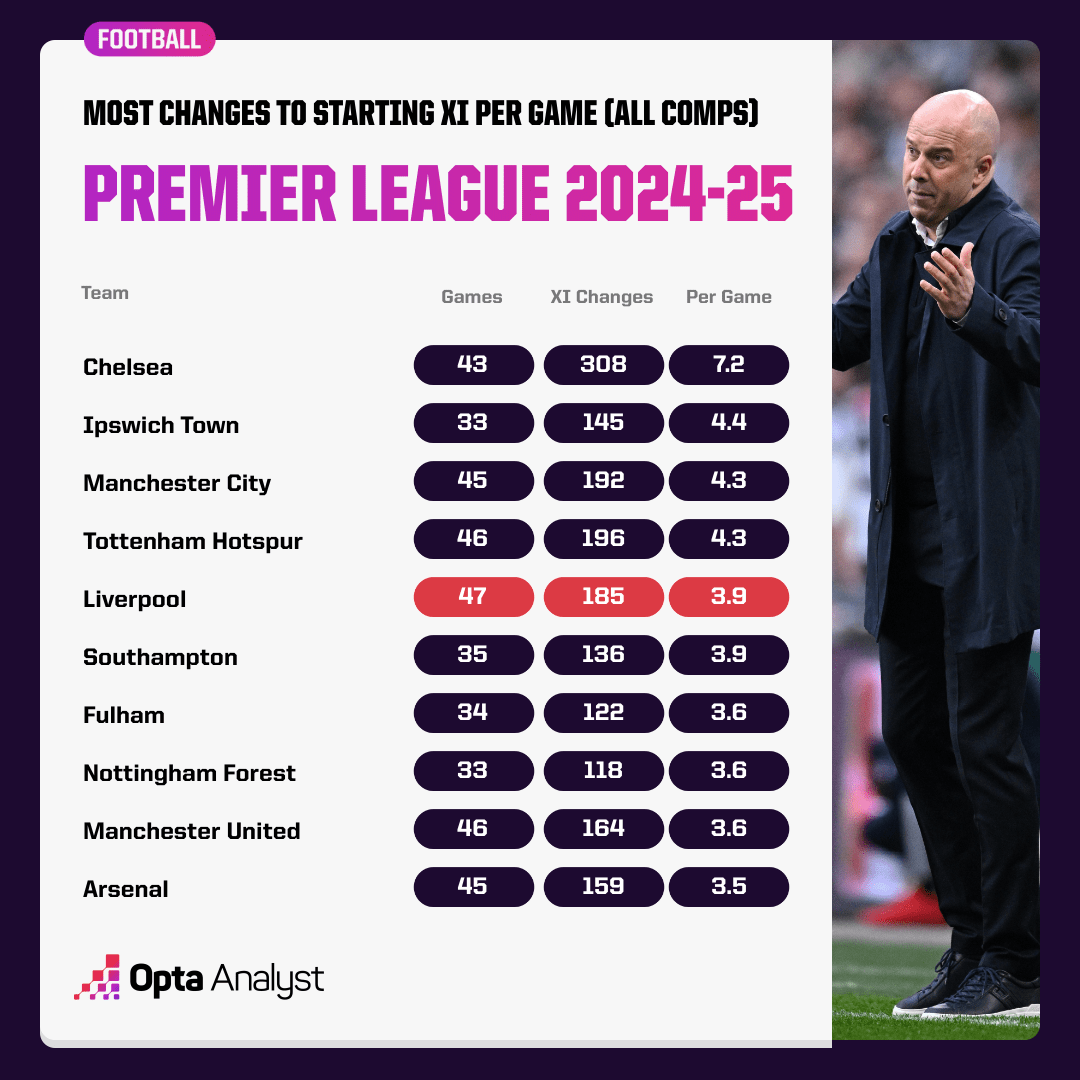
The issue with this way of assessing rotation is that Slot routinely changes eight or more players for domestic cup games, then switches back for the next fixture in the league. If we exclude those matches plus the Champions League dead rubber against PSV, Liverpool have only averaged 2.2 changes between games.
But let’s return to the cup final. If we look at how many 90s players have accumulated as a percentage of the squad total, it is Newcastle who take more of the leading positions when compared with the Reds. This suggests Slot has shared minutes around better than Howe has.
The cup final is just one game. Playing a two-hour match against one of the best sides in Europe five days earlier is likely more pertinent than the playing time accumulated across the first seven months of the season.
Nonetheless, a look through Slot’s managerial career neatly illustrates that he is now dealing with an unprecedented level of demand compared with what went before. This chart shows the most minutes played by his players from his three campaigns with Feyenoord and this season with Liverpool, with the addition of a little poetic licence for the latter.
As the Reds have one game a week once their first double header is out of the way following the international break, it’s reasonable to assume the key players will play close to every minute of every remaining game.
The top three Liverpool players on this chart would be in the top 20 even if the season was already over. If the assumption regarding the remainder of 2024/25 comes to pass, there will be as many Reds listed above as from the last two campaigns at Feyenoord combined. That’s with an early FA Cup exit and about as hard a Champions League season as it’s possible to get too; these numbers could easily rise further next year.
Take a look at Transfermarkt’s page of the most minutes accrued by players in Europe’s big five leagues, which also factors in the demands of cup and international football1.
Who is the leading winger for matches played? Luis Díaz. Which man is fourth for total minutes, topping those standings for both players aged over 30 and also defenders? Virgil van Dijk.
Who is the only forward aged 32 or older with over 3,420 minutes? Mohamed Salah, who is over 500 clear of that mark. Which Dutchman called Ryan Gravenberch has recorded the most minutes by an under-23, the third most by any defensive midfielder? Guess who, it’s Ryan Gravenberch.
Slot has rotated reasonably well in terms of sharing the workload. As he has probably learned this week, the demands of being a Champions League team from England in 2025 mean he must go a step further in future.
Data correct on March 18, 2025