
It started, as attacking moves frequently do, with an innocuous throw-in. Curtis Jones restarted play by hurling the ball to Ryan Gravenberch, who passed infield to Conor Bradley. He transferred possession to Dominik Szoboszlai, who returned it to enable the right-back to find Jones on the left flank.
The #17 passed to Florian Wirtz (as he frequently does), with the German picking out Milos Kerkez on the edge of the penalty area. He crossed to Virgil van Dijk, whose touch steered the ball to fellow veteran Mohamed Salah. The 33-year-old laid the ball back, out of the box, for Szoboszlai to have Liverpool’s first shot on target of the match.
Eight players had combined to produce a 10-pass move that generated a goal attempt which forced a save. A beautiful sequence of play. It was a pity that Liverpool were already 3-0 down to Manchester City at the time, wasn’t it?
Three minutes later, a Kerkez header on the half way line set Salah through on goal for an Opta-defined big chance. Where it had taken 10 passes to produce a 0.03 expected goal chance for Szoboszlai, an 0.25 xG opportunity came via a full-back heading a clearance back whence it came.
That both shots were missed is not a surprise when you look at the data on the Opta Analyst website. The former was classified as a Build-up Attack, the latter a Direct Attack. The Reds have been bad at converting both of these contrasting style of attacking moves in 2025/26.
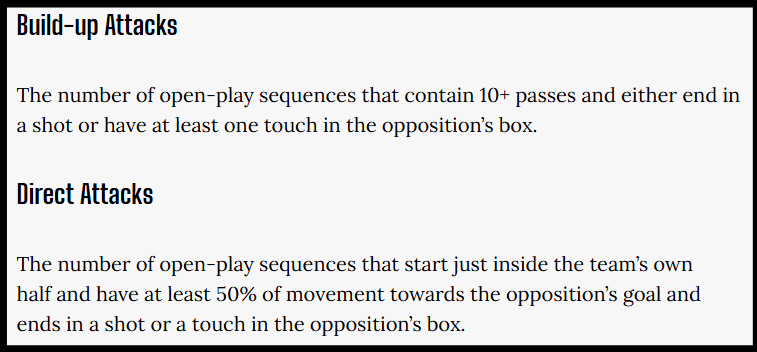
Liverpool have had more shots from direct attacks than any other team in the Premier League this season. Only four teams have had more thanks to build-ups, with just two of those being more than three in front of the Reds. The goal figures are far less encouraging, which brings the tactical plan into question.
Arne Slot has overseen a change in style of play. The following graph is taken from an Opta Analyst newsletter published in September. It shows that Liverpool are averaging slightly fewer passes per possession sequence than last season while moving the ball up field more quickly. Like most of the Premier League, they have become more direct. Check out the direction of travel for the Manchester City comet:
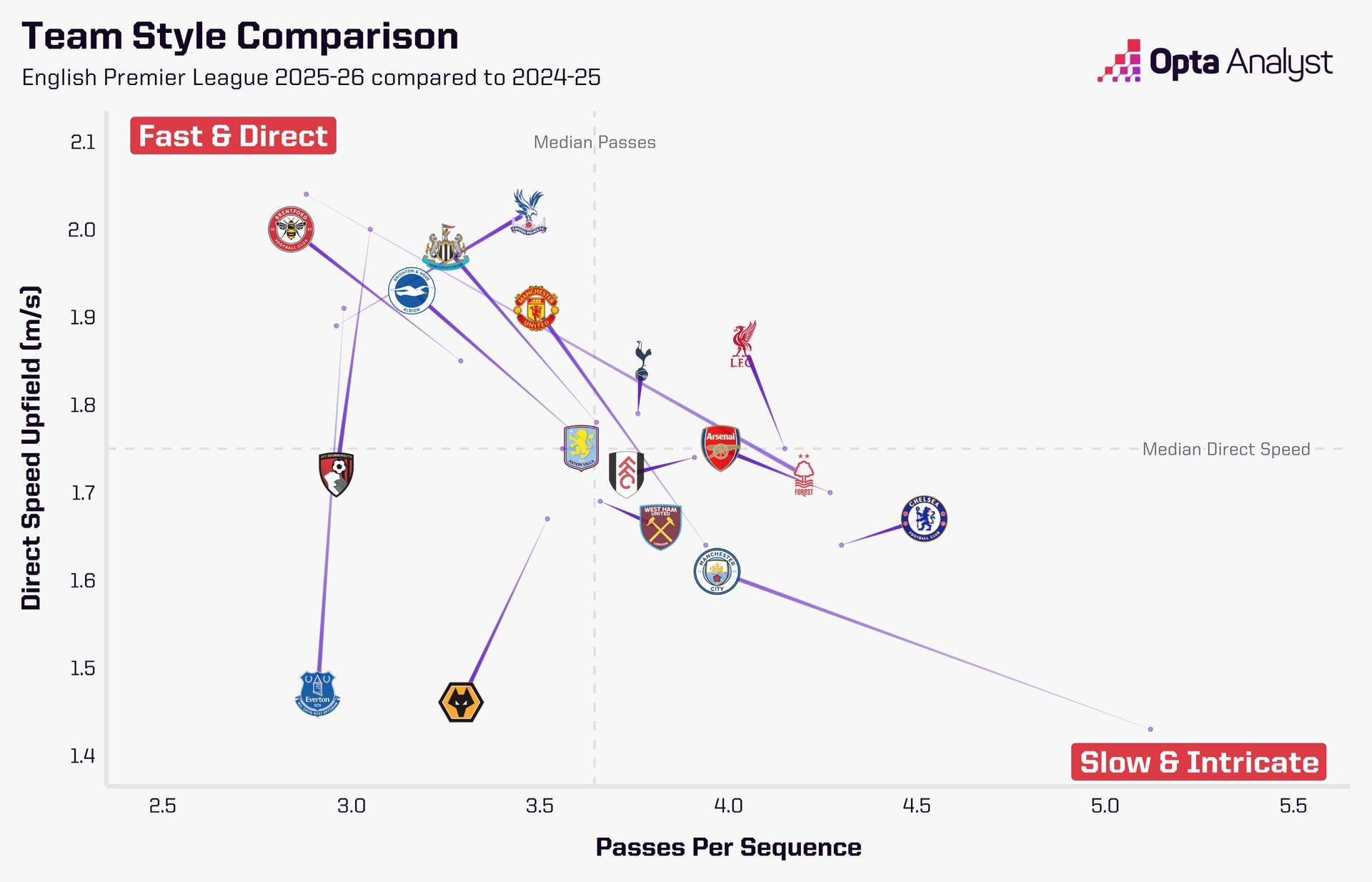
The broad theme remains true today. The Reds are one of only four teams averaging at least four passes per sequence, one of five who move the ball up the pitch at a rate of 1.9 metres per second or faster.
They are a tactical outlier, and not just in England. Applying those filters across the 96 clubs in Europe’s big five leagues leaves Liverpool as the only side standing. Betis, Dortmund, Lille, Villarreal; there are teams in other countries who are close, it’s just that nobody else in England gets near.
As these figures are averages we must consider the game-by-game numbers. Only one of the 11 league matches the Reds have played meets the aforementioned benchmarks. It was the 2-0 win over Aston Villa, one of the better - certainly more controlled - performances of the season.
That is likely a coincidence as far as this data is concerned. Some of the best matches for non-penalty expected goals have been when Liverpool have been more direct, others when they have been at their most considered.
It feels fair to ignore the Burnley match thanks to what a was: 90 minutes of attack versus defence, a non-contest beyond that basic parameter. For the other 10 games, the Spearman’s rank correlation coefficient for Liverpool’s direct speed and non-penalty xG is 0.59, on a scale running from 0 for no correlation through to 1 for being perfectly in sync.
The faster they move the ball forward, the more they create (within reason). We can see this reflected in their sequences leading to big chances in the league, as 22 of the 31 (71 per cent) have featured nine or fewer actions prior to the shot. Just under half (15) have needed no more than five.
For the opponents, the correlation between speed of attack and xG rises to 0.67. Taking out Newcastle (as they had to play for half the game with 10) lifts it 0.71. We could raise the coefficient to 0.83 by disregarding Chelsea, the one team who averaged more passes per sequence than Liverpool, as they generated over two-thirds of their expected goals in stoppage time. We’d be making an already small sample microscopic, but a broad trend looks apparent: faster play = better chances.
How much is deliberate on Liverpool’s end of the tactical equation is hard to establish. Several of their games grew frantic as they chased goals to recover from losing positions. It would be nice if Opta shared the data by game state as it would likely be more insightful.
Nonetheless, despite leading the league for direct attacks in 2025/26, the Reds have generated a solitary goal from them. It occurred in the season opener against Bournemouth, with Mohamed Salah’s stoppage time strike sealing the result rather than improving it.
This means Liverpool have recorded 16 direct attacks without scoring in the 10 games since. While not really underachieving against expectation - the average conversion rates suggest their 21 direct attacks this term merit 1.4 goals - half of the division have scored a higher proportion of their similar moves.
(For the record, both of the Cherries’ goals against the Reds came through Opta-defined direct attacks, as did Kevin Schade’s effort for Brentford. That gives opponents three goals from 15 when 0.9 is the expected goal tally).
Liverpool have been more effective with their build-up attacks, scoring two of 31 to convert at double the average rate. Again, though, they flew out of the traps only to stumble into a drought. Hugo Ekitike’s goal against Bournemouth ended an 18-pass move before 13 preceded Rio Ngumoha’s dramatic winner at Newcastle. There has been nothing similar since, save for the long sequence which led to Szoboszlai scoring the fifth in Frankfurt.
Combining direct and build-up attacks in the Premier League gives Liverpool an overall conversion rate of 5.8 per cent; above average (4.5) but below West Ham (5.9). You don’t want to be below West Ham for anything.
The Reds are an outlier. They can generate shots from lengthy possession build ups or speedier moves. In only three of the 11 league matches this season have they not recorded at least one of each, never blanking on both.
Yet neither approach has worked in terms of goals over the last nine games, even if finishing lies at the heart of the problem. Slot doesn’t need to pick a preference, just figure out a way to make his charges more effective at both methods of attack.
Maybe this is just another way of showing that the team isn't playing that well at the moment. But most teams have their 'thing' (set pieces/long throws/whatever) whereas Liverpool seem to be struggling for an identity this season.