
Liverpool Defending the Danger Zone
Liverpool dropped two points to Burnley thanks to a goal hit from wide in the box. How are they performing defensively in their danger zone?
We looked into Liverpool’s record for attacking in the danger zone - the central area of the penalty area within the width of the six-yard box - earlier this week. Read the analysis here. It’s time to perform a health check on the defence.
Liverpool have conceded some bad goals this season. Like, really bad. Not just in the sense of how they came about, which has often been sickening enough, but also in terms of the timing.
The Reds have let in four stoppage time goals in the Premier League, just one fewer than in the previous four completed seasons combined. Had they occurred with Liverpool 3-0 up, they would not have warranted a second thought. Instead, they have cost the club six points. Arne Slot’s men would be one point off a second place Manchester City side that is stumbling badly without those goals.
Harrison Reed’s rocket was the exception in the quartet as it was struck from distance at an angle. The other three were all hit at very close range in the central area of the penalty box. Liverpool were unable to snuff out the danger they faced in their danger zone when it mattered most.
The alarm was ignored, the monster got them and they paid a severe price.
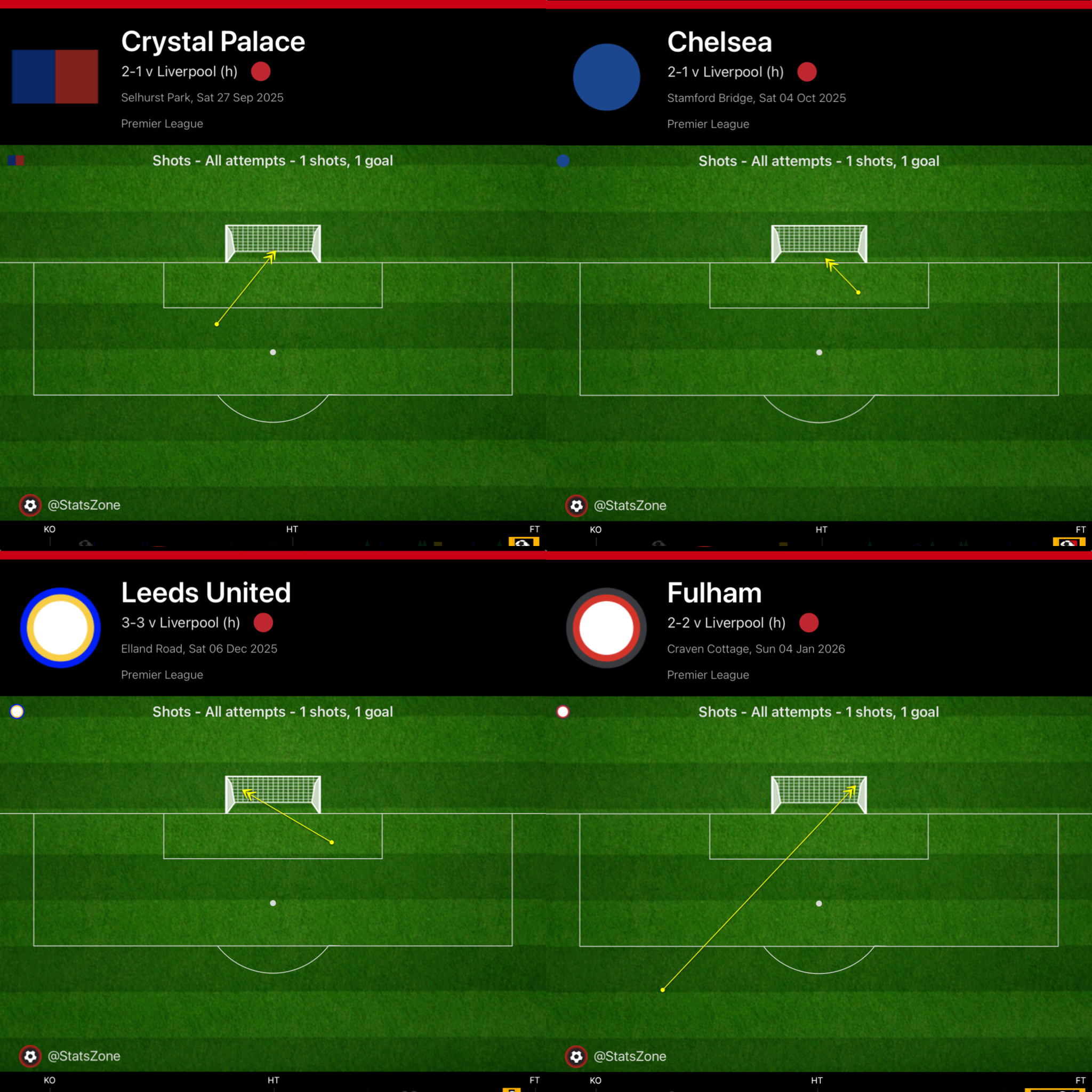
Two of the first three were also set piece goals, which contributed to Aaron Briggs leaving the club. The fourth is the only set play goal Liverpool have conceded in the six games since his departure. While there is obviously a crossover, if you count up the goals conceded by the Reds in the league in 2025/26, shots in the danger zone outnumber those from set pieces.
As they are more detrimental than what many fans would pinpoint as Liverpool’s main defensive shortcoming, we’d better analyse the data. Has the tactical switch to more cautious play following the run of heavy defeats improved their defensive danger zone numbers?
Yes. And not by a small margin either.
The raw numbers have not fallen too far. Slot’s side allowed 5.3 shots per game in centre of their box in the 12 matches which ended (very, very badly) with their 3-0 defeat to Nottingham Forest. That rate dropped to 4.0 across the 10 games since, an improvement of 25 per cent.
It’s also encouraging that the bulk of the 1.3 fewer shots have been in open play (1.2) rather than via set pieces (0.1). The vast majority of attacking will always occur in open play, no matter how much opposition dead ball situations have plagued Liverpool this season. In a season of crosses, Slot deserves a tick for this.
There’s even better news if we dig into the xG. If an improvement of 1.3 on the shot count doesn’t impress you, how about a move from 1.2 expected goals per game down to just 0.5? From 0.9 in open play down to just 0.3? That’s phenomenal.
With so little xG occurring outside the danger zone - it’s about a third of the total allowed by the Reds in open play this term - a team that concedes 0.3 per match in the vital area will not lose very often. Liverpool’s largely uninspiring unbeaten run proves as much.
The red men have conceded 10 open play danger zone shots across their previous five league matches having allowed nine at Selhurst Park alone. Similarly, the xG for the 10 games since Forest is lower than for the defeats against Crystal Palace and Chelsea combined. The shift has been beyond significant.
So significant, in fact, that it betters the best 10-game run for this very niche metric last season too. The xG allowed is so minimal that the xG per shot average is also at a new low for the Slot era, even though there have been streaks with fewer opposition shots.
The theory floated to explain the drop in the Reds’ danger zone output in attack was the reduction in passes, crosses and carries into opposition penalty areas. It would be good to compare those figures here, except that (as I assume you’ve heard) FBRef no longer carries detailed data. It’s a real kick in the teeth for amateur analysts.
We may not be able to compare like-for-like but the Fantasy Football Scout figures for opposition passes into the box and crosses illustrate that Liverpool have improved in the last 10 games.
The combined total attempted has fallen, for starters, which can only help. An average of 26.4 in matches in games one to 12 became 18.7 for matches 13 to 22. Control has increased.
Opposition crosses have become less frequent (2.6 per match from 3.5) and less successful (22.2 per cent completion has shrunk to 17.6). A couple of checks suggest that passes into the box on Fantasy Football Scout include crosses. Either way, there are also now fewer of them being completed than there were in the opening 12 matches (7.5 versus 11.9), at a five percent lower success rate. This is clearly helping reduce the activity in the Reds’ danger zone.
As positive as this appears, don’t forget the attack is down too. We’re back under Rafa Benitez’s blanket, friends. Here’s the shot and xG difference in open play in the danger zone by match, which seems to justify the change in tactics.
How Liverpool conspired to draw with Burnley will always be a mystery. The City game wasn’t as bad as you remember, though the performance against 10-man Newcastle was vastly inferior to the result.
Ultimately, as the figures show, the tactical shift has worked. What the football now lacks in aesthetic beauty, it makes up for in effectiveness. If they can sort out the set plays, this team could really fly.
It's nice to write a positive article. The tide is turning...
This series on DZ shots was great work Andrew ... really appreciate the effort!
Biggest takeaway = credit to Arne for changing tactics after the Brentford match. As you pointed out, we deserved at least 6 more points from the 6 draws since Aston Villa (we'd still be in the title race). Arne has played the hand he was dealt very well (an extremely difficult hand), though you'd never know it listening to media/fan banter. Look at his track record...
First Season: He delivers a league title & is a Quansah-header-off-the-post from making the UCL QTR; all despite: (i) adjusting to a new country, league, or club, (ii) succeeding a legend, (iii) no transfer spend, and (iv) left to manage the player feelings & public controversy re: the contract expirations of Mo/Virg/Trent. Throughout, he demonstrated tactical nous + an ability to get the most out of his talents (esp. Mo, Dom, Ryan, Luis).
Second Season: He's on course to qualify for next season UCL + go for it in this year's UCL despite: (i) the tragic loss of Diogo, RIP, (ii) selling 2 of our best players + 3 reliable squad players, (iii) integrating 6 new players, 4 of which were changing country/league/club, (iv) Alex's late arrival & fitness issues + injury, (v) the dip in form of Mo/Macca/Ibou, (vi) Mo's drama surrounding not starting in 4 EPL matches, (vii) losing Mo to AFCON just as Alex is injured, and (viii) Hughes' inability to close the Guehi deal in the summer. That's a lot of roman numerals! Almost all of these factors were beyond Arne's control & several were sudden or unexpected.
Arne's not perfect but his is a track record of leadership & accomplishment through difficulty. Where other managers (Amorim, Postecoglou) have stubbornly refused to adapt, Arne has changed his game model to play the hand he's dealt as Andrew's data shows. Where others have made public comments against their hierarchy (Maresca, Glasner), he hasn't. He's demonstrated strengths in areas we need in a manager, e.g. (tactical nous, player development, working within FSG's model). Yes, he's got some annoying in-game tendencies and press conference behavior, but that is on the margins. Does anyone doubt that next season, he'll have it easier and develop further as a manager? We'd be fools to replace him with Xabi who's accomplished a lot but is an unknown quantity in the EPL and within the FSG/Edwards model.
Sorry for the long rant but, similar to Virgil's comments this week, I get really frustrated when supporters complain and reach for too-simple solutions (Xabi) vs looking at the facts.