
Liverpool's Big Chances. Part One: The Attack
Welcome to 2:1, a mini-series on how Liverpool fared with Opta-defined big chances at both ends of the field in 2024/25.
Liverpool’s attack in 2024/25 was much more efficient than it had been in Jürgen Klopp’s final campaign. The Reds needed an additional 142 shots to generate the extra 5.2 expected goals they produced in the 2023/24 Premier League. Was it worth it?
Arne Slot honed the attacking process to become more patient, which delivered higher quality goal scoring opportunities. This was evident in his side’s record for big chances, which are defined by Opta as per the below.
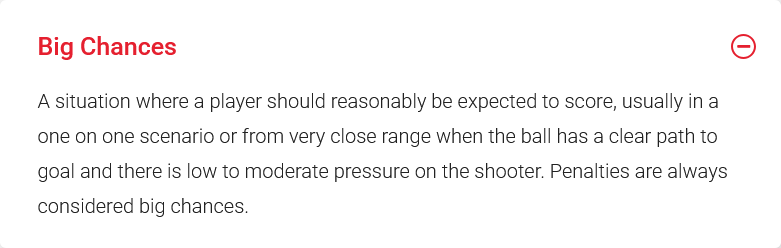
Liverpool amassed 208 of these golden opportunities in all competitions last season, allowing 104 in return. 2:1 isn’t just a song by Elastica in Trainspotting, it’s also a very healthy ratio between attacking and defensive metrics.
We’ll be looking into the back end of the team in the next section of this two-part series. For now, we’ll focus on this fact: The Reds’ total of 144 big chances in the Premier League set a new record for the competition since records began in 2011.
Opta may have relaxed their big chance definition. The record in total across the top flight prior to 2022/23 was 1,485, in 2019/20. There were then 1,559 three years ago, before the tally rose rapidly to 1,820 in 2023/24 then 1,847 last season. Even if Slot’s Liverpool benefitted statistically from this trend, they’re clearly one of the elite attacking units of English football’s enlightened era.
The Reds converted their big chances at a slightly below average rate for the fourth time in the previous five league seasons to undermine their creative potency. Across all competitions, with penalties excluded, they were even worse.
This is impossible to control. Such things inevitably fluctuate from player to player, year to year. They vary by game state too; Liverpool converted more of their non-penalty big chances when losing (47.1 per cent) than when level (34.1) or winning (32.9) last season.
This makes no sense, as finishing should be more difficult when trailing. Randomness is always a factor. As the champions lead for far longer than they trail, regression to the mean across all three game states would be a decent trade off.
The Reds’ attack is about to evolve. A deal is on the verge of completion for Hugo Ekitike, a talented yet somewhat wasteful forward. It has been highlighted that Liverpool didn’t rely upon their central striker for goals last term. This was because the players in that position wasted good opportunities, not because they didn’t have any.
Will this now shift with Florian Wirtz guaranteed to start almost every game? The changes in the full-back positions will also have an impact given their creative value in the past. We need to establish what Slot’s Liverpool did in 2024/25 before we can speculate about what might happen in future.
With 17 big chances teed up in the Bundesliga last term, Wirtz would’ve finished joint-fourth in the Premier League standings. He should logically replace Trent Alexander-Arnold (who created 15) in this respect, albeit he will likely be taking Dominik Szoboszlai’s advanced role, with the Hungarian third in the Reds’ chart with 12.
No matter how the creativity is carved up, Mohamed Salah will remain essential. Even if he eases off a touch with another year on the clock (and with AFCON taking up some of his time), he will be doing so after of one of the most creative campaigns of the modern age.
When you break it down, the level of big chances in which the Egyptian played a part was truly, utterly, insane. Nobody else got close, with the following figures not including the nine penalties which he successfully converted.
Trent being almost matched for pro-rata creativity by Conor Bradley is notable ahead of 2025/26. Milos Kerkez delivered eight big chances for Bournemouth (at a rate of 0.22 per 90 minutes), while Jeremie Frimpong created six (0.23 per 90), so both were broadly at Andy Robertson’s level.
We can take involvement a step further using Opta’s chalkboards. They enable us to see which players contributed to sequences that produced big chances (or any shot). If you want to find some without Salah’s footprint, they’re small, shiny and over there in that haystack.
There were just 37 in the league in which he played no part. Seven of those were set plays which went ‘creator to player, shot’, so with Salah stationed at the back post he was unlikely to be involved. Even he is not a miracle worker.
Another Salah-less set piece big chance followed some penalty box pinball, leaving 29 in open play, 10 of which featured only three or four players in the sequence. The strangest one of the season was therefore put off target by Cody Gakpo against Manchester United at Anfield; 10 men in red played a part in the move, none of whom was called Mohamed.
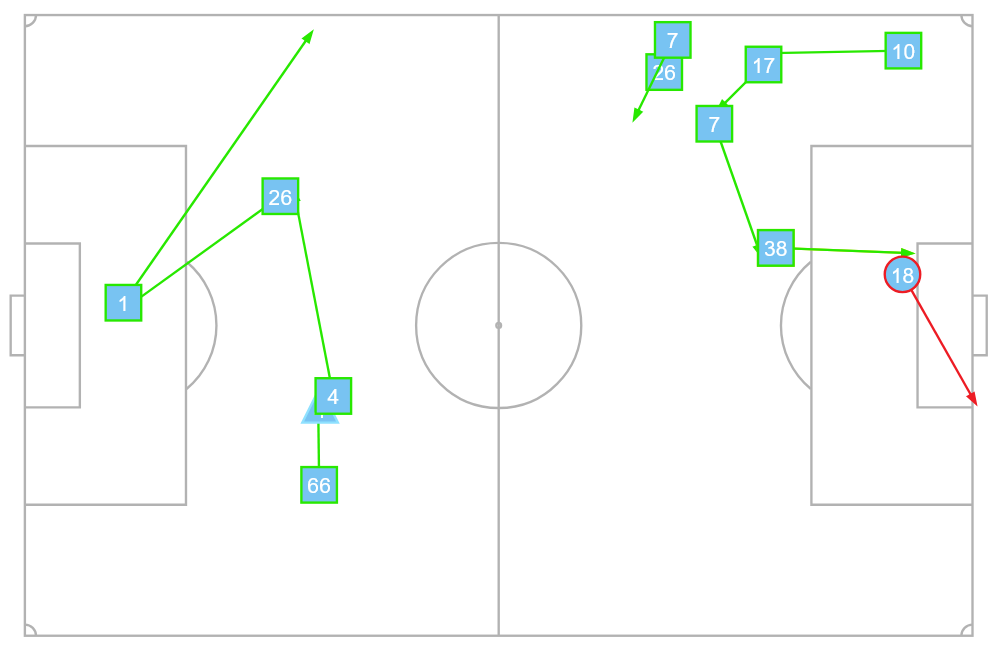
Salah’s dominance of the big chance metric meant he was part of almost all of the leading combinations. This article is like the Oscars or BRITS when one film or singer takes home all of the big awards.
Liverpool’s number 11 linked up best with their number seven, though interestingly his combination with Luis Díaz was more potent when the Colombian was playing on the left rather than centrally.
They produced six goals from their 16 big chances fashioned as a pair. Salah also delivered six with Gakpo, from 12 in total. The Dutchman had the Reds’ leading combination that didn’t feature Mo, producing five golden opportunities with Szoboszlai. This only really serves to highlight Salah’s dominance anyway.
As crucial as productive pairings are, many of them will be lost through line up changes or tactical tweaks. It's more instructive to see how the chances came about, as this will demonstrate what Slot hopes his attackers will produce.
The following descriptions of the chance creating passes are mine, 100 per cent unofficial classifications. They are easy enough to visualise though.
The most frequent way Liverpool fashioned a big chance was with passes which began and ended in the opposition penalty area, with crosses - which were such a hallmark of the Klopp era - second. Combining through-balls (as classified by Opta) with passes into the box would give them the silver medal, though not all of the former would have been received in the 18-yard area.
Either way, the following fact in a recent article on Wirtz illustrates that we can expect him to play plenty of defence-splitting passes for the Reds. “The German international topped the Bundesliga chart for through-balls in each of the last two seasons. Since summer 2021, only Rodrigo De Paul averages more per 90 minutes in the big leagues.”
If we take Wirtz’s through-balls as guaranteed, a recent issue of The Transfer Flow helps explain why the club might pursue Ekitike. Here’s a key paragraph from the piece, accompanied with his shot map.
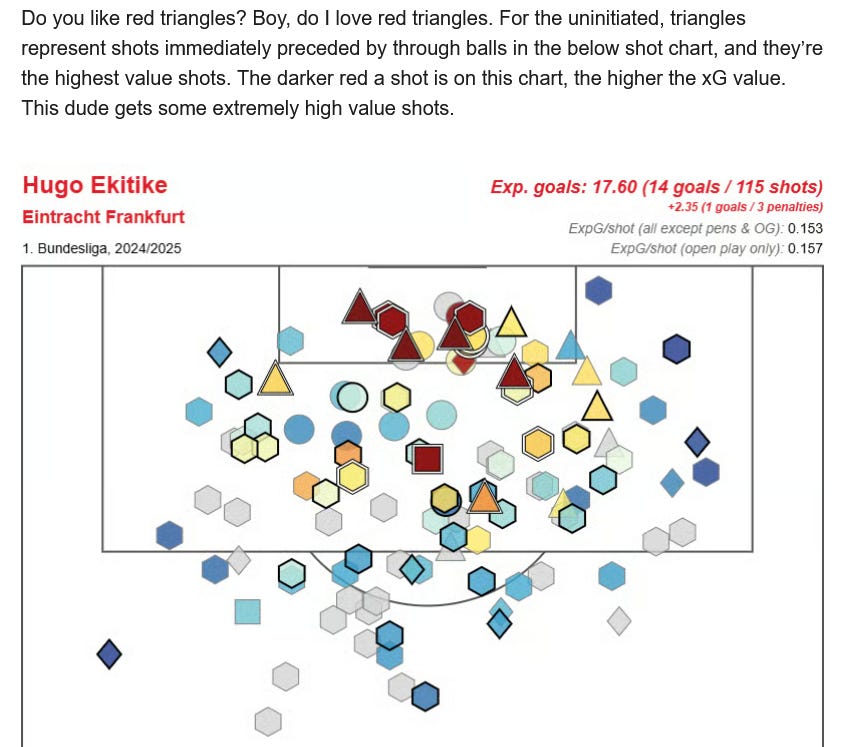
Liverpool are on the brink of purchasing a top through-ball receiver to complement the elite player of such passes that they recently acquired. Building an attack sounds easy when you frame it like that.
Alexis Mac Allister was the top man for big chance creating through-balls in 2024/25, with four, ahead of (yawn) Salah and Curtis Jones on three. It’s forwards who dominate box passes with Mo (seven), Díaz and Gakpo (five) filling the podium.
Here’s where it gets interesting. Szoboszlai was one big chance off a place in the joint-top three for both through-balls and passes within the box, as were Alexander-Arnold and Bradley.
Yet the Northern Irishman played less than half as many minutes as Liverpool’s former first choice right-back. Six of the seven big chances Bradley created came via passes in the box or through-balls, delivery methods that Slot’s Reds favour.
Even his one which was received outside the area was in the ‘D’ on the way to assisting Díaz at Craven Cottage. It was broadly similar to a pass he played through the Tottenham defence in the League Cup semi-final second leg for Szoboszlai’s benefit.
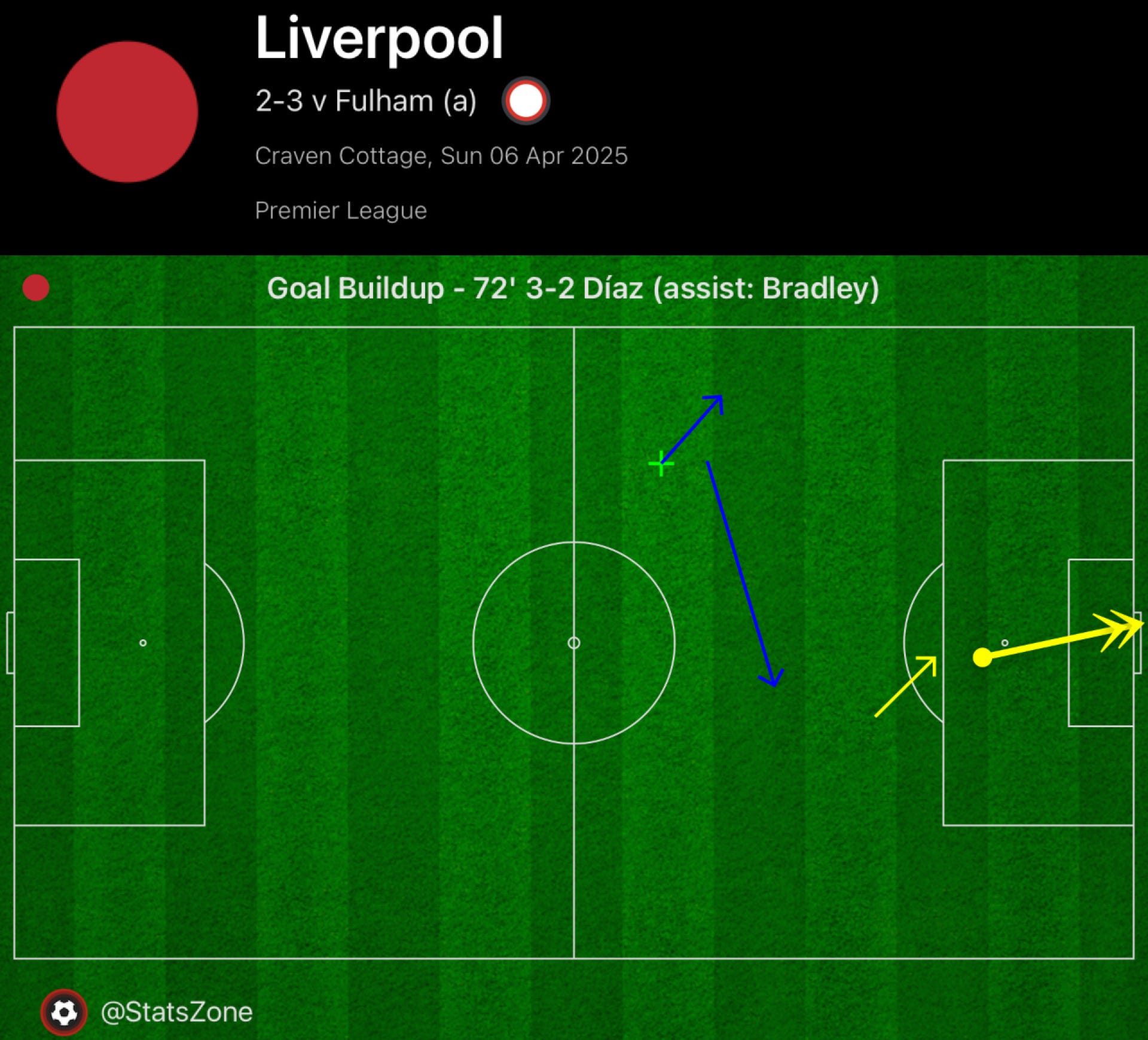
Bradley is unlikely to ever be quite as good as Alexander-Arnold. He doesn’t need to be, though. The 22-year-old looks a better fit for a side that wants full-backs to invert to central areas in front of the opposition box rather than their own.
The 2024/25 data suggests Bradley will create far more with through-balls than Trent did given similar playing time. Wirtz will contribute in similar fashion, as will Salah. The best big chance team of the Premier League’s data era might be about to get even better.
Part two on big chances in defence will follow later this week.
Hope people like the article.
Is it going too far suggest Bradley is the better full-back for a Slot side? I guess we'll find out over the next year or so!
Is that Ryan Fraser on that all time Big Chances board?
That wasn’t even the season of our 4-3 loss, where he seemed to beat us single-handedly.
There’s an article in there somewhere: “Fraser 2018-19”?