
Mohamed Salah is A Man for All Seasons
Mohamed Salah has signed a new Liverpool contract while on a goal drought. It feels like he often hits a slump in the spring but does the data bear that out?
We all need a nudge from time to time.
The background of this website is littered with draft articles, by which I mean posts containing one line of an idea to come back to at some point. Here’s one from earlier this year.

Mohamed Salah frequently dominates the first halves of seasons before fading away after the new year. Or so it feels, with it having occurred often enough to warrant a deeper investigation. While he kept contributing in the immediate aftermath of the creation of that draft, the only output he has to show from his previous six Liverpool games is a pair of penalties against Southampton.
Listening to the latest Distance Covered podcast, I heard Josh Williams discuss with David Lynch the idea of Salah fading late in seasons before suggesting it’s the sort of thing I should look into. They know me so well.
With Salah’s contract extension being announced today, it’s also a good time to assess his record. Perhaps his campaign will be kickstarted by the matter of his future being resolved.
There is strong evidence of the Egyptian’s issues at this time of year in one of Opta’s pre-match stats for the Reds’ clash with West Ham (via Statszone):
Mohamed Salah hasn’t scored or assisted a goal in any of his last four games for Liverpool in all competitions, his longest run without a goal involvement for the club since March 2021 (also 4). Only in March 2019 has he ever gone five appearances without a goal or assist for the Reds.
Not a fan of March, Mo? As the trivia implies, it is not his strongest month for goal contributions, but research shows neither is it his weakest. Salah also has a clear leading quarter of the year, albeit the underlying data suggests his hot runs are somewhat random. We have the factor of Ramadan to consider too.
The statistics which follow have been calculated using months, which are utterly arbitrary portions of days, with the requirements of the fixture list bending time further. Salah’s favourite month for both goals and assists is December, though it is also the one in which he has played the most football for Liverpool.
Even so, if we strip out penalties - which is the case for all of the data which follows - the final month of the year remains the Egyptian’s most productive per 90 minutes played.
(We will be ignoring June and July, as the sample sizes are predictably small. Were it not for the pandemic, Salah’s only game in either month would be the 2019 Champions League final).
As autumn turns to winter, Salah comes to life. His record in the final three months of a year is remarkable when compared to the other three quarters; he averages 1.04 non-penalty goals and assists per 90 from October 1 to December 31, 0.77 for the rest of the season.
That’s still a phenomenal record when he’s not quite at peak performance. Harry Kane, for context, recorded 0.75 for this metric across his Premier League career. Even though Salah tails off once a new year has dawned (to the horrendous depths of 0.73 npG&A per 90 from January through March), he’s downgrading from superhuman to merely elite. It’s a problem we’d all love to have.
The obvious issue to resolve is why it happens. A look at the underlying advanced data for Premier League and European matches begins to reveal the degree of random variation involved. You can’t escape chance when analysing football.
December remains Salah’s leading month by this measure, but the order below that has shifted. Early months of years again prop up the rest, once more at a high level; the 32-year old’s underlying performance in Februarys are broadly in line with the Premier League careers of Alexander Isak (0.70) or Raheem Sterling (0.67 since 2017).
If we plot the combined numbers from the above charts against each other, it shows that the range of monthly figures for actual output is far wider than it is for Salah’s underlying metrics.
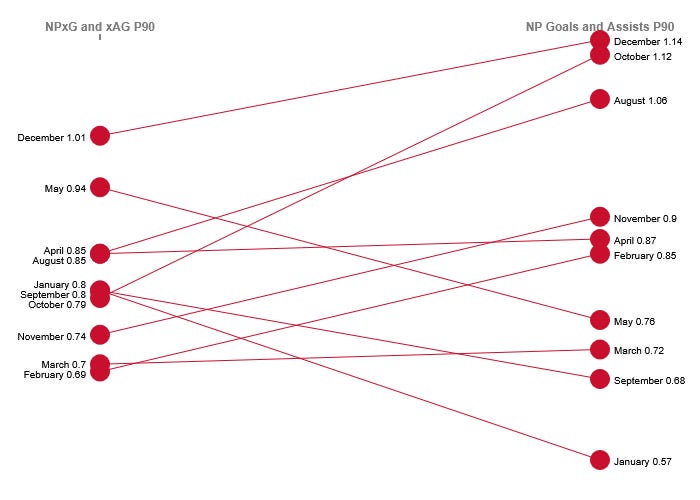
Liverpool’s number 11 has delivered essentially twice as many non-penalty goals and assists in Octobers than he has in Januarys despite the expected numbers for the two months being virtually identical.
In Salah’s strongest quarter of October to December he has outperformed the underlying statistics by 0.21 per 90, whereas he is fractionally down (0.01) across the other months. His npxG and xAG were 0.05 and 0.01 per 90 higher respectively for the fourth quarter of years, not enough to determine the output margin.
The great, good and Micah Richards have floated the theory over the years that fasting during Ramadan could be the explanation for any dips in form which Salah suffers around this time of year. I must stress I am no expert, but as it is the ninth month of the Islamic calendar which is based on 12 lunar cycles, Ramadan is not at the same time every year.
Salah has played 30 games which fell within the dates of Ramadan as observed in the UK. I also thought it would be interesting to look at the games from the first month following Ramadan (Shawwal) too, as his body potentially readjusts after a period of fasting during daylight.
Again, I am no authority in physiology, just interested in what the numbers might suggest. Below are how his statistics for matches with advanced data compare. It may be better to view the graph on the site (here) as hovering over the columns reveals the numbers and isolates each section.
In terms of combined xG and xAG, Ramadan is better for Salah than the rest of the season. As with the monthly data, though, the output is random. Could his inability to convert chances at that time be down to not being in peak condition through fasting? It’s an easy connection to make, which doesn’t make it accurate. Besides, the drop off is even greater in the month following the end of Ramadan.
When people say he struggles around this time of year, they forget his four goal game against Watford in March 2018 or his pairs of both goals and assists when Manchester United were thumped 7-0 five years later.
The final two of six blocks in the above graph sum it up neatly. Salah remains a potent attacking force all year round, no matter how you chose to slice the data. His goal contribution output varies at different times because they do for every player.
If an occasional quiet month is the price to pay for someone who delivers a goal or assist every single match on average, Liverpool fans will be more than happy to accept another two seasons of that.
Surprised at the findings? I'm not in the sense of him having a dip in the spring... should've known the xG data would've been fairly consistent regardless.
Anyone have any theories for an explanation for the slowing down in goals and assists beyond random chance?!