
Mohamed Salah's Lesson in Fickle Finishing
Mohamed Salah has scored two goals in two games after a bad run. His standards have slipped but have Liverpool done all they can on the pitch to help?
Football is so random. The best player or team can go on an epic slump while another side can amass win after win that they don’t deserve.
Liverpool and Mohamed Salah recently fell head first into the former category. The Egyptian went four starts without a goal, though the greater concern was that he looked like he’d barely seen a football before, never mind played the game. His touch was so off that finishing was the least of his worries.
Salah then lashed home a brilliant strike with his weaker foot at Brentford, before being handed a gift by Emiliano Martínez on Saturday. Drought ended, he is back on track to be the most productive 33-year-old the Premier League has ever seen.
Only the latter of these two goals was classified as a big chance by official data provider Opta. Liverpool’s number 11 had been on a run with these golden opportunities so poor that it would embarrass Darwin Núñez.
We’ll ignore penalties in this study as they are their own thing. Salah converted his final big chance last season after missing 11 in a row, then put one away from his first 10 in 2025/26. He scored just two out of 22, a nine per cent conversion rate when four times that still wouldn’t reach par.
To frame it another way, if we assign each big chance the average value for one rather than focussing on individual shot xG, a player is likelier to score 15 of 22 (which has a 0.35% probability) than two (0.25%). Yet as crazy as it sounds to say for a man with 250 Liverpool goals, Salah hasn’t been a spectacular finisher over the years.
Per FBRef, he has scored 8.8 non-penalty Premier League goals more than expected during his time with the Reds. He was, however, at +8.4 after his incredible first campaign. Salah’s 887 shots since the summer of 2018 have seen him collect 0.4 goals above xG, or 0.0005 per shot. Anyone got a microscope?
Despite this, he has usually kept his head above water for converting big chances. So what happened? Was he at fault or was it the opportunities themselves? Let’s review some numbers and clips.
Salah’s record with Opta’s ‘should score’ shots in 2024/25 only emphasises the point about his finishing. His 43 efforts that were deemed big chances were worth 14.1 expected goals; he scored 14 of them. The dry spell at the end of the campaign was just a correction to bring the Egyptian King in line.
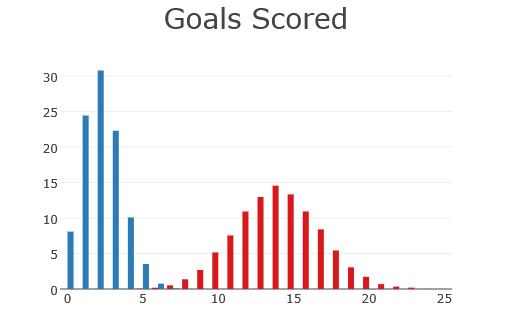
This season has been the same, with two big chance goals from 2.17 xG. The likeliest totals scored are also 14 and two respectively when simulated with the individual shot values, as per this chart:
So far, so expected (in more ways than one). There is an extra point of interest in relation to the quality of the chances though. As these are all shots where “a player should reasonably be expected to score,” their expected goal value is in one sense irrelevant. Some will inevitably be easier to convert than others but they should all favour the attacker regardless.
In the case of Salah, the 11 big chances he has had this season are of lower average xG value than any other batch of 11 since the start of 2024/25. Plotting the trend on a graph also reveals why the Reds’ right forward was so influential in the first half of last season: his chance quality was absurdly high. Even an average finisher will make hay with this repeated grade of opportunity.
This brings us to one of the key questions of Liverpool’s season so far. While both things can be true - they will be to some extent - has the Reds’ poor form been down to Salah or has he been dragged down by the openings he has been given? Even his big chances have mostly been, well, quite small.
Take these four, for instance. Salah’s clear shots at goal are hampered by having the goalkeeper in close proximity. If they feel like big chances when he receives the ball, they have shrunk by the time he takes the shot. Better control of the ball would’ve helped massively in some of these situations.
The last of these examples, against Crystal Palace, is not the only one this season where Salah received a bouncing ball over his shoulder. It’s hardly the same as being put clean through with a defence-piercing pass along the turf. There are plenty of Premier League forwards who wouldn’t be able to even take a shot in this scenario.
New relationships also need to be forged. Hopefully Salah and Florian Wirtz become attuned to the same wavelength before the veteran leaves the club. As magical as the German’s flicked pass at Stamford Bridge was, the ball was closer to Marc Cucurella (see below), with Salah needing to cover decent ground to get there first. Had he anticipated the direction of the pass, he’s likelier to score.
If we can explain or excuse some of the above, there have been bad finishes too. At Selhurst Park, Salah deflected a Dominik Szoboszlai effort when in an offside position. It’s a big chance that would’ve been struck from the record had he converted it while also possibly denying a goal to his teammate. Oh, Mo.
But when it comes down to it, Salah can still put a big chance away when the conditions are favourable. That appears to include the opportunity being at the Anfield Road end.
It is up to Arne Slot to help his team tilt the odds in Salah’s favour more often. Football is so random that they need to do this to prevent the Egyptian and the Reds nosediving into another slump.
As with anything, there is more than one explanation. But the supposed best chances Salah has had this season have frequently done him few favours.
Good stuff Andrew. Because data alone can miss important context, the clips were particularly valuable to judge the shot quality for myself. Appreciate the work you put into this. The data on finishing matches matches the "eye test" in recent seasons, i.e. he's an average finisher. Beyond finishing, there's also been a big decrease in the # of "quality" np shots and that's not all on Mo.
An elite forward needs to take lots of shots from the danger zone (6-yd box extended to 18 yards). I like looking at shot count from the danger zone bc forwards of Mo's ability can often score shots that an "average finisher" can't. It gives you another data point along side np xG. In the EPL this season, Mo's getting 1.4 shots per 90 inside the danger zone (vs. 2.0 & 2.4 the previous two seasons). That's 30% fewer shots from a good location vs. last season. Yikes!
He's also down in np xG shots worth 35% or more per 90. A 35% probability is my unscientific definition of a "good chance". Mo's only had 0.10 such chances p90 this season (vs. 0.56 and 0.60 the previous two seasons). That's an 80% decrease!
Some of this decline is down to Mo but a lot is the shortcomings of other factors, e.g. the tactics and the team around him.