
Who is Liverpool's Prince of Sprints?
Does sprint data tell us more than distance covered statistics? They might but not in the way you would necessarily think.
The previous edition of this newsletter looked at the distance covered by the teams in Liverpool’s Champions League matches. It’s now time to look at the sprinting numbers.

We have an issue here that the previous article did not. The distance a player covers isn’t up for debate. It is fact. What constitutes a sprint seems to vary between data providers. Here’s a list from a recent Driblab newsletter
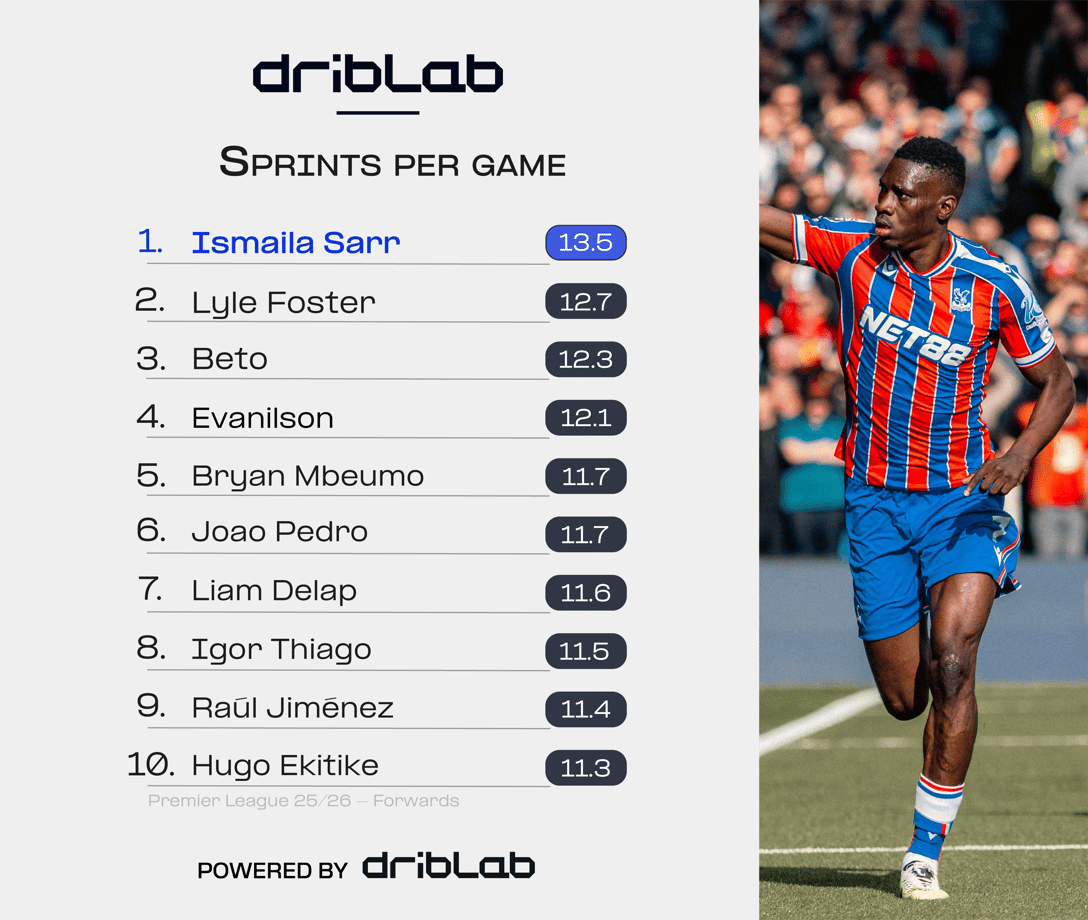
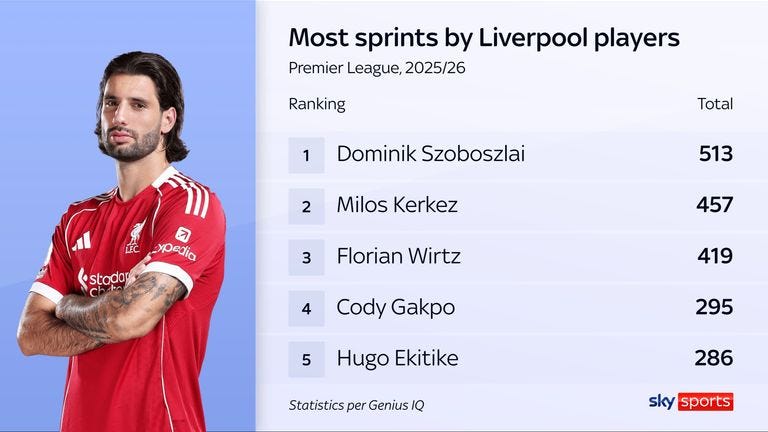
We can see that Hugo Ekitike averages 11.3 sprints per league game. Yet based on the below figures from a Sky Sports article that was published earlier the same week, Liverpool’s number 22 had averaged 11.9 per match.
That difference could be down to the data being cut off at different times, not that the Reds played between the two dates. The below figure for Cody Gakpo also suggests he should be on the Driblab list when divided by his games played (assuming he’d be classed as a forward).
Regardless, sprint data drips out here and there without much in the way of a regular source or any context. Another recent example was provided by CIES Football Observatory, who posted the top 20 Champions League players for maximum speed for five different positions. Liverpool had a man in four of the categories, shown here:
It’s unsurprising that ‘Side midfielders/wingers’ is the one classification in which the Reds have no representative, as it has been the most problematic position. The area of an Arne Slot team that most needs pace and trickery has largely lacked it in 2025/26.
Having started on the wing against Galatasaray in the league phase, Jeremie Frimpong could arguably be counted, albeit four of his five Champions League starts have been at right-back. Wherever he plays, only three men in the study - Gonzalo Garcia, Oleksii Kashchuk and Anthony Elanga - have covered a higher percentage of their distance in the highest speed category.
Have the likes of Cody Gakpo and Mohamed Salah been strolling down the flanks this season? We’ll need to interrogate the match-by-match data on Fotmob.
Christos Tzolis of Club Brugge and Vinícius Júnior have recorded the joint-most sprints so far this season (148), four more than Anthony Gordon. Their clubs were all in the play-off round, as was the team of the sprints per 90 minutes leader: the aforementioned Kashchuk of Qarabağ FK, with 24.7. That podium is filled with Alisson (not that one) Santos of Sporting (23.1) and Andreas Helmersen (22.5) of distance leaders, Bodø/Glimt.
In at number 11, alongside Omar Marmoush on 20.5, is Milos Kerkez. If we ignore players with fewer than 180 minutes played, Frimpong is next for the Reds on 19.7, with the somewhat surprising name of Alexander Isak (16.6) stamped on the bronze medal.
Comparing these men with counterparts at other Premier League clubs suggests Liverpool sprint more than most other English sides (as Fotmob unfortunately doesn’t provide team figures). Marmoush has no colleagues at Manchester City averaging above 14.4 sprints per 90, when the Reds have Conor Bradley (15.2) and Cody Gakpo (14.9) providing able support behind their aforementioned trio.
Only Newcastle (six) have more players above the arbitrary bar of 14.4, with Tottenham also on five, Chelsea at three and Arsenal on two. The top per 90 sprinters for those clubs are Elanga, Destiny Udogie, Alejandro Garnacho and Gabriel Martinelli respectively. If you play on the flanks, get ready to sprint.
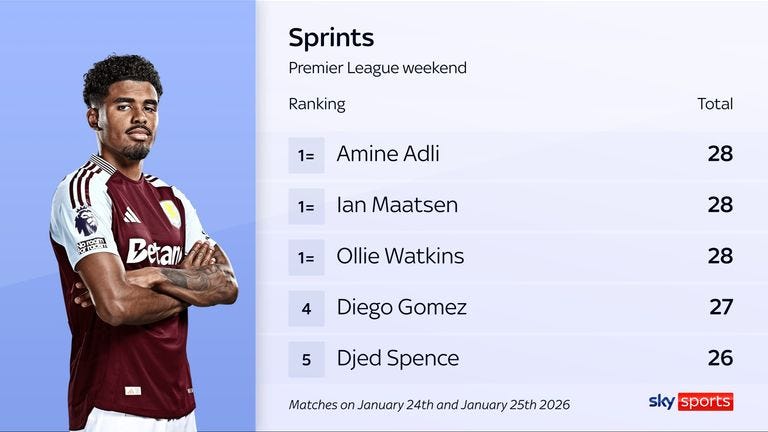
As well as having their highest average, Kerkez is also Liverpool’s top player for sprints in an individual game thanks to recording 26 against PSV Eindhoven. While we must again be wary of different sources using different criteria, another article from Sky Sports suggests that this total is in the upper echelon of what occurs in a given Premier League weekend.
Arguably more impressive than the total was the distance. Kerkez sprinted across 608m of Anfield turf in the PSV debacle, at least 88m more than anyone has managed in any European game involving the Reds this season. The Hungarian also posted the second furthest sprint distance by a Liverpool player in the 2025/26 Champions League, with 483m in the Stade Vélodrome.
Just as Florian Wirtz delivered the two highest proportions of team distance covered in our previous study, so Kerkez does with sprints. It’s on a different level, though; Wirtz peaked at 11.0 per cent of Liverpool’s distance (in Frankfurt), whereas sprinting is shared around far less fairly.
This again highlights the players on the wings. On top of the obvious names, Wirtz played right midfield in a 4-4-2 against Frankfurt, while Dominik Szoboszlai had a similar position when Slot opted for a diamond midfield in the San Siro. Ekitike and Isak clearly had to work harder than usual in the front two that night too.
Despite appearing more times than Frimpong in the above list, Kerkez is only marginally ahead of the Netherlands international when it comes to the proportion of distance covering that was done via sprints this season. Fotmob carry figures for walks and runs, enabling us to see the proportion of each.
The player data doesn’t provide too many surprises whichever way we slice it. You don’t need these figures to know that Frimpong and Kerkez sprint most for Liverpool. It is the team numbers which perhaps deliver a greater level of insight.
For instance, the Reds’ share of the sprint distance has been above their proportion of the total distance covered in seven of their eight matches.
It doesn’t correlate with winning, as the match with Real Madrid is the exception. However, this data also doesn’t suggest a lack of effort from Liverpool either. If you think Slot has lost the dressing room (to use a horrendous cliche), these figures do not fit with a side that is going through the motions.
The most interesting aspect of the sprint statistics may lie in illustrating the pace at which a game was played. The sprint totals for the Reds’ matches hint at this, with the top four all occurring in the cauldron of Anfield. Slower, more controlled games on the road are how you engineer a (horrendous cliche alert #2) ‘classic European away’.
Think back to the Inter game; slow, wasn’t it? If you had to blindly rank Liverpool’s European matches this term from most to least chaotic, the order wouldn’t be too far from simply ordering them by their sprint total.
As long as his men are on the right side of the result this time around, Slot won’t mind if another match in Turkey is at the quieter end of this scale again. He might not have too many rotation options but the starting XI and formation will likely hint at how much sprinting we can expect if the league phase has been any indication.
I've gone early with the first newsletter of this week as it will be a little out of date by about 7:30pm tomorrow night!