
Basic Stats Suggest Liverpool Have The Best Attack In The Premier League's Data Era
Liverpool might not be as exciting to watch under Arne Slot as they were when Jürgen Klopp was in charge but they are more efficient.
“XG is a load of nonsense”
SOME GUY - IT’S ALWAYS A GUY - REPLYING TO ME ON SOCIAL MEDIA RECENTLY
Football data is now incredibly detailed, even when only having access to that which is available online for free. With expected threat building on the xG models which went before, everything in the game has a value.
As the old saying goes, not everything that can be counted counts and not everything that counts can be counted, though. If not ‘a load of nonsense’ as some would suggest, expected goals is not sacrosanct. Do you think Arsenal fans were bothered that their five goals against Manchester City came from their total chances valued by Opta at just 1.0 xG? The quote at the top of the page should give you a hint.
We saw with Liverpool’s recent 2-0 win at Bournemouth that their two highest value non-penalty chances were offside and arguably more of a pass than a shot respectively. As useful as expected goal models are, we can still learn a lot about a team’s attacking process through basic statistics which would have been available over 20 years ago.
Another recent 2-0 victory for the Reds proves the point. Liverpool had 37 shots at Brentford last month, the most by an away team in the Premier League since records began in 2003. It matches the total posted in a Merseyside derby win at Anfield almost nine years ago. However, there’s a noticeable difference between the shot maps for the two games.

Everton finished 2015/16 in 11th, the position Brentford currently occupy. While these opponents were therefore of broadly similar standard, the Blues played almost half of the match deservedly a man down on enemy territory. Despite these advantages, the Liverpool of Jürgen Klopp’s first part season took 19 shots from outside the penalty area, compared to just nine for Arne Slot’s present day vintage.
To anyone with a passing interest in football data, this isn’t a surprise. As thinking has evolved regarding shooting choices, so the proportion of shots that are taken from within the 18-yard box has grown in almost linear fashion year-on-year.
Liverpool have broadly followed that trend, taking it to a new level this term. Slot has built upon Klopp’s work, with a combination of box shots and another basic metric suggesting the Reds of 2024/25 might just be the most potent attacking force the Premier League has seen in the data era. If that is the case, then they are probably the best ever.
Let’s amend the graph to include Liverpool’s figures. They show that Klopp inherited a side which was not even attacking at league average standard by this simple measure. His Reds quickly put par in their rearview mirror, and though they fell below that in his final campaign, their sheer shot volume ensured the Liverpool of 2023/24 averaged more box shots per game (13.6) than any team in the last 15 seasons.
Relying on shot volume to generate a decent xG total was far from ideal (as this analysis of the numbers showed). Slot has found a new peak for the club, with 73.2 per cent of shots taken in the box. This not the highest proportion in the top flight this season, with both Brentford (at 74.8) and Arsenal (75.2) riding higher. But neither the Bees (11.5) nor the Gunners (13.7) average close to the shot volume of the Reds (17.9 per game), meaning the latter take the most from within the penalty area.
They are about half a shot per game down on last seasons Liverpool side. They are more controlled and efficient, though, which may help explain their lower injury rate. Taking one fewer goal attempt in the box every two games is a fair price to pay for having a fully fit squad when the campaign entered February.
A huge part of the change rests with Mohamed Salah, the player whose 2024/25 shot map adorns the top of the page. He has fired off 90 goal attempts in the league, one more than Liverpool’s next two players for shot volume - Luis Díaz (46) and Dominik Szoboszlai (43) - combined. With only seven of the Egyptian’s efforts stuck from behind the 18-yard line, a stunning 92.2 per cent of his shots have been taken inside the box.
The trio of Erling Haaland, Reds-linked Antoine Semenyo and Cole Palmer are the only players with more shots in total in the Premier League than Salah has taken in the box alone. While pressing less appears to help the 32-year-old score more goals, generally trying to do so from closer range doesn’t hurt either; Salah’s average shot distance of 14.8 yards is lower than in any of the previous seven seasons. Since 2017, there have been only four players who’ve had as many shots over as much playing time from at least as close, with all of them representing Manchester City and three of them Haaland.
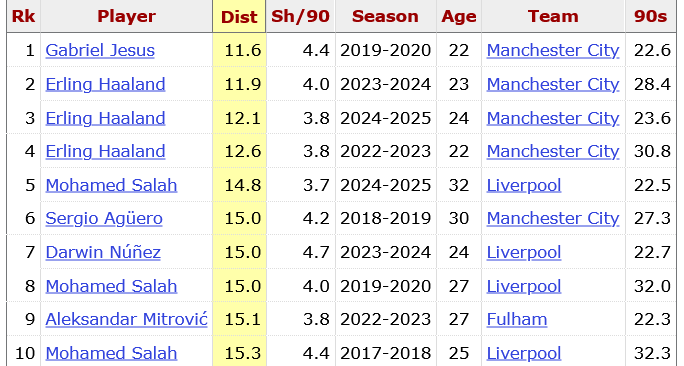
Uh-oh, we’ve strayed into advanced data territory. Our favourite poindexter expected goals will rear its head if we’re not careful. The point of this was to show the power of the Reds’ attack using basic metrics. We’ve established they have good shot locations, but do they test opposition goalkeepers enough?
Yes.
Slot’s boys are averaging 6.9 shots on target per game. Even though it’s a decrease on last season (7.3), only five of the last 300 team seasons in the Premier League have been better. And here’s the kicker. There are better teams for this metric and stronger sides for proportion of shots in the box, but none that are ahead of the current Liverpool for both.
The below chart shows how every Premier League side since 2009 fares for these two data points. Slot’s Eredivisie campaigns have been added in orange, with Liverpool marked red. Hover over any team (if on the website) to see who they are.
There is no correlation here, no apparent link. To be elite at either metric would be quite the thing. To excel at both? Chef’s kiss.
Of course, to figure out how Liverpool are doing this would involve a deeper dive into the fancy numbers. That can wait (probably just until Friday, if you’re impatient). For now, bask in the Reds being the only team of the data age to be in the top 20 for both percentage of shots in the box and shots on target. They’re top six for both, in fact. Who needs that load of nonsense, xG, eh?
What do we think then, folks? Too grand a claim? 'Best' or not, Liverpool score incredibly well in two very important shot metrics.
And that'll do for me.