
Putting Alisson's Paris Heroics Into Context
Alisson Becker's shot stopping against Paris Saint-Germain was the best performance of his career. What else makes the Liverpool #1 so good?
The previous edition of this newsletter, published on Wednesday, looked into whether Liverpool have been lucky this season. On the same evening, at the Parc des Princes, the Reds proved that they have been by beating Paris Saint-Germain despite losing the expected goal count by 1.8 to 0.3.

As much as the match fell into the ‘Twenty-Seven Shots Good, Two Shots Better’ camp, it wasn’t an outlandishly fortunate victory on xG difference alone. Per FBRef, there have been 17 wins with wider unjust margins in the last eight seasons of Champions League football alone.

If karma can determine such things, note that PSG benefitted from the most unlikely win in that period while the Reds were on the wrong end of the second harshest loss. Maybe luck does even out in the end after all.
Not really, of course it doesn’t. What gives, are you new around here?
Besides, is it lucky to have the best goalkeeper in the world? Because Liverpool would not have won in Paris were it not for the performance of Alisson Becker. Not only did he record his best shot stopping performance from his 320 entries in the FBRef database, the Brazilian also collected the pre-assist for the only goal of the game.
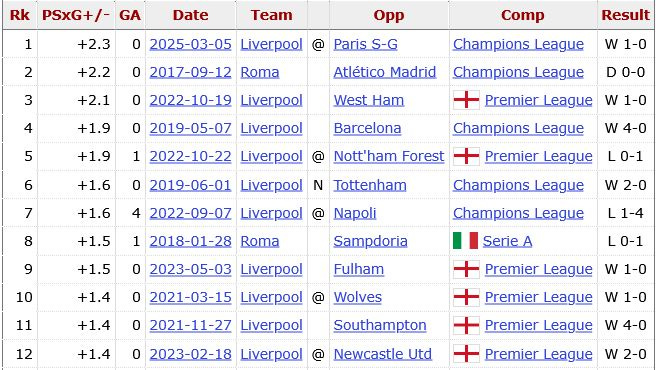
There must be thousands of games with advanced Opta data at FBRef. Only once in all of them has a goalkeeper saved more post-shot xG (a.k.a. xGOT) when also recording one of the two actions directly prior to a goal being scored. If you can name him without checking here, please collect your $1m prize from reception.
According to The Analyst, there have only been five instances of a higher xGOT total being repelled for a clean sheet in a Champions League knockout match since 2010/11. We really are talking about the best of the best of the best, sir. With honours.
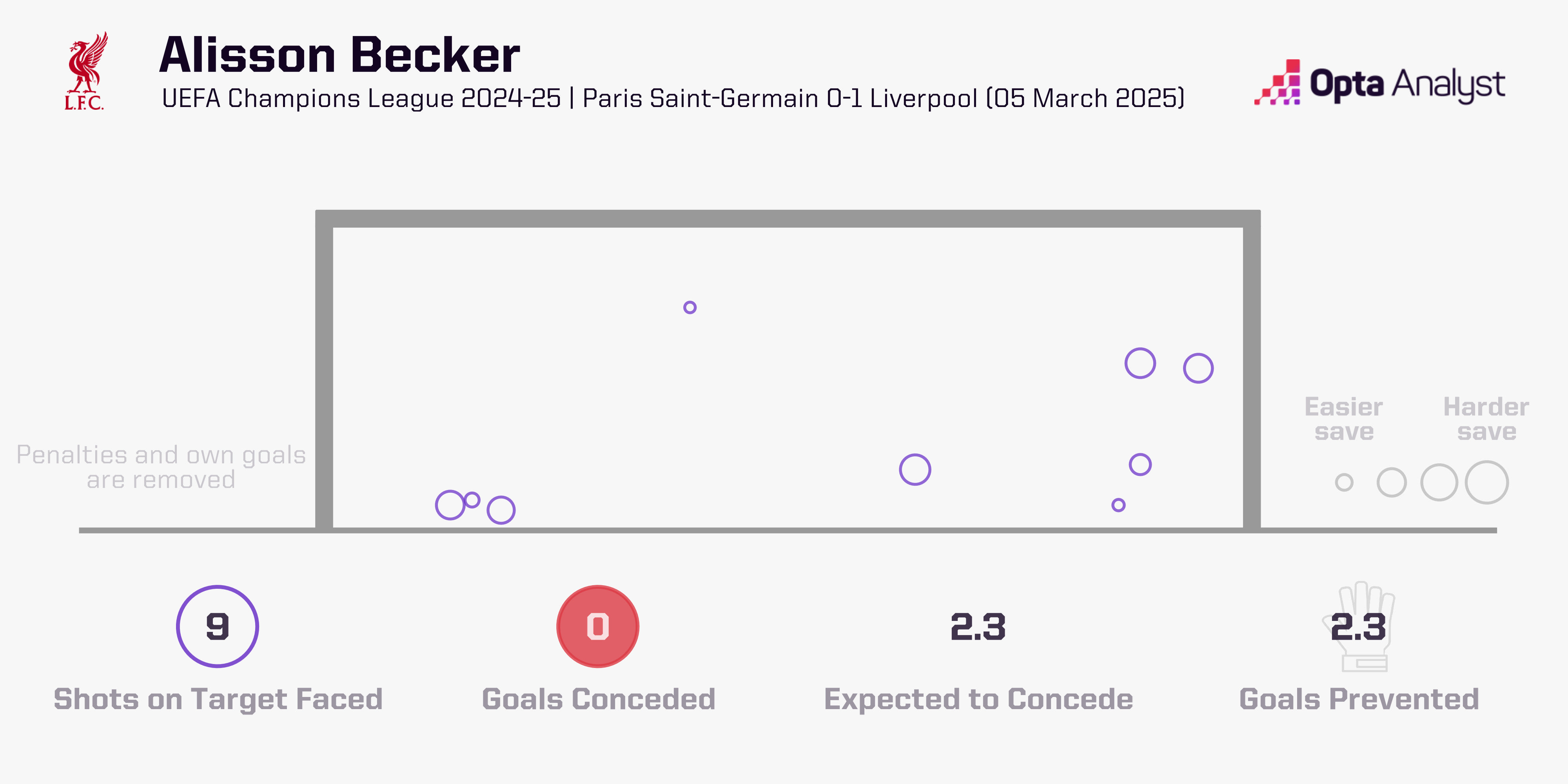
That Becker was capable of such heroics is hardly a surprise. He’s been one of the best goalkeepers in the world for pushing towards a decade, maybe even the number one number one. Yet doubts were expressed among the Liverpool fanbase in recent months, suggestions whispered that perhaps the holy goalie is finally past his best.
A record of saving 0.1 post-shot xG more than expected in the Premier League since the start of last season suggests as much. Alisson Becker has been average for almost two years when he seems anything but. The Independent ranked his nine saves against PSG but we’re going to go deeper than that. It’s time to take a dive into the bottom corner of the goal that is Alisson’s data.
Without wishing to undermine what the 32-year-old achieved last time out, it is interesting to look at a graph of every on target non-penalty shot from a Liverpool match in the Champions League or English top flight this season (below). There have been 12 saves by Reds goalkeepers that were statistically better than any of the nine Becker produced in Paris - Caoimhín Kelleher made two against Real Madrid - with 17 logged by opposing goalkeepers against Liverpool.
PSG’s real skill was to turn low-quality chances into potential goals, as Arne Slot noted after the game. “All these shots from outside the box were with a certain speed that you only see with top players… that’s why Alisson still had to make a lot of big saves,” he said.
The Parisiens’ shots are marked orange in this chart. You won’t seem them all as some are buried in the bottom left corner. Click on one of them to reveal them all, if you’re interested. You can also hover over a dot (on the site version) for full details about who took the shot, against whom, where, and what happened.
If you want to feel good about Liverpool, check out shots to the right of the 0.5 xG line, as you won’t find many from opposing teams. It suggests a repeat of what happened on Wednesday is unlikely.
In terms of Opta-defined big chances, those opportunities where it’s reasonable to expect the attacker to score, PSG had three on Wednesday night. Only one was on target, though, when Ousmane Dembélé ran clean through on the half hour mark. It is the most clearly visible orange marker on the above graph, near the 0.4 xG line. Coming out on top in moments of this ilk has been Alisson’s superpower for years.
When a non-penalty big chance is put on target, it is converted 57.5 per cent of the time. If a club can find a goalkeeper who performs a few points above average over a decent sample then they’ve done well. Becker is so proficient that he has turned the odds in his favour in such moments. Think about that; by its very definition you should expect the chance to be scored yet it’s likelier to go unconverted when Alisson is in the way. Dembélé never had a hope.
These numbers defy rational description. The least proficient man on the chart, Alex McCarthy, is 4.8 per cent below league average. Bernd Leno, the silver medal recipient, is 6.2 per cent above par. The range is not wide, yet Alisson is six per cent better than the closest goalkeeper to him. He’s like Usain Bolt in the keeper’s homeland of Brazil in 2016, except that he’s been smiling while leaving the competition for dead for almost seven years, not 10 seconds.
(Kelleher’s sample size of 31 faced is far too small to feature here. His save rate of 48.4 per cent beautifully illustrates his potential, nonetheless).
If there’s a mild concern, it’s that Alisson has been better in the past than what he has delivered in the league this season. Equally, the sample size has thankfully shrunk considerably since the chaos of 2022/23, so any single big chance saved or scored will make a far more notable dent in his percentages.
It’s not as if there haven’t been occasional downturns in form before. Even the greatest players in the game are not immune. Nobody grumbled when Alisson had a rough patch in the middle of 2020 because Liverpool were winning the league. Oh, and the world had ended.
This chart of his rolling 19-game performance sums up the previous point about the collapse of Jürgen Klopp’s Liverpool two seasons ago. Between the third game of that campaign and the 22nd (in league and Europe combined), Allison saved 10.9 goals more than expected, more than one goal every two games. It’s worth pausing to think where the Reds might have finished that season had Becker been merely average over that spell, never mind if his efforts were below par.
(Pauses. Thinks. Cries a bit.)
A decline from that extreme was inevitable, with Alisson hovering either side of the par line ever since. But before we write him off as average, the simple fact is that it’s hard to record sizeable save numbers, be that in the raw sense or in xGOT terms, when part of a solid team.
Paris was an aberration for Slot’s Liverpool, with the need to make close to so many saves a rare occurrence. If Becker has the odd run of questionable games, it’s because everybody does. Even the best. His efforts in the first leg of the Champions League last 16 tie show of what he’s still capable when the need arises.
Slot pointed out an important aspect of shots which is not reflected in the data: the speed. Did I imagine it or was there a recent tournament in which after every goal the broadcaster showed shot speed and even spin?
Lovely piece Andrew. What stood out to me was the multiple shots he parried one handed out of danger. A less capable Keeper could have given up significantly more than 2.3 goals with average parrying ability.