
Things have understandably become negative around Liverpool of late. You think the Reds’ performances deserve criticism until you hear Andy Robertson speak about Diogo Jota after helping Scotland seal World Cup qualification for the first time since 1998, and… well, rather than what I had started writing for this week’s Friday post, here’s something else.
The Liverpool of Jürgen Klopp was founded on the bedrock of a ferocious high press. One of the changes Arne Slot implemented when he took over was to dial the pressing back a bit. His Reds suffering fewer injuries was likely no coincidence.
Things have eased off even further in 2025/26. Per the Statsbomb data on Fantasy Football Scout, Liverpool averaged 229 possession-adjusted pressures per match in Klopp’s final campaign, the most of any side in the Premier League. That figure dropped to 211 last term (placing the Reds third in the standings) and sits at 198 (the fourth most) after 11 matches this season.
These numbers won’t surprise Kopites. The feeling is that Liverpool’s press is not as effective as it once was, with opponents able to play through the Reds’ structure too easily. Another issue is that some teams go over rather than through, illustrating that some of the tactics responsible for Liverpool’s drop in pressures are the opposition’s, not just Slot’s.
The data tells a different tale. It suggests the Reds’ press is more effective in 2025/26 than in either of the preceding two seasons. As many of the top performing clubs across the last three campaigns are from the current one, it suggests rates will cool. Even so, Liverpool look far more effective than we might assume.
The class of 2025/26 can afford a dip, they have got ample room for manoeuvre. Liverpool regained possession within five seconds of applying a pressure 35.1 times per match in 2023/24, 35.6 last season and 46.8 this term. Possession adjusting those figures spits out new numbers of 45.3, 42.3 and 60.0 respectively, with the latter the highest of any Premier League team in this three-season study.
Not only has the Liverpool press improved, their ability to win the ball high up the pitch has helped generate a few goals. After highlighting their wastefulness with build-up and direct attacks in the last edition of this newsletter, perhaps this is the positive the Reds can focus on ahead of a favourable run of fixtures.
Liverpool’s pressing has evolved in more ways than one. Their rate for possession regains in the attacking third is at 3.8 per game this season, the club’s lowest mark since at least 2017. It’s still more than the Reds averaged when Damien Comolli fetishized final third regains from the team he built, but there’s no need to dwell on ancient history here.
The rate is also in a sense identical to last season, when the title winners averaged 4.4 regains in the opposition’s defensive third per match. Factoring in how many touches opponents have in that zone reveals that Liverpool allowed 48.4 per recovery in 2024/25 and 48.4 this season.
Applying the same logic to the central region of the pitch shows that opponents are averaging fewer touches in their middle third per Liverpool recovery now (10.0) than they did last term (10.8). Or is it the Reds’ middle third? It’s all perspective. Half full or half empty?
One positive perspective is that the figure of 10.0 is lower than any other side has recorded in the Premier League in either of the last two campaigns. However, a possible explanation gives less credit to Slot’s men.
When teams go long against Liverpool, they largely bypass the middle third. If Virgil van Dijk wins an aerial duel at the end of a long ball, as he usually does, he sends a headed to pass to, say, Ryan Gravenberch. He then records a ball recovery, probably in the middle third. What looks like pressing in the stats may often be a by-product of opposition direct football.
Even if this is part of the explanation, it doesn’t affect high turnovers. This is Opta’s metric for when teams start a new open play possession sequence by recovering the ball in the final 40m of the pitch. They are in decline in English football, likely as a result of teams being more direct.
A recent Opta Analyst study noted that: “In the 2023-24 campaign, there was an average of 16.7 high turnovers per game, the most in the last 10 Premier League seasons. That dipped to 14.6 last season, and is down at just 11.5 in 2025-26, the fewest in the last 10 seasons.” The figure for this term has since risen to 12.6, for the record, maintaining the theme if not the specifics.
The same article also included this stat: “The percentage of shot-ending high turnovers has dipped too, going from 17% in 2023-24, to 16.4% last season, to 14.9% now”, though 2025/26 has lifted again, to 15.9%. The Reds have broadly followed these trends while consistently remaining above league average. That’s not to be taken for granted as they have above average possession too.
It’s a shame there’s no method to adjust these figures for possession (as nowhere provides touches or passes in the final 40m of the pitch). Liverpool currently have the highest possession average in the Premier League, so their high turnover efficiency is probably better than those teams who look stronger in the raw numbers:
It is vital that Slot’s side are efficient with their high press because they simply have to be. Per another recent Analyst piece, the Reds have spent longer against mid or low blocks than any other side in 2025/26. As much as this is game-state influenced, it shows how they need to be effective when chances arrive to attack quickly if they can recover possession in advanced areas.
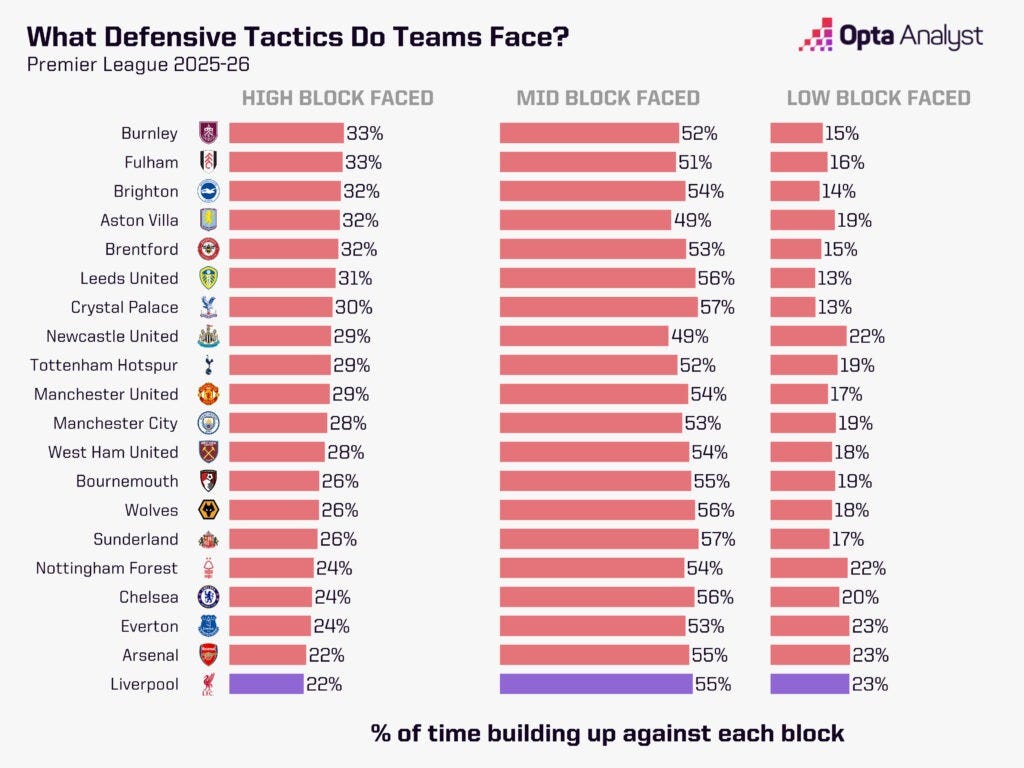
Most importantly, Liverpool have more goals via high turnovers (three) than any other side in the Premier League. It puts them on target to match the 10 they recorded last season, which topped anything Klopp’s Reds managed in his final three campaigns: seven, four and seven respectively. How’s that for another surprising stat?
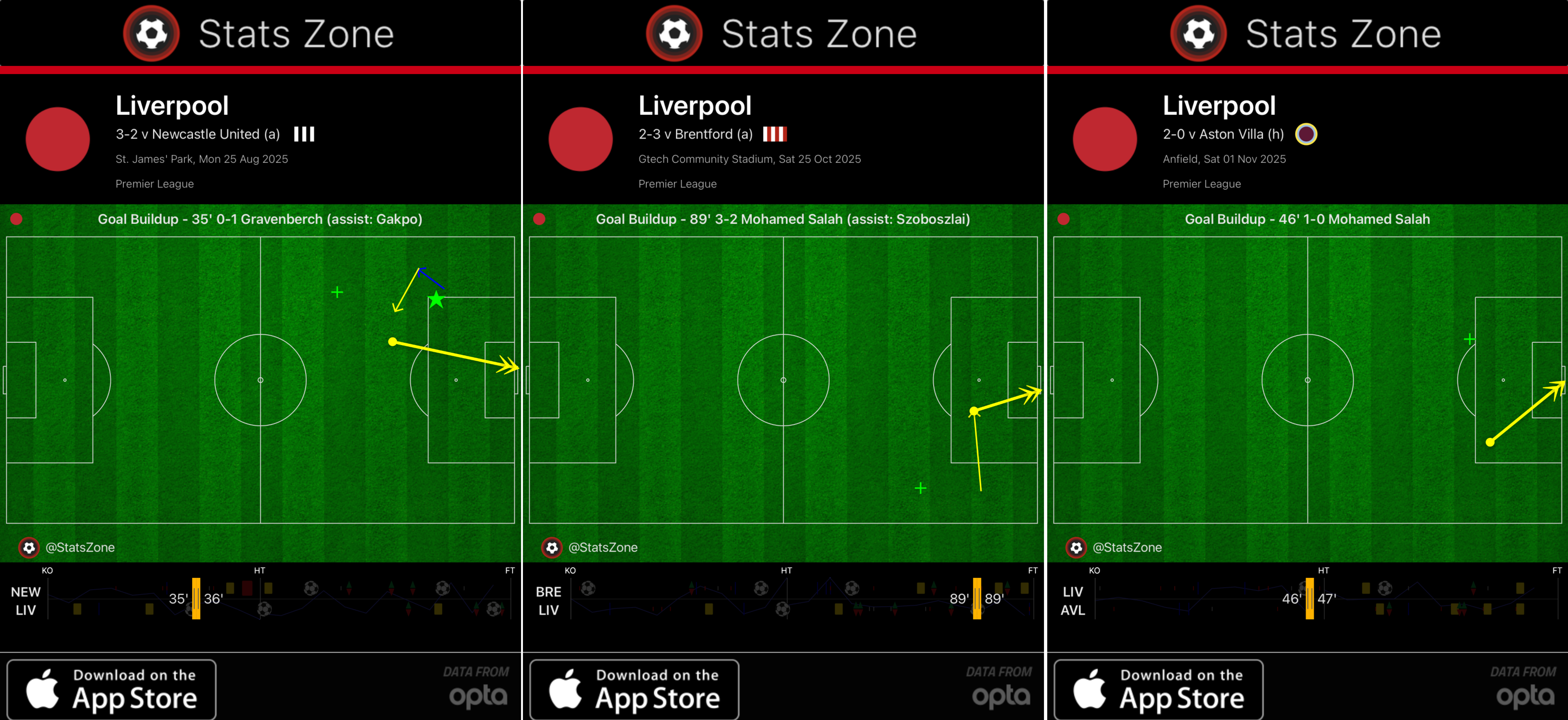
Gravenberch got the first goal following a high turnover, at Newcastle, before Salah profited against Brentford and Aston Villa. Some might call the latter lucky but how often do you see an errant goalkeeper pass go into touch for a harmless throw?
Anticipation is everything. Being in the right place at the right time counts for even more. The data is implying that Liverpool are doing this more often than we might think. It’s something to build upon as they try to get back on track.
I'll write a critical post again soon enough, no doubt, but it didn't feel right this week somehow. Up the Reds.