
Top Five Stats
Liverpool lost by three goals in the league at Anfield for just the fourth time in the Premier League era. It was only the third with fans present.
The Reds have won every league match in which they scored first this season, losing every time they have gone behind. 1-0 or 0-1 decides the result.
Arne Slot’s side have lost their last four halves of football: 0-2 and 0-1 at Manchester City, 0-1 and 0-2 today.
Two Nottingham Forest defenders scored while Alexander Isak didn’t have a shot until the 64th minute.
Mohamed Salah attempted 17 take-ons, just the 10th time someone has done this in the Premier League since the summer of 2017. The others all hit double figures for completing them, whereas he succeeded with five.
Match Review
Wound, meet salt.
Given the nature of Liverpool’s disallowed goal from a corner in their previous match, at Manchester City, we should’ve guessed they would go behind to Nottingham Forest in broadly similar fashion today. It is simply the way this season is going.
To add to the frustration, the Reds had actually started well. With 32 minutes gone, the data read 1.09 versus 0.08 on expected goals. Alexis Mac Allister had seen what proved to be Liverpool’s only Opta-defined big chance of the match blocked by last man Elliot Anderson. A goal there would’ve opened everything.
Football is much easier when you go in front. The Reds have now scored their first big chance just three times in the 17 matches in which they’ve had at least one. Even though they didn’t all occur at 0-0, seizing that moment more often would lift spirits in the team and the stands.
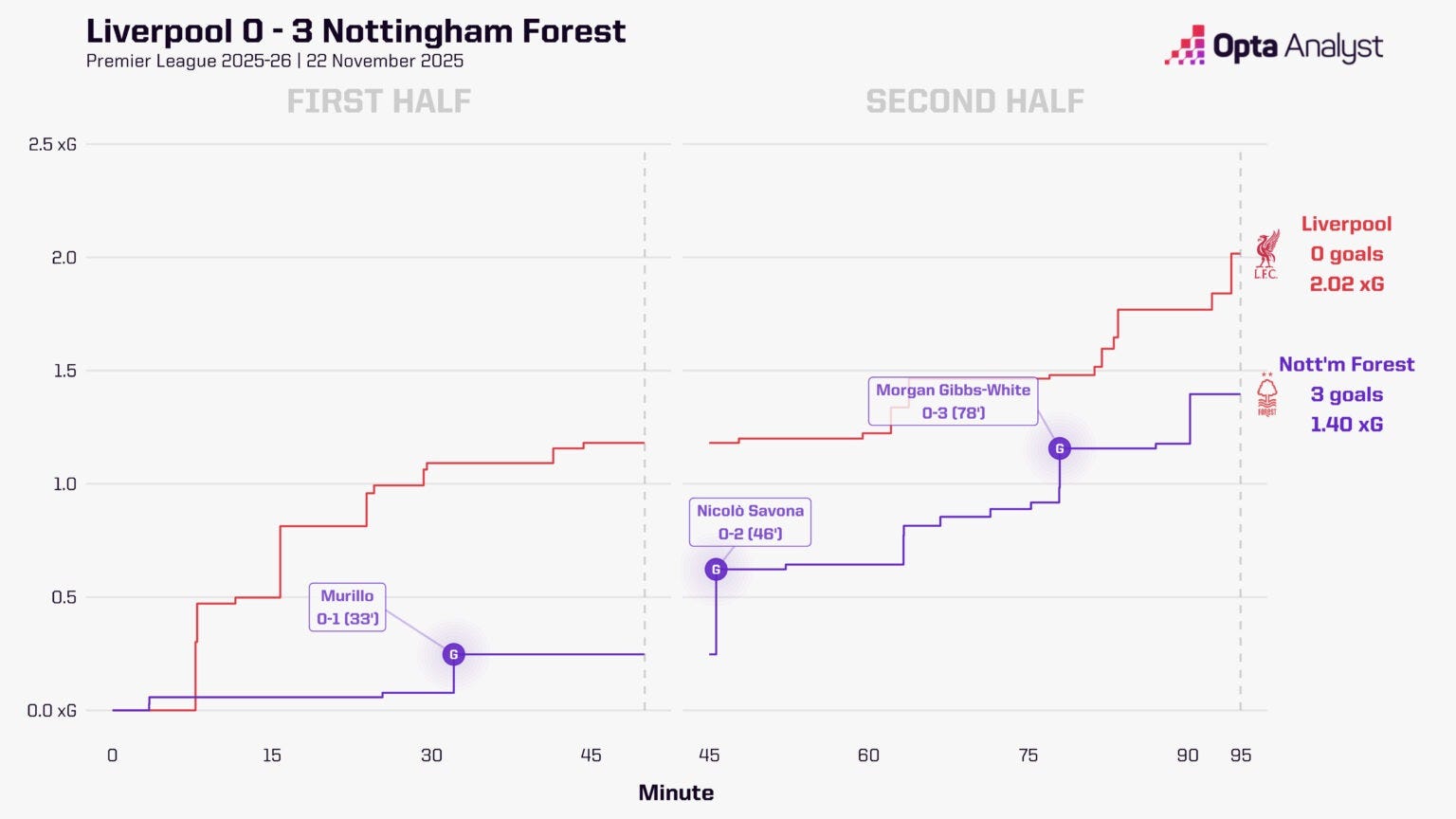
Instead, Liverpool then went behind through a set piece. Their mental fragility shone through, with a VAR intervention saving them from conceding a second goal immediately. To struggle in tough times is understandable given what they have been through. They look incapable of recovering from setbacks though.
Maybe they might have done so today had they not gone 2-0 down within a minute of the restart. We’ll never know, but I suspect not. Former Red Neco Williams was Forest’s top player for Statsbomb’s on-ball value metric this season before kick off, with his assist for the second goal likely increasing his lead over his colleagues. The Welshman had Mohamed Salah’s measure for most of the match too.
Liverpool created little of note in the second half as their heads dropped. Their best chance in xG terms after the interval occurred in the 95th minute; fat use. They also struggled to get Alexander Isak into the game throughout. Forest have been his joint-favourite opponent for scoring, as he netted in all four previous Premier League matches against them, with six goals in total. Today? Barely a sniff; two touches in the box, one shot and one chance created, Forget how much the Swede cost, Hugo Ekitike must start at centre forward more often for now.

In 2020/21, Udinese lost five league games in which they generated at least two non-penalty expected goals. It is the most such defeats by a team in England, France, Germany, Italy or Spain in any of the previous eight seasons.
The loss against Forest took Liverpool to four matches of this nature before December has even arrived. While the amount a team concedes must be considered too, this was the Reds’ third defeat with a npxG advantage of at least 0.6. The record? The same Udinese side, with six.
Arne Slot’s team look like they’ll claim that unwanted crown before we know it. They need to respond better to going behind but how do you lift the mindset of a group of grieving young men? Who would blame them if football is no longer even the most important of the least important things for them? FSG deciding to ditch Slot would be unlikely to lift the mood of the players either, given the responsibility they would feel.
There’s no easy fix here. Scoring when on top, as they undoubtedly were here, would mean everything though. Liverpool are a team in desperate need of endorphins.
Source for graphic: Opta Analyst.
Before diving in, I want to thank both Beez and Paul (on his substack) for their excellent work over the last week. Paul has outlined the multi-layered complexity behind this season better than anyone, and Beez has captured the statistical and psychological fingerprints of what’s happening on the pitch with real clarity. (The same post is on TTT so apologies to a few who might be seeing this long rambling nonsense again).
What follows is simply my amateur attempt to sit between those two perspectives. My key takeaways are that this season can’t be understood through tactics or effort alone (as Paul & co. reminded me after City); grief and disrupted foundations have shaped everything; early goals and officiating randomness are distorting game-states; and this is still a very good squad trying to find rhythm in very abnormal circumstances. Above all, Slot must keep his agency, and some fans must not see hope as a bad thing. Remember where you were in May.
This really is the season that won’t give Liverpool a break, isn’t it. Before we even try to reach for explanations, we have to acknowledge the simple truth that this team is carrying things no model or metric can fully capture. Paul’s written about it from Day 1 to 144 and counting. Losing Diogo Jota wasn’t just a tragedy; it altered the emotional chemistry of the entire squad. Grief doesn’t stay boxed up, no matter how professional you are. It drains energy, clouds focus and takes a toll that people outside the dressing room can only guess including us. That’s the starting point of this season, and it colours everything that follows, which is why so much of what we’re seeing needs to be understood in a deeper context. When I remember sitting through session after session of my son's chemotherapy it hurt so deeply, I had to bury it there to carry on. Life doesn't detach itself for 90 minutes a week.
Preseason was disrupted before it began, and cohesion never caught up. Slot didn’t get a clean slate to build automatisms; he walked into a group still processing a loss and trying to reassemble itself on the fly. He did too with a young family not even living with him. It is hard. Liverpool have now lost four consecutive halves of football, and while stats don’t capture emotion, they do show patterns of a team struggling to absorb shocks. What looks like disconnection is often the aftershock of a season that began without rhythm despite all those early fightbacks.
On top of that emotional instability, the squad has been reshaped. Key players left, new players arrived, and natural cohesion has had to coexist with natural grieving. This isn’t a broken squad; it’s one evolving under abnormal circumstances. Slot’s patterns appear in flashes, the players try to impose structure, but the ground keeps shifting—sometimes literally in the form of injuries, sometimes psychologically in the form of confidence wobbles. Even the front line reflects this. Against Forest, Alexander Isak didn’t register a shot until the 64th minute, while Mohamed Salah attempted 17 take-ons — something only nine other players have done in the Premier League in the last seven years — yet completed just five. These are the statistical fingerprints of players straining to make a mark - one still looking in preseason and the other maybe in his last season.
None of this has been helped by the stop-start nature of injuries. Alisson’s absence alone alters the team’s balance but Mama had a decent run. Bradley’s disrupted momentum is a sign of his age and NI's over reliance, Wirtz and Frimpong missing games denies us options, Mac Allister and Isak lacking a full preseason — all of it chips away at continuity that Slot had mostly last year. Systems require repetition, and Liverpool haven’t had much. Without a rhythm, fragility appears where fluidity should be. The midfield press looks fine one moment, frayed the next. The attacking patterns spark, then drop away. Confidence cannot regenerate without sustained flow, and that is the one thing Liverpool have not been able to build. When we concede first we now lose.
And then there’s the environment they’re operating in. The return of long-ball chaos, slow restarts, time-wasting, scrappy duels and anti-football tactics has dragged Liverpool out of the controlled, structured mechanics they want. Referees have enabled this, consciously (or not). Every 60-second delay on a throw-in, every slow goal-kick, every borderline foul waved away — it all chokes momentum. Forest’s defenders scored twice, Liverpool’s centre-forward barely touched the ball in the box, and the flow of the game was dictated by disruption rather than quality. This is becoming a theme across many fixtures, and it affects teams who rely on tempo and structure more than those who rely on chaos.
The strangest element of all is the opposition finishing streak. Opponents are scoring at freakish rates, often from half-chances, often early. Before Forest, Liverpool were already nearing historically rare levels of “played well, lost anyway” matches. The Forest defeat made it four games this season in which Liverpool generated at least 2.0 non-penalty xG and still lost — something only one European team has done more often across eight seasons (mentioned by Beez over on his Substack mirroring some of the themes here). Early goals, deflected goals, first rebounds falling to opponents: these are small things that have large emotional consequences. Shoulders drop, urgency rises, patience thins. These moments flip psychology.
And then there is officiating — the constant, unpredictable variable that distorts everything. You can accept mistakes; you cannot accept randomness that always flows in the same direction. Forest’s opener being allowed to stand despite interference was another example of the moving target that is Premier League officiating. Liverpool have now won every game in which they scored first, and lost every game in which they conceded first in the league. That isn’t fragility alone; it’s the emotional toll of chasing matches shaped by forces you can’t control. When you send letters and receive silence, when VAR interpretations shift from week to week, when the pattern becomes too consistent to dismiss — a psychological cage forms within the institution. You can see it in hesitation, frustration, resignation. Liverpool aren’t just playing opponents; they’re playing games whose realities change with each referee, linesman, and VAR official.
With all this mind-fucking, confidence inevitably becomes fragile. Pressure slows touches, clouds decision-making, tightens finishing. A team can only suffer so many early blows before it becomes difficult to reset emotionally, and Liverpool have been punched early far too often. As Beez noted in his post match article, Liverpool have only scored their first big chance in three of the 17 matches in which they’ve had one. Football becomes an uphill drag when key moments aren’t converted and the next blow lands almost immediately. From a corner to seconds later Konate giving one away.
What we need, more than anything, is perspective. Not blind optimism or denial, but an honest understanding of what we’re watching. Liverpool are not a team in freefall; they’re a team carrying too much at once, adjusting to new players and new ideas while being punished disproportionately for every single mistake. They are not collapsing — they are straining under a season that keeps stacking complexity upon complexity. And that distinction matters because one implies panic while the other calls for patience.
And this is where I come back to what I’ve been saying for weeks: Slot must keep his agency, and we must keep our perspective. He cannot allow randomness, grief, referees, chaos-ball or streaks to rewrite his principles. Managers earn their reputations by navigating storms, not by avoiding them, and Slot’s refusal to abandon his ideas — even when the season keeps kicking him in the gut — is exactly what a long-term project requires. This is still a great squad, still packed with intelligence, hunger and technical quality. These players aren’t lost; they’re overwhelmed. And overwhelmed teams don’t need reinventing — they need time, calm and clarity.
The bridge between today and everything we’ve been saying all season is simple: patience isn’t passive. It’s an act of belief. Perspective isn’t weakness. It’s strength in the face of noise and echo chambers. And backing Slot isn’t blind loyalty — it is recognising that you don’t judge a project during this sort of once-in-a-decade super storm, but after it. Liverpool will come through this. The squad is too good, the ideas too strong, and the manager too principled for this to be anything but a painful and short chapter, not the whole story.
Just as Red said in The Shawshank Redemption: “Hope is a dangerous thing. Hope can drive a man insane.” Red is the voice of someone institutionalised, who’s learned not to expect too much, dictated by the cage he’s been put in by others. But Andy Dufresne has a different perspective of his own agency: “Hope is a good thing, maybe the best of things, and no good thing ever dies.”
Apologies for the long ramble and for reusing that Shawshank line both in the good and bad times. I suppose that’s the point though. Because if this season has shown us anything, it’s that endurance is sometimes the only path through the chaos — just as Red says at the end:
“Arne Dufresne – who crawled through a river of shit and came out clean on the other side.”
YNWA.
How do you lift players who are still grieving when football may not feel important?
I don't know the answer and I'm not even sure it matters for now.